

Summary: S&P earnings grew 50.4% against a 23.1% bar, the index is at record highs, and hedging has dropped to its lowest 20th percentile. Real yields closed at 2.41% on the 10-year and 2.78% on the 20-year — levels the market has not sustained since 2008. Job growth posted its fifth decline in twelve months, and construction payrolls fell for a fourth straight month. Investors are split on whether that gap is a warning or a rotation. Underneath it, SanDisk’s investor day reframed memory from a boom-bust commodity into a contracted business, with customers escrowing billions for the right to walk away. Rounding it out: Korea’s forced deleveraging, private credit NAVs “too high at all of these funds,” and Michael Froman on why Chinese overcapacity now has the makings of a global financial crisis.
Don’t miss the latest scuttlebutt and save 100+ hours each week with a daily digest of podcasts, interviews, and events featuring top investors, founders, and CEOs.
Quotes are condensed and lightly edited for clarity. Numbers, names, and speakers’ own qualifications are preserved.
Macro
Earnings have covered up a lot of sins
“Earnings have covered up a lot of sins. The sins are: what’s going to happen in the Middle East? Is inflation the problem that many of us think it is? How high will interest rates out the curve go? It wouldn’t matter if stocks were selling at 15 or 16 times earnings, but they’re at 20, down from 22, 23, as earnings have gone up faster than the stock market. ... These are among the things that keep me up at night.” - Bob Doll, CEO & CIO at Crossmark Global Investments, on The Claman Countdown
50.4% growth against a 23.1% bar is a once-in-a-generation quarter
“We’re witnessing once-in-a-generation earnings growth. As of last Friday, 88% of companies in the S&P had reported, and we’re showing earnings growth year over year of 50.4%. So that is once in a generation, mic drop. Going into this quarter, expectations were earnings growth of 23.1 percent. So there was a lot of concern the bar was set too high.” - Elizabeth Evans, Evans May Wealth, on Making Money
A great economy if you own capital, less so if you sell labor
“One of the things we’re seeing in the stock market is steadily widening margins. As revenues go up, companies aren’t hiring, so more and more of that revenue flows to the bottom line. I realize there are some one-offs. But the picture is clear. We are in a world where profit margins keep going up. If you’re an owner of capital, this is a great economy, and AI will make it greater. If you’re a provider of labor, not so much.” - Greg Ip, Chief Economics Commentator & Deputy Economics Editor at The Wall Street Journal, on Squawk Box
Jobs fell in July for the fifth time in twelve months
“I think there’s a lot of euphoria about the economic prospects of the United States — a lot of it AI driven — gripping the market and showing up in earnings. And yet it’s not translating through to job creation. Jobs actually declined in July, the fifth time in 12 months. The weakness of job growth is something we rarely see outside of recessions. ... The hiring rate today is about half of what it was in the years before the pandemic.” - Greg Ip, Chief Economics Commentator & Deputy Economics Editor at The Wall Street Journal, on Squawk Box
A September hike is underpriced at a 25% chance
“Our base case is that the Fed would stay on hold, and I think that’s still probably the right base case. I just think that the odds of a hike at the September meeting are underpriced at a 25% chance. When we plug the CPI and PPI data into our PCE nowcast, we see core PCE coming up around 0.28% month over month. ... If there’s going to be a hike, this is the time when we get it.” - Warren Pies, Co-founder & Strategist at 3Fourteen Research, on Squawk on the Street
Four straight declines in construction payrolls rarely happen outside recessions
“My belief is that the Fed is restrictive. So a hike would be a mistake. ... Residential construction payrolls, the housing market — I think that’s the area of the economy that the Fed can most easily influence. You’ve seen four straight monthly declines there. In general, you don’t see that many times outside of recessions. So I think there’s some weakness and restrictiveness in the job market. It is being offset by the AI boom, in my view.” - Warren Pies, Co-founder & Strategist at 3Fourteen Research, on Squawk on the Street
Bond traders can stop panicking once the Fed starts panicking
“Bond traders can stop panicking when the Fed starts panicking. If the Fed isn’t gonna address inflation, then maybe the bond market needs to do it, which will drive rates up higher. And the bond market has tendencies to overshoot. ... If the Fed were to raise rates at the September or October meeting, then there’s a little bit of panic from the Fed. Bond investors can stop panicking. We might move long duration for the first time in years.” - Jim Bianco, President & Index Manager at Bianco Research Advisors, on Behind the Markets
A long end selling off on lost credibility is not the Fed’s friend
“It does slow down the economy if we have higher rates. But if the reason the long rate is up is because they’re not confident that the Fed will bring inflation down, that’s a problem for the Fed. That’s really not the way they want the market to tighten. ... I do think it’s a little bit glib to just say that the market is doing the Fed’s work for it. I think you have to interpret why it’s moving.” - Eric Rosengren, former President & CEO at the Federal Reserve Bank of Boston, on Bloomberg Talks
Real yields this high have never been sustained since the financial crisis
“You have real yields in the 10 sector that are almost 2.5%, in the 20-year sector more like 3%. Against the history of the TIPS market, those are historically elevated real yields. If you go back to the global financial crisis, between then and now you really don’t see any periods where those sorts of real yields were sustained for any meaningful period. ... We think that would suggest that there is value in these levels.” - Mike Mitchell, Head of US Treasury and Inflation Trading at Goldman Sachs Global Banking & Markets, on The Markets
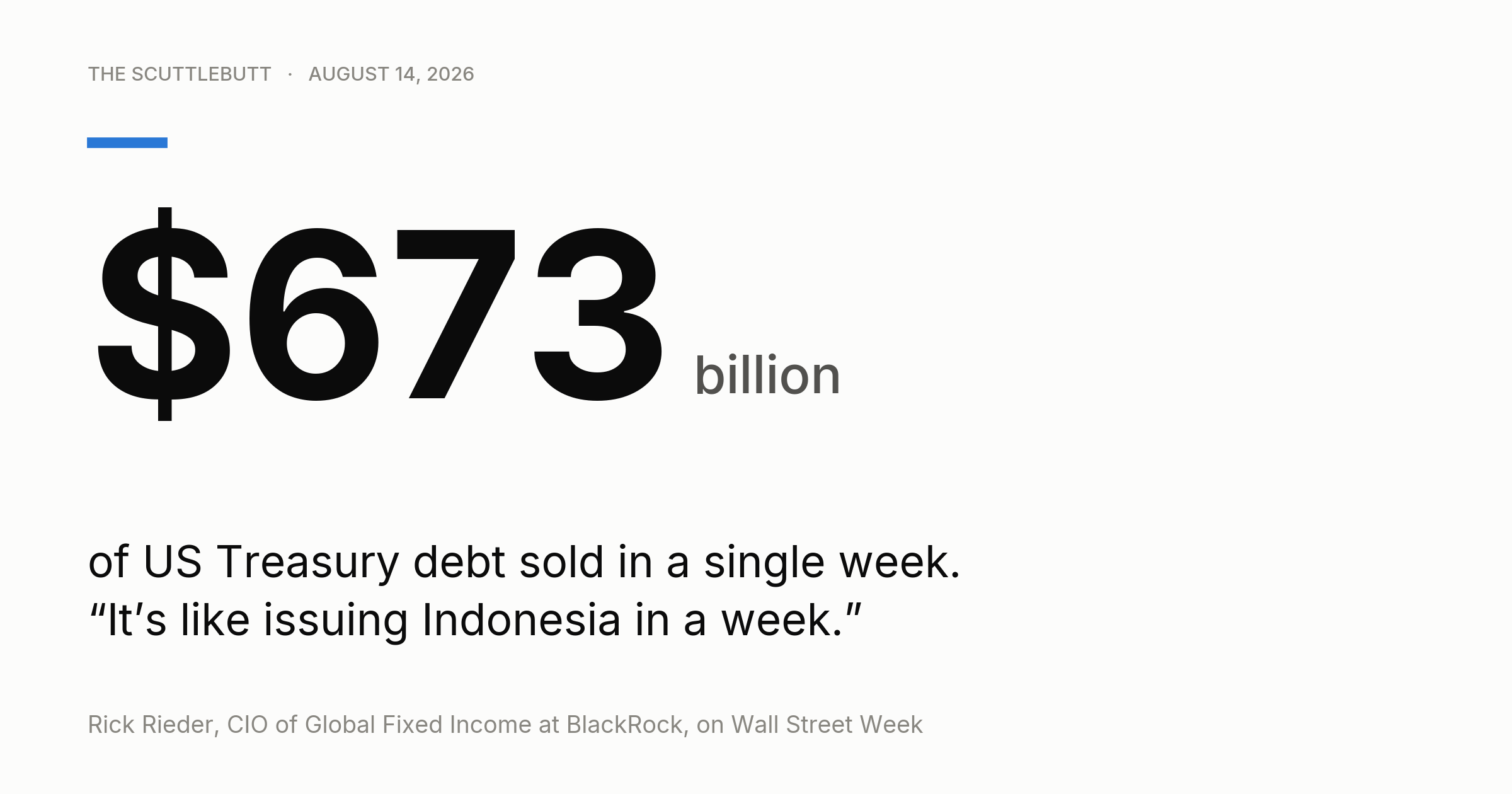
The US issued the equivalent of Indonesia in a single week
“You have fiscal burdens that are significant. And, by the way, alongside of the amount of financing this week, there was 673 billion of U.S. treasury debt. It’s like issuing Indonesia in a week. It’s an awful lot of debt. Plus, you have an immense amount of supply coming through that is A.I.-related. ... To me, that’s why real rates are pressing higher: the cost of finance is going up, driven by fiscal deficits around the world, not just U.S.” - Rick Rieder, CIO of Global Fixed Income at BlackRock, on Wall Street Week
The postwar debt fix was minus 13% real rates and dead bondholders
“The last time US debt to GDP was 110% or higher was after World War II. That was 1946. By 1951, it was 50-55%. How did they do it? Simple. Capital controls, significant inflation, and real rates in the United States that bottomed at -13%. Thank you for your service, long-term Treasury holders. That’s how it happened. They got killed. They got carried out on a real basis.” - Luke Gromen, Founder at Forest for the Trees (FFTT), on The Meb Faber Show
Margins went from 1% to 14.7 and never mean reverted
“Corporate margins in the mid-70s were 1% for the S&P, and the last reading in Q1 was 14.7. We can debate whether that’s an anomaly, but they’ve gone up in a straight line. And that coincides almost tick for tick with the decline in the labor share of GDP. ... Jeremy Grantham’s claim that there’s something wrong with the global economy if margins don’t mean revert — well, Jeremy, I’m sorry, you’re wrong, because margins haven’t been mean reverting.” - Paul Krake, Founder at View from the Peak, on Macro Hive Conversations
Hedging has fallen to roughly its lowest 20th percentile
“I wish I could tell you that people are getting really tactical and making sure that they’re covering themselves should it roll over. But now we’re seeing hedging at maybe the lowest 20th percentile right now. So it just seems like people are okay with the rally right now. They’re not looking to protect some of that downside. We’re still seeing a decent amount of put selling, especially in the tech names.” - Joe Mazzola, Head of Trading and Derivatives Strategy at Charles Schwab, on Morning Trade Live
This is an earnings bubble, not a price bubble — and the second derivative will be enough
“I think the big difference with the dotcom bubble is that the dotcom bubble was a price bubble. Earnings were not there. This time, the earnings of Nvidia are growing faster than the stock price of Nvidia. ... But that’s the key: we are in an earnings bubble, and the market will start to really freak out the day when earnings growth will start to decelerate. You don’t need to wait for earnings recession. The second derivative will be enough.” - Charles-Henry Monchau, CIO at Syz Group, on Top Traders Unplugged
A VIX at 14 alongside record highs leaves no cushion
“I’m not bearish, I’m just a little cautious at these levels. Valuations are priced for perfection, but really not for surprises. The S&P 500 is making all-time highs. The VIX sits around 14, one of the most calm readings we’ve seen all year. Low volatility combined with record highs tells you positioning is a bit stretched, a little too complacent. The market has very little cushion if something goes wrong.” - Gene Goldman, CFA, CIO at Cetera Investment Management, on Morning Trade Live
International
Korea’s forced deleveraging
Foreigners dumped $150 billion of Korea for mechanical, not fundamental, reasons
“Foreign investors have sold about 150 billion U.S. dollars year to date. At every inflection point of the KOSPI — which started at 4,000 and peaked at 9,000 — foreigners sold massively. It is due to technical and mechanical reasons, including portfolio rebalancing: their portfolios are concentrated in the two names. ... So whenever those stock prices exceeded the limit, they had to sell for mechanical reasons. Fundamentals can go beyond that and the KOSPI can go further.” - Cindy Park, Analyst at Nomura, on The Asia Trade
5% of Korean brokerage accounts closed on margin calls — and US momentum took the hit
“Certainly 5% of all brokerage accounts in South Korea closed due to margin calls. So you have the regulator there deleveraging their leveraged ETFs. That’s actually part of what’s put a lot of pressure on the US momentum traders. Those same investors hold a lot of stock here in the US. They were forced to sell them. And this rebound is basically them coming back after that deleveraging process.” - Brendan Ahern, CIO at KraneShares, on Making Money
The crackdown was about concentration in two stocks, not leverage itself
“When you look at South Korea, that market was extremely concentrated. There’s two major companies, SK Hynix and Samsung, and the volume of products built exactly on top of just those two companies was obviously a big issue for regulators, especially because they hadn’t spent a lot of time educating their public. ... Here in the States, these are the largest companies in the world, big liquid names. Typically, leverage and inverse products are not the cause. They are the byproduct.” - Bilal Little, Global ETF Strategist at Direxion, on Schwab Network
Europe and China
European banks have out-earned the Magnificent Seven for a stretch this year
“What is unusual is the degree of concentration in the indexes, and the single risk factor from that AI trade. If you had been diversified across that supply chain, you weren’t as sensitive to the semiconductor meltdown. You look at value outside the US, cyclicals, bank stocks in Europe. We had a period where the bank stocks in Europe have been outperforming the Mag 7. So it is working, if you stay disciplined.” - Adam Farstrup, Head of Multi-Asset for the Americas at Schroders, on Squawk Box
Once China is cheaper and better, the argument is already over
“I have already seen once what happens when the Chinese show up with cheap stuff. I heard it 20 years ago: oh, it’s not as good. No, it’s getting higher-end, but it’s still cheap. Oh god, it’s cheaper and it’s better. And if you get to that last one, it’s already over. ... A serious debate about China as a competitor to American AI is fatal to thousand times sales, hundred times sales, 10 times sales.” - Luke Gromen, Founder at Forest for the Trees (FFTT), on The Meb Faber Show
Without a wake-up call, Europe becomes an open-air museum
“I think there needs to be some kind of wake-up call in Europe. Europe does have huge talents. There are a lot of ideas, bright people, great education systems, and we need to recover from that side, because otherwise we’re going to end up being just an open air museum, good for tourism but not good for business. ... The dependency we have with the US is terrible. If they pull the plug we are done.” - Charles-Henry Monchau, CIO at Syz Group, on Top Traders Unplugged
Financials
BDC managers choose a new 12% loan over a 100% return buying back their own stock
“What’s really going on is you don’t want your fund, which has a NAV of 5.6 billion but is trading at 2.8 billion, to shrink, because you’re paid fees — and they’re paid fees on NAV, on basically twice the price. And when they don’t buy back shares at a 50% discount, which is 100% to the upside, because they want to make a new loan at 12% — greed is laid bare.” - Boaz Weinstein, Founder & CIO at Saba Capital Management, on Money Stuff: The Podcast
PayPal retires 15% of its stock a year on $6 billion of free cash flow
“Record revenue, record free cash flow. They’re doing the turnaround. This is at a record low multiple, trading at about 10 times forward earnings. ... They’re going to use that $6 billion of free cash flow they’re generating, Stu, from 439 million users around the world to buy in 15% of the stock per year. So even if they didn’t grow, your share of the company is getting bigger and bigger and bigger without even putting more money in.” - Thomas Hayes, Chairman & Managing Partner at Great Hill Capital, on Varney & Co.
Wealth managers keep only a quarter of the money when clients die
“Certainly the wealth management industry is going to lose, as things stand. They keep about 25% of the wealth when people die. The children get the cash, they go round to the wealth manager and they say, well, you’ve been looking after that gorgeously for 40 years, but now I’ll have it. And if they do need it, they’ve got their own managers, who swoop it up.” - Paula Steele, Director at John Lamb Hill Oldridge, on Merryn Talks Money
Life insurers repriced after COVID by raising the bar, not the price
“The insurance companies didn’t put the price of life insurance up post COVID. What they did was they increased the bar. So where before we would have got standard rates for somebody, now they’ll load the premium by 50%. So they’ve changed the pricing without looking as though they’ve changed the pricing.” - Paula Steele, Director at John Lamb Hill Oldridge, on Merryn Talks Money
Crypto and Digital Assets
Stablecoins are a plan to manufacture new buyers of Treasury bills
“There is a wall of maturity coming and they need to keep the cost as low as possible. ... They have some tools. Also something which is called stablecoins. Stablecoins are cryptocurrency pegged to a fiat currency, and 99% of them are pegged to the dollar. Each time you buy a stablecoin, the stablecoin invests into US treasury bills. That’s one way, if stablecoins start to be used worldwide, to find a new source of buyers for the treasury.” - Charles-Henry Monchau, CIO at Syz Group, on Top Traders Unplugged
Crypto ETF flows are ice cold and the products got stupid
“The money is leaving crypto ETFs. ... They’re just buying AI stocks now. Or maybe software. ... It’s ice cold. The amount of crypto ETF products though got stupid. I mean, we were doing 2x Dogecoin. Why? ... Nobody wants it. ... The majority of advisers will buy the brand name, which is Bitcoin.” - Todd Sohn, Chief ETF & Technical Strategist at Strategas, on The Compound and Friends
Alternative Investments & Private Equity
Private credit sold fire insurance that fails when there is a fire
“My partner Kieran Goodwin has been ranting on Twitter — in a good way — for two and a half years, three years, about how the BDCs and interval funds have overpromised liquidity to their investors. You have fire insurance — that in a sell-off you can get out — but it doesn’t work if there’s actually a fire. ... I think when you go to Cliffwater, the shocking number of 14%, which was only 4% the quarter before.” - Boaz Weinstein, Founder & CIO at Saba Capital Management, on Money Stuff: The Podcast
Falling NAVs feed outflows feed forced selling feed falling NAVs
“The reflexivity of falling NAVs leading to larger outflows leading to forced selling leading to falling NAVs, and then you’re out in three or four years. I don’t believe that the retail investor understood that, and I wonder if it’s even disclosed.” - Boaz Weinstein, Founder & CIO at Saba Capital Management, on Money Stuff: The Podcast
You don’t need to be Merlin to know these NAVs are too high
“I don’t have to be a Merlin to know that the NAVs are too high at all of these funds. They’ll mark down what they observe and then they’ll do some matrix pricing. But JPMorgan just marked everything down. So doesn’t everything then have to come down? ... You see all these forces together, from the default rate rising to the kind of NAV recalibration. It’s not hard to see it getting really bad.” - Boaz Weinstein, Founder & CIO at Saba Capital Management, on Money Stuff: The Podcast
A data center is a boring net lease with an investment-grade tenant
“What is a data center really? It’s a net lease asset. You’ve built it, you own it now, you’re leasing it back to Meta, to Google, to Amazon. What you have is actually a pretty boring investment, because you have a counterparty that’s IG and above paying you that lease payment for 15 to 20 years. As much as we sometimes think of these as equity-related because they’re development, they’re really a credit profile because of the structure of that lease.” - Joel Holsinger, Co-Head of Alternative Credit at Ares Management, on How I Invest with David Weisburd
The old 5% growth deal now needs 12% to earn the same return
“I think 2022 was an inflection point for our industry. If you look at the prior 20 years, if you bought something and grew it a few percent a year and took on some leverage and had multiple expansion, that was a great return. The Bain Research Report chronicled this and said, ‘Here’s the new norm post-2022, which is the old 5% growth is really now a 12% bottom line growth to achieve the same return that one did before.’” - Andrew Weinberg, Founder & CEO at Brightstar Capital Partners, on Wall Street Week
GPs are holding 2020-21 vintages hostage and DPI is suffering
“The deals in 2020 and 21, they paid high prices, then they got hit by interest rate increases, and those deals are not doing so well. I think a number of the private equity firms don’t want to sell, because they think if they hold it longer they’ll be able to get a higher value. And so realizations, or what they call in the industry DPI, is on the low side, and that’s what LPs are complaining about, rightfully so.” - Steven Kaplan, Professor at the University of Chicago Booth School of Business, on Wall Street Week
Consumer
Walmart’s weakest comp in years is drug pricing, not the consumer
“I think the core business at Walmart remains very strong. But we’re expecting closer to a 3% comp for the Walmart US business, which would be one of the lowest comps that you’ve seen in years from Walmart. It’s really because there’s a headwind from some of these regulatory changes and capping drug prices, and there’s also less of a benefit from the ramping of GLP-1s. If you strip out those pharmacy and drug changes, the business is much steadier.” - Spencer Hanus, Senior Research Analyst at Wolfe Research, on Fast Money
The one question for every retailer: real sales, or just tariff lift
“If I could ask every company for one thing: in the last 12 months, did you drive revenues by selling more, bringing new people in, or did you just get that tariff lift? Because if you just got that tariff lift — which is a funny thing to say, that tariffs were positive, but they did raise prices — if that’s all you got, it’s going to get a lot harder starting next quarter.” - Simeon Siegel, Senior Managing Director at Guggenheim Securities, on Closing Bell
Fast food has priced itself out and traffic is migrating to casual dining
“QSR, or fast food, has taken 50% pricing since 2019, and this year is taking another three to 5% to cover the inflation. Whereas casual dining and fast casual are much more in line with grocery at the low 30% range. We are seeing that play out as traffic share is trending toward casual dining and fast casual. Casual dining — Chili’s, Cheesecake Factory — that’s where we see the winners today.” - Nick Setyan, Managing Director at Mizuho Securities, on Bloomberg Surveillance
Luxury hotel pricing is up 10% against 1% at the economy end
“Leisure demand is off the chart, but the high end consumer is off the charts. If you look at luxury pricing in hotels, it’s up 10% versus the economy side — that’s plus 1%. And this is also the first year in ten years that we’ve seen U.S. travel within the U.S. be stronger than international. ... Luxury supply of hotels is sub 1% for the last five years, and so the demand is far outpacing supply.” - Lizzie Dove, Analyst at Goldman Sachs, on Closing Bell
A stock portfolio is the buffer the poorer consumer does not have
“Some of the largest drops in sentiment that we saw between last month and this month have been among lower income consumers — specifically the types of consumers who are most sensitive to the persistence of high prices and don’t have the buffer stock of a large stock portfolio to cushion them through high inflationary periods. ... But those who are wealthy, those with large stock portfolios, have the wealth that will power them through this period.” - Joanne Hsu, Director at the University of Michigan Surveys of Consumers, on Open Interest
42% of Afterpay transactions are now everyday essentials
“When you look at the Afterpay for Cash App credit card, 42% of the transactions that were happening on that were actually moving towards the more everyday type of transactions — grocery, utilities, any sort of restaurants. And those bigger items that we tend to buy sometimes in the summertime aren’t really happening. ... I think the consumer is using this more as a tool to manage their expenses, not just something that we use at the register to finance purchases.” - Hitha Herzog, Chief Retail Analyst at H Squared Research, on Market On Close
Rivals are merging because they want to look more like Disney
“If you look at what’s happening all around us, companies are trying to acquire scale, or acquire IP, or acquire additional businesses. And the reason that they’re trying to do that is because they want to look a little bit more like Disney. We have the deepest library of intellectual property and characters and franchises by far. Our scale is enviable. And so we have everything that we need right now.” - Josh D’Amaro, CEO at The Walt Disney Company, on Squawk on the Street
A $7 million-a-day ticking fee is driving Paramount out of California
“It’s $7 million a day starting October 1st. And in a meeting with his top executives a week ago, Ellison said that this move would essentially help pay for that fee, because he estimated to his staff that he could save about $500 million a year by moving the company’s headquarters. He didn’t say which state, but he intimated that it might be Nashville, Tennessee, or somewhere in Texas, potentially in Georgia.” - Matt Belloni, Founding Partner at Puck, on Squawk Box
$236 billion of healthcare M&A is the best in five years
“From January up until the end of April it was one of the worst-performing sectors, but since May it’s the top-performing sector. I think healthcare is the next to catch wind of this AI, because we’re going to see AI help shorten drug trials and make them more economically feasible. ... We have $236 billion in announced M&A activity just in healthcare alone, and that’s the best in five years.” - Eric Sterner, CIO at Apollon Wealth Management, on The Claman Countdown
Healthcare took a GLP-1 and halved its weight in the S&P 500
“For the last year and a half, two years, the case has been the same thing for healthcare: massive money out of healthcare ETFs. So I start to think contrarianly. The temperature is very cold and relative performance is in its bottom decile — so bad it’s so good. People hate it. And it’s finally starting to work. The joke I always use is healthcare took a GLP-1. It went from 16% to 8% of the S&P 500.” - Todd Sohn, Chief ETF & Technical Strategist at Strategas, on The Compound and Friends
Prime steak is selling because eating out got too expensive
“Pickle me everything. We do these potato chips with pickling flavoring on them. They’re flying. ... We added some pickle to our chicken salad, and we thought sales would go down because people would pick some of this. It was all incremental extra sales. ... Our prime beef steak sales have gone up, maybe because people aren’t going out to restaurants as much, because it is pretty pricey out there.” - Stew Leonard Jr., CEO & President at Stew Leonard’s, on Market Domination
Sports
NBA franchise prices are just the stock market with a scoreboard
“These are all the transactions in the NBA going back to when Steve Ballmer purchased the Clippers for $2 billion. Then you got the Rockets at 2.2. You have the Nets at 3.3. There’s some in between. The Suns at four. Celtics just sold for six. Lakers sold for 10 a minute ago. Now they’re up for 12.5. The freaking Trailblazers are 4.25. You know what this is? It’s the stock market.” - Michael Batnick, Managing Partner at Ritholtz Wealth Management, on The Compound and Friends
Streaming lets a niche league ladder up to an ESPN deal
“We all grew up where cable and TV were the only options. Now we’re in full-fledged streaming and you’ve got YouTube TV. I was an early investor in pickleball, which has done incredibly well. Major League Pickleball teams now sell for tens of millions of dollars. ... They can now make it, because you can win on a small streaming service or social media and then build your way up to your ESPN deal or your Paramount deal or Netflix deal.” - Gary Vaynerchuk, Chairman at VaynerX and CEO at VaynerMedia, on Squawk Box
Technology & AI
SanDisk’s investor day reframes memory
Memory’s cyclicality is a product of the business model, not demand
“We operate in a market that’s traditionally been very cyclical, and that cyclicality, in my opinion, is a product of the business model. On the supply side, we make decisions and investments ten years out, 15 years out. We spend billions of dollars building fabs, then lock in a production plan for, let’s say, three, four or five years. On the demand side, we would negotiate price every quarter. ... That’s what we’re changing, by asking the demand side for more visibility. And we’re getting it.” - David Goeckeler, Chairman & CEO at SanDisk, on Squawk on the Street
Customers escrow billions with a third party to buy the right to walk away
“The idea is to align our interests with our customers. But we know it’s an uncertain world, so something may happen where they have to walk away. That’s what the financial guarantee is about. They set aside billions of dollars with a third-party financial institution and give us commitments quarter by quarter for the next four years. If they have to exit, we get that money — a soft landing, some runway to sell that product to somebody else.” - David Goeckeler, Chairman & CEO at SanDisk, on Squawk on the Street
The industry lost tens of billions in 2023 and is short three years later
“If you go back to ‘23, all of the memory players were just bleeding money all over the place. The industry lost tens of billions of dollars. Here we are three years later, and it’s like we don’t have enough. And so nobody wins. I don’t see how anybody wins in the way things are organized today. So if we can converge those time horizons ... I think that the business will just be a lot more predictable.” - David Goeckeler, Chairman & CEO at SanDisk, on Squawk on the Street
80% gross margins through 2030, even at the low end of contract pricing
“Could not have been more bullish. They provided guidance through 2030, basically promising 80% gross margins through that period of time. That’s where they have visibility, based on their contracts, and they said even the lower pricing of the contracts has this type of margin embedded. ... They’re introducing a competitive product to HBM called HBF, and that’s something that I found to be very interesting from the investor day.” - Ivana Delevska, Founder & CIO at Spear Invest, on Making Money
SanDisk can buy back two-thirds of itself in four years
“I think if you listen to Dave and you think about the next four years, they will generate about $150 billion of free cash flow — two thirds of the market cap. So if we stay at this stock price, they’ll be able to buy back two thirds of the company over the next four years. And if these contracts, where pricing is set for the next four years, remain intact, this stock is going to scream higher. Or these contracts get broken eventually.” - CJ Muse, Senior Managing Director & Semiconductor Analyst at Cantor Fitzgerald, on Squawk on the Street
The bear case: memory is a commodity, and retail has not seen the cycle turn
“A lot of the retail gamblers haven’t been around through enough cycles to realize that memory is a commodity. Every four years there’s a new story of what’s going to create the shortage in memory, and guess what, there is a shortage. And then Micron comes out and says we’re going to increase capacity, and SanDisk comes out and says we’re going to increase capacity, just in time for demand to fall off.” - Thomas Hayes, Chairman & Managing Partner at Great Hill Capital, on Yahoo Finance Live
The capex question
Alphabet will outspend Russia’s war; the hyperscalers will outspend the Pentagon
“The biggest concern that seemed to be articulated is the massive amount of CapEx spending and whether it can be paid back. ... Alphabet, Google is going to spend $190 billion on their build-out of AI this year. That’s more than Russia is going to spend on its war in Ukraine. And all the hyperscalers, the Metas and Amazons and the rest of them, are collectively going to spend a little over a trillion dollars, bigger than the Defense Department’s budget just this year.” - Jim Bianco, President & Index Manager at Bianco Research Advisors, on Behind the Markets
AI credit supply could reach $400 billion next year
“The amount of supply that’s come to market to support the AI infrastructure build-out has been quite impressive. We think it’ll be upwards of $250 billion this year, perhaps as much as $400 billion next year. And it’s pointing in the same direction as the heavy Treasury supply, in the same direction as the longer-term fiscal issues that we already talked about.” - Mike Mitchell, Head of US Treasury and Inflation Trading at Goldman Sachs Global Banking & Markets, on The Markets
The shortage of plumbers and electricians is what gives this cycle duration
“If we had an infinite supply of everything, I think we would be in overcapacity today. But it’s actually a blessing that the market is being capped by all of these supply chain shortages. The fact that we don’t have plumbers and electricians to actually work in our data centers is capping the growth of data centers. And so it is allowing for duration, versus a one-time growth path, which you’re not going to pay a high multiple for.” - Ankur Crawford, EVP & Portfolio Manager at Fred Alger Management, on Masters in Business
The overwhelming majority of tokens are profitable for everyone in the chain
“I do think the Anthropic S1 is going to be really important, and I think it’s going to break a lot of people’s brains. I think there are a lot of macro and value investors very confidently making these prognostications about AI with the assumption that tokens are subsidized. ... Open source tokens are profitable, Anthropic is profitable, OpenAI — if they’re not generating cash, they will be imminently. ... The overwhelming majority of tokens are profitable for everyone in the chain, everyone.” - Gavin Baker, Managing Partner & CIO at Atreides Management, on All-In
Seventy percent of hyperscaler AI revenue comes from two loss-making customers
“These reports state that 70% of hyperscaler AI revenue is from Anthropic and OpenAI, and 25 to 35% of total cloud revenue. Also, Oracle has a $600 billion backlog, and half that backlog is from OpenAI alone. The dependency of the hyperscalers on Anthropic and OpenAI is just huge and quite scary, given that both companies lose billions and are reliant at this point on raising capital for their survival.” - Steve Eisman, former Senior Portfolio Manager at Neuberger Berman, on The Real Eisman Playbook
On a ten-year view, OpenAI is probably worth zero
“I think ultimately all the companies that are doing it won’t exist. You’ll probably end up with a couple of Chinese ones, probably Gemini. My guess is one of Anthropic or OpenAI won’t make it. Probably OpenAI is worth zero, if you made me gamble, on, like, a ten-year view, because you’re just not going to pay for all of them at the rate you are. We’ll see.” - Adam Parker, Founder & CEO at Trivariate Research, on Squawk on the Street
80% margins at Nvidia and in memory cannot survive the AI math
“Enterprises are now heat-seeking to the lowest cost on their tokens — open source, Chinese models. ... To me, the 80% margins that we’re seeing at the memory names and at Nvidia are unsustainable. There’s no way all of this is going to work if we’re consistently overpaying for the chips needed to do this in perpetuity. So eventually they have to come down, in order for pricing on the front end to continue to come down because of these open models.” - Vincent Daniel, Partner at Seawolf Capital, on RiskReversal
Fiber optics fell 90% last time, and the overspenders were punished
“During the dotcom bubble — Juniper Networks, Nortel, Alcatel and others — they were obsessed by fiber optics. They invested so much into fiber optics that it created the supply gluts, with a massive deflationary impact, with fiber optics prices collapsing by 90%. And those who overinvested, they got massively punished by the markets. The winners were those who benefited from the fact that fiber optics suddenly got much cheaper: the internet companies, the new stars, the new Mag 7.” - Charles-Henry Monchau, CIO at Syz Group, on Top Traders Unplugged
The SOX entered bubble territory in April, and exiting is the bearish part
“Our definition is if something goes up more than two standard deviations against the long-term trend, inflation adjusted, it enters bubble territory. And the SOX has done that as of April. Now, it is less alarming than it sounds, because whenever you enter a bubble, there’s usually a fair amount of upside left. And it’s not a bearish sign. The bearish thing is actually when you exit bubble territory. ... There will be payback time.” - Dirk Willer, Head of Macro Strategy and Asset Allocation at Citi, on The Exchange
Infrastructure businesses do not deserve software multiples
“If you look at the enterprise to CapEx ratio, that went from about 8% in 1980 down to 1% in 2020. That’s because companies grew their market cap without spending money on CapEx. Those companies deserve stratospheric multiples. Suddenly, you do the AI spend, and in Google’s case, you go into negative free cash flow. If you’ve got negative free cash flow, you’re not a Lucas tree business anymore. You’re an infrastructure business. And infrastructure businesses don’t deserve software multiples.” - Paul Krake, Founder at View from the Peak, on Macro Hive Conversations
Collapsing token prices are a Jevons paradox for the infrastructure trade
“What we’re seeing is a bit of a Jevons paradox, where usage is actually exploding as token prices go down, and that’s going to run on a ton of infrastructure. That’s probably why you’re seeing a complete tone change in companies that are highly doubted, like CoreWeave and, frankly, all the clouds this quarter. They see it, and it’s got to run on infrastructure. So it is very good for the infrastructure trade, folks.” - Ben Reitzes, Managing Director & Head of Technology Research at Melius Research, on Squawk on the Street
Meta’s Louisiana campus alone needs 8 million miles of fiber
“Meta’s big Louisiana campus — if they were to overlay it on Manhattan, it would be like from Second up to 86th or 87th, and probably from about 2nd to 8th Avenue. But what’s even more stunning is how much fiber is in there. That’s going to need 8 million miles of fiber. ... That’s enough fiber to go around the equator of the earth 320 times.” - Wendell Weeks, Chairman & CEO at Corning, on Mad Money
VC & Startups
Automate every step of mining and the miner becomes a landlord
“Industrial AI is basically multiple hundred billion or trillion dollar industries that are going to get automated. This is a new industrial age that’s sort of coming. I compare it to the second industrial revolution. ... Will mining get automated? And if it does — not just the movement of the materials, but every part of mining — then what is a mining company? It just owns real estate. It will be completely revolutionized, a multi-trillion dollar market.” - Travis Kalanick, Founder & CEO at Atoms, on the a16z Podcast
Humanoids already hit human speed at 2.9 seconds a package
“The task you saw on the logistics line that we livestreamed was a real use case for one of our customers. That needs to be done at 3 seconds a package, five hours a day, I think five days a week. We did that 200 hours straight at 2.9 seconds a package. So we’re already at human speeds. They’re already having ROI.” - Brett Adcock, Founder & CEO at Figure.ai, on My First Million
Count the hires in an AI pitch deck: the number is zero
“My neighbor is a 28-year-old who just got a quarter million bucks from a seed fund for an AI business. You should have seen his deck. Do you know how many times he mentions how many people he’s going to hire? Zero. Because he knows, and everyone who sends a deck to a VC knows, that they don’t want to hear that you’re doing anything but deploying AI tools instead of hiring people.” - Paul Krake, Founder at View from the Peak, on Macro Hive Conversations
Build reactors on equity, because venture underwrites tech risk best
“Venture capital in the United States is the best at underwriting tech risk of anywhere in the world. That is how Silicon Valley has come to be what it is. ... We are willing to go build reactors on equity balance sheet, because that’s going to allow us to prove it years ahead of anybody else. Where our competitors are still trying to convince fundamentally risk-averse financers to finance a project, we will be on our fifth reactor.” - Isaiah Taylor, Founder & CEO at Valar Atomics, on No Priors
Selling to startups means your customers keep dying on you
“If the customer didn’t make it, it was just a lot of work for someone who just died. Even if they paid us a lot up front and they died, it was very painful for our business. Moving enterprise allowed us to have longer-term relationships with companies that will probably be okay in 10 years. On the downside, we ended up becoming more of a whale business, with more timing risk in our forecast.” - Shensi Ding, Co-founder & CEO at Merge, on The Peel with Turner Novak
Industrials and Transport
A $3.7 trillion infrastructure deficit means demand beyond anything the industry has seen
“We’ve underinvested for decades. The American Society of Civil Engineers says there’s $3.7 trillion of deficit that needs to be made up in the next ten years. So what we’re talking about is a demand that just exceeds anything the industry has ever seen. And it’s going to go on. ... Our backlog is $20 billion, near a record for us.” - Gary Smalley, CEO at Tutor Perini, on Squawk Box
The contractor bids AI work for the margin, and plans for AI to end
“We turned in a couple bids last week on AI projects because they’re high margin and we’ve got the capacity with the electricians. However, that’s not our bread and butter. That’s not where we’re going. So when AI goes away — and at some point in time it will, I don’t know if it’s five years or ten years or 15 years, but at some point it goes away — we’re going to be there servicing the customers we’ve been servicing forever.” - Gary Smalley, CEO at Tutor Perini, on Squawk Box
Rework fell from 25% of cars to 1%, and that is where the headcount went
“As you improve quality, you need less people. When I first joined a couple of years ago, about 25% of the cars that we built came off the production line and then had to be reworked post production. We’ve got that figure down to about 1%, which means instead of spending extra hours at the end of production, the cars run straight through. Improving quality is a key to releasing workforce. It’s not the only thing.” - Adrian Hallmark, CEO at Aston Martin Lagonda, on Bloomberg Talks
Drones should be procured like ammunition, not like aircraft
“The goal is to treat these drones not like aircraft, but more like ammunition. Build millions of rounds, millions of drones, and they’ll be expended just like ammunition. ... We’re headed out to Fort Carson, Colorado next Friday as part of the drone dominance program, a billion-dollar initiative put on by the Pentagon, a two-year program. The federal government is putting priority on domestic drone production, to figure out how can we build millions of drones at scale.” - Gavin Gardner, Co-founder at AG3 Labs, on Varney & Co.
Europe’s decades of underspending on defense are now a procurement advantage
“Do you really want a destroyer for several billion dollars, or a whole bunch of drones and drone interceptors? ... The fact that Europe was so far behind in defense spending might turn out to be a benefit in the long run, because its procurement in the wake of the Russia-Ukraine conflict may be for the stuff that they actually need and not the large legacy projects. It puts the underspenders of the early 21st century at a significant advantage in procurement.” - Sam Rines, Macro Strategist at WisdomTree, on Behind the Markets
Materials & Energy
A $5 million nuclear control box, built in-house for $400,000
“We were quoted about $5 million for our reactor protection system, and told it would take about two and a half years to build. So we said, ‘Maybe I’d be willing to pay $5 million, but I’m certainly not going to wait two and a half years.’ ... Six weeks later we had a working RPS, and we spent about $400,000 on it. There are totally fake costs from an industry that doesn’t know how to build anything anymore.” - Isaiah Taylor, Founder & CEO at Valar Atomics, on No Priors
US electricity generation has not grown since 2004
“The United States grid generation in 2023 was the exact same as it was in 2004. We were generating the same amount of electricity as nominal GDP has soared. If you said, Luke, you can have one indicator that tells real economic growth of a country, what is it? It’s absolutely electrical generation. It’s very tight to GDP.” - Luke Gromen, Founder at Forest for the Trees (FFTT), on The Meb Faber Show
Central banks are buying gold in place of Treasuries
“You are seeing a very persistent demand for gold — reserve managers, central banks buying gold in lieu of what traditionally would have been Treasuries. Presumably? Not presumably — certainly. ... Today, we’re relying much more than we ever have on domestic purchase. Think about how much China used to buy, how much Japan used to buy. There’s no doubt they’ve pulled back somewhat. And we got to watch that, because you got to fund an awful lot domestically now.” - Rick Rieder, CIO of Global Fixed Income at BlackRock, on Wall Street Week
Commodity producers went from a third of the S&P to under 5%
“If you look at the proportion of the S&P 500 that is invested in commodity producing companies, 50 years ago it would have been almost a third of the index. Today it’s less than 5% of the index. A lot of people think they have exposure to these companies, when in reality they don’t, just through their natural broad equity exposure.” - Doug Daly, Portfolio Manager at Core Commodity Management, on Open Interest
Inventories are critically low and no supply response is coming
“Inventories are at operationally critically low levels. We’ve seen China pull back on its purchases, but they’re going to run through that at some point and we’re going to have to build those inventories up — that should be a strong floor of demand. And you have not seen CapEx spending in the oil companies to take advantage of these prices. They have continued to be very restrained, enjoying free cash flows and strong margins. So we’re not really seeing a big supply response either.” - Doug Daly, Portfolio Manager at Core Commodity Management, on Open Interest
Solar panel prices fall 48% with every doubling of production
“I think every time we double the production of solar panels, the price of them comes down by 48%. And it’s happening every 18 months. It’s almost following something like Moore’s law, because it’s kind of based on silicon. The biggest cost is the cost of installation, the people. So if you can speed that up, suddenly we as a civilization can print solar panels like a newspaper. There’s a giant fusion reactor in the middle of the solar system, and it never stops.” - Puneet Puri, Gritt Robotics, on This Week in Startups
Policy
250 billionaires’ wealth now equals the total income of 25 million families
“Total AGI — total income for 25 million Californian families — is as big as the total wealth of 250 billionaires. Which means you get as much tax revenue from an increase in the income tax of five percentage points for everybody in California as from a 5% tax on the wealth of 250 families. Currently that wealth is barely taxed. They pay only the equivalent of 0.2% of their wealth.” - Gabriel Zucman, Professor of Economics at UC Berkeley, on Prof G Markets
Escaping a state wealth tax means moving your doctors, schools and burial plot
“Doing this is not a matter of just buying a home in Miami. To be considered resident in another state, you have to demonstrate that the center of your life is in another state. So you have to change schools for your children, you have to change doctors, you have to change vets, you have to change burial plots. The best experts believe no billionaire successfully moved out of California, from a tax perspective, in a few weeks at the end of 2025.” - Gabriel Zucman, Professor of Economics at UC Berkeley, on Prof G Markets
88% of the tax base rests on labor, and labor is in structural decline
“The fiscal problem is less on the spending side and more on the revenue side, because you’ve got 88% of the tax base funded by labor. Labor’s in structural decline. Nine percent of the tax base is corporate taxes. And corporates are flexible, they’re mobile, they’re litigious, and they will fight tooth and nail to stop paying what I would argue is their fair share. ... Capital needs to be paying more tax, and labor needs to be paying less.” - Paul Krake, Founder at View from the Peak, on Macro Hive Conversations
Prediction markets are mostly sports betting, and 44 attorneys general agree
“Gambling is governed by the states, just like, say, alcohol is. One of the reasons you’ve seen this explosion in the prediction markets is that 80% of what they’re doing on any given day is related to sports. I think it’s the 44 attorney generals, US state attorney generals, have taken this position. When’s the last time 44 attorney generals in this country agreed on anything?” - Mick Mulvaney, former Director at the Office of Management and Budget, on The Exchange
No plausible rate hike stops hyperscalers from spending on AI
“Think about what you would have to do to rates for the big hyperscalers not to spend on AI. You’d have to raise hundreds of basis points to get your IRR to a level that didn’t make sense. ... Raising the overnight funds rate, in my mind, is not a terribly effective way to bring that number down. You have the balance sheet, you have the money supply, a lot of tools at your disposal.” - Rick Rieder, CIO of Global Fixed Income at BlackRock, on Wall Street Week
Geopolitics
The law of arithmetic now works against China’s export model
“It’s the law of arithmetic. It was one thing for China to export substantially more, faster than the global growth of trade, when it was 10% of the global economy. But now it’s 25% of the global economy. It’s 30% of all manufacturing. It’s heading towards 45% of all manufacturing. In certain sectors like EVs, it can produce virtually 60% of global demand for the product, if not more. At that scale, the more it continues to export in excess of global demand, it’s unsustainable.” - Michael Froman, President at the Council on Foreign Relations, on Squawk Box
China’s overcapacity has all the makings of a global financial crisis
“You could see it collapsing on itself, and all of these companies in China that are operating at narrow to negative margins begin to implode. And that’s going to affect Chinese growth. China is the number one trading partner for so many emerging economies and developing countries. When they see a reduction in Chinese demand, they too will be affected. And they’re all carrying a lot of debt. And so it has all the makings of a global financial crisis.” - Michael Froman, President at the Council on Foreign Relations, on Squawk Box
A real blockade forces Iran to shut in wells it cannot easily restart
“Iran has demonstrated a great capacity to absorb pain. The big question is, if you had an effective blockade in place for an extended period, obviously we would have to live with higher oil prices, but Iran ultimately would have difficulty getting its oil out of the ground. It would have to shut in wells. And that’s a very expensive and long-term damaging process, where it’s hard to get your oil back going again once you’ve shut in your production.” - Michael Froman, President at the Council on Foreign Relations, on Squawk Box
Other
The coming El Niño could cost the world $10 trillion over five years
“When I think about the cost of this forthcoming El Niño, I estimate somewhere around $10 trillion of global economic losses conservatively, over the next five years, right up to $14 trillion if you take some of these tails. Only about $10 trillion of that is in sample, meaning supported by existing data. ... These losses are associated not just with the magnitude of the El Niño, but the size of our global economy. There’s just more stuff to be impacted.” - Justin Mankin, Associate Professor of Geography at Dartmouth College, on Odd Lots
El Niño does not dent output, it permanently shifts the growth trajectory
“What we find is that observationally, El Niño seems to systematically depress growth, meaning your country is growing at a rate, and then an El Niño occurs, and then you are growing on a different trajectory. And so those losses just accrue ad infinitum in time. ... The ‘97-’98 El Niño was about $36 billion in economic losses, as estimated at the time. What we actually found is that over a five year period, that amounts to about $5.7 trillion in global economic losses.” - Justin Mankin, Associate Professor of Geography at Dartmouth College, on Odd Lots
Nuggets of Wisdom
Every investment is a number from today times a story about tomorrow
“My grand theory of every investment, no matter what it is — it can be housing, it can be stocks, it can be Bitcoin: the value of any investment is you take a number from today and you multiply it by a story about tomorrow. That is what every investment is. ... Bitcoin is that too, but there’s effectively no number from today. So Bitcoin is purely a story.” - Morgan Housel, Partner at Collaborative Fund, on The Morgan Housel Podcast
There is no such thing as rising uncertainty, only rising awareness
“There is almost never such a thing as rising uncertainty in the world. Was terrorism risk low on September 10th, 2001? No. We were just oblivious to it. And it wasn’t necessarily higher on September 12th. We were just very aware of it. When people say there’s rising uncertainty, what they really mean is that for the first time in a while, they’ve woken up to how fragile the world has always and will always be.” - Morgan Housel, Partner at Collaborative Fund, on The Morgan Housel Podcast
Buffett’s “God’s plan”: investors now buy because it seems a mistake to be out of stocks
“Warren Buffett talked in 1999 about what he called God’s plan. Once a bull market gets underway, and once you reach the point where everyone has made money no matter what system he or she has followed, a crowd is attracted to the game that is responding not to interest rates and profits, but simply to the fact that it seems to be a mistake to be out of stocks. It’s exactly where we are now.” - Leon Cooperman, Chairman & CEO at Omega Family Office, quoting Warren Buffett, on Squawk on the Street
Buy umbrellas when there’s a drought
“It’s always risky to say the bubble is here, but I think we’re closer to bubblicious than not. The valuations are certainly very frothy... So I would say right now, when volatility is low, if you’re a little bit nervous, buy umbrellas when there’s a drought, basically.” - Steve Sosnick, Chief Strategist at Interactive Brokers, on Power Lunch
No one copies Buffett because no one wants to get rich slowly
“The gamblers are back in the casino and want more free drinks. Jeff Bezos once asked Warren Buffett, ‘If what you do is so simple, why doesn’t everyone copy you?’ Buffett replied, ‘Because no one wants to get rich slowly.’ These Gen Z’ers got hurt chasing the AI trade in June and got wiped out in July, and now they’re turning to sports. Sooner or later, the casino always wins, and those drinks are not free.” - Thomas Hayes, Chairman & Managing Partner at Great Hill Capital, on Varney & Co.
Win every hand in the negotiation and you never trade with them again
“We treat it like a game of poker. When you’re early in your career, you’re trying to win every single hand, negotiating to the end. You’re working on loan documents, you’re working on agreements, and you’re negotiating every last thing like it’s the end of the world. And what you realize is, by the end of it, congratulations, you structured a great deal, and you are never going to do a deal with me ever again.” - Joel Holsinger, Co-Head of Alternative Credit at Ares Management, on How I Invest with David Weisburd
When a founder says everything is easy, check him for wounds
“I notice that all the time when I talk to entrepreneurs. They start going, ‘Yeah, it’s easy. It’s going so well. We don’t have competition. I just hired this guy. He had an offer from Anthropic for $5 billion, but he took my $400,000 a year job.’ I’m like, ‘Bro, check yourself for wounds, cuz I assure you you’re bleeding.’” - Ben Horowitz, Co-founder & General Partner at Andreessen Horowitz, on the a16z Podcast
There is no data set for AI, only supposition — and that is uncomfortable
“Before the GFC, I had Moody’s securitization database, and every month it reaffirmed our thesis. There is no such data set with respect to AI. When OpenAI and Anthropic go public, we will have some real data. Until then, we have supposition. Relying on supposition is by definition uncertain. And uncertainty is uncomfortable. My message to investors today is: deal with it. Stop rushing to call the top or the bottom.” - Steve Eisman, former Senior Portfolio Manager at Neuberger Berman, on The Real Eisman Playbook
Saving is just spending later; all money is eventually spent
“Saving is just spending later. All money always will just be spent. It’s either now, or a little bit later, or you buy some stocks and have it pay dividends for 40 years and then you spend that money, or you die and your kids spend that money. Money can only ever be spent. ... When people get good at spending, their worry disappears.” - Jesse Mecham, Founder at YNAB (You Need A Budget), on Money Life with Chuck Jaffe
Hedging every geopolitical scare just costs you the compounding
“How many people lost their shirts trying to hedge the Iran war? And the Iran war in different guises has happened every year since the dawn of time. What happens is you sell into the hole, you don’t catch the rebound, and you just lose compounding every time you try to hedge.” - Paul Krake, Founder at View from the Peak, on Macro Hive Conversations
What did you think of today’s edition? Hit ‘reply’ to this email, send us a message, leave a comment, or join the chat.
