

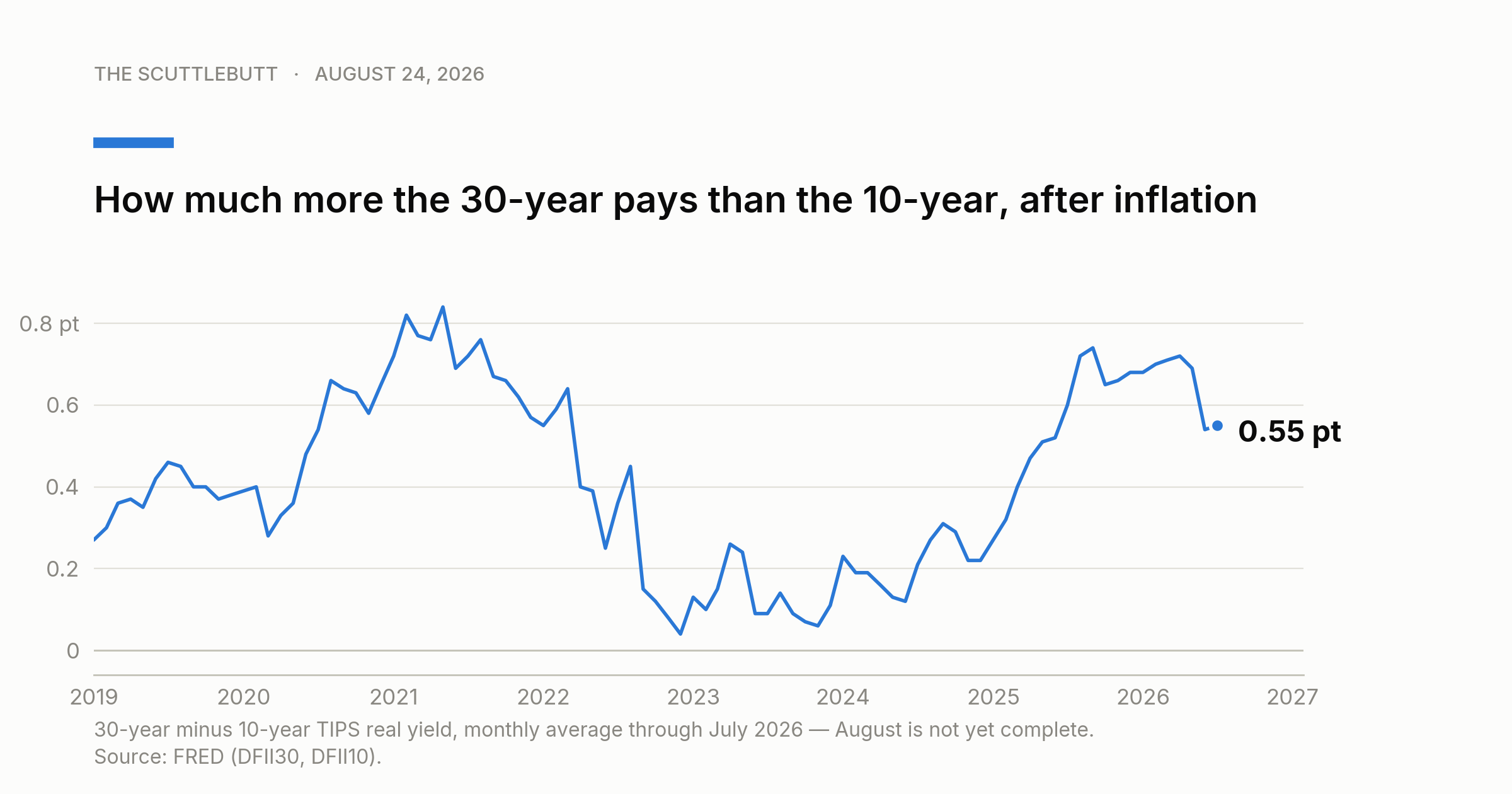
Summary: The Treasury doubled the size of its long-bond buybacks — from a $2 billion maximum per operation to at least $4 billion — and 30-year yields fell, then returned to where they started within a day. Eric Van Nostrand, who ran economic policy at the Treasury before joining Lazard, called that the market’s feedback. Barclays argues the move in long-term yields isn’t a risk premium at all but a higher neutral rate: a 3.75% policy rate is turning out not to be restrictive. BMO now expects the 30-year to reach 6% before the 10-year reaches 5%. Claudia Sahm names the older danger — a Fed that takes orders from the Treasury has, historically, produced higher inflation. Underneath the rates argument: AI token prices fell 9% in a month to $2.21, their first decline after three years of increases, and OpenAI cut GPT-5.6 Luna pricing by 80%. Rick Rule puts $11 trillion of alternative-energy spending against fossil fuels’ share falling from 83% to 81%. And a nuclear developer explains why he now wants customers to pay for the plant before it is built.
Don’t miss the latest scuttlebutt and save 100+ hours each week with a daily digest of podcasts, interviews, and events featuring top investors, founders, and CEOs.
Quotes are condensed and lightly edited for clarity. Numbers, names and speakers’ own qualifications are preserved.
Macro
A higher neutral rate, not term premium, is lifting long-term yields
The big thing that has changed this year is not term premium ... we thought beginning of the year, 3.75% policy rate was restrictive. It’s becoming increasingly clear that it is not. The longer run neutral rate is what has gone up, and that is what is pushing longer-end yields higher. - Ajay Rajadhyaksha, Global Chairman of Research at Barclays, on Bloomberg Surveillance
Buybacks move parked Treasury cash from the Fed into the banking system
they intend on using dollars that have already been issued. ... They issued a bond a while ago, and then they use the proceeds to put in a war chest basically. So those dollars are currently parked at the Fed ... If they use those exact dollars to buy back bonds, those dollars will go from the Fed into the banking system. So it will eventually turn that idle dollar into a live dollar for the financial system. - Andreas Steno Larsen, Founder & Chief Executive Officer at Steno Research, on Macro Mondays
Nvidia falls after earnings because of options positioning, not results
the big idea here is long calls in Nvidia by most customers, dealers are short call, long put. So, the event comes out and the higher probability during this period is Nvidia down. And they had by the way beaten every single one of those earnings. So don’t tell me it’s fundamentals. - Cem Karsan, Founder & Chief Investment Officer at Kai Volatility Advisors, on Tasty Crumbs with Cem Karsan
Refilling the Treasury’s cash account just means borrowing again later
But how do you replenish the TGA, David? You issue T bills or you issue bonds. So all you’re doing is borrowing ... spending short term. You’re going to have to refill it at some point. Just like the SPR, you drain the strategic petroleum reserves. Oil, you’re going to have to fill it up at some point. So, we’re using all these mechanisms ... to cap oil prices, to cap inflation, which in turn should cap yields. - Danny Moses, Investor; host of the On The Tape podcast and co-author of the What Are We Doing? Substack at On The Tape, on The David Lin Report
Yields are up because the economy can afford them
I think one of the main reasons that the bond yield is up here is because the economy can take it ... because there is a lot of borrowing going on, not just by the government but by the hyperscalers ... the spreads between corporate bonds and Treasuries really hasn’t widened at all. And so that’s a sign that there isn’t really a lot of stress in financing these things. - Ed Yardeni, President at Yardeni Research, on Squawk on the Street
$300 billion of balance sheet growth equals a quarter-point rate cut
By increasing the balance sheet by $300 billion, that is the equivalent of a quarter percent rate cut. They have been actually somewhat stimulative, along with the one big beautiful bill tax benefits, fiscal spending, tariff refunds. This has been very heavily stimulative for half of the year, relatively speaking, that actually slows down and may come to a stop in the second half. - Anne Walsh, Chief Investment Officer at Guggenheim Partners Investment Management, on Bloomberg Surveillance
Treasury pressure on the Fed has historically produced higher inflation
The less benign version, and this has a history in the U.S., where the Fed takes orders from the Treasury ... there is a lot of incentive for that to happen right now. And that, in history, has led to inflation that really moves higher. So that is the danger, so we have to be careful about who was making the decisions about interest rates. Are they staying at the Fed? Or is the Treasury calling the shots? - Claudia Sahm, Chief Economist at New Century Advisors, on Open Interest
Future lease and purchase obligations are missing from the balance sheet
essentially in this article what they did is they compiled the total amount of future lease payments and the total amount of future purchase obligations that all these companies are currently on the hook for and at this point they’re not accounted for on the balance sheet. So I think that was a big eye-opener for a lot of people out there. - Dave Sekera, Chief U.S. Market Strategist at Morningstar, on The Morning Filter
The 30-year reaches 6% before the 10-year reaches 5%
We think there is a higher chance of 30-year hitting 6% first then 10-year hitting 5%, despite 30-years being away from it ... 10-year being 35 basis points away from 5%. The reason why we think that is the pressure on the long end in the long duration of risk. There is not as much with 10-years. We are big buyers at 5%. - Earl Davis, Head of Fixed Income and Money Markets at BMO Global Asset Management, on Bloomberg Surveillance
The buyback’s rally in 30-year yields lasted 24 hours
Certainly some unconventional policy out of the Treasury last week. But I think the market gave its feedback on that policy very quickly. The Treasury has had a stated goal of keeping long-term rates down since the start of the Trump administration, clearly hasn’t been very successful ... the market’s been pushing yields up on concerns about fiscal sustainability over the past year and a half. We saw quick reaction in Treasury’s favor, where 30-year yields came down. 24 hours later, they were back up at the same level. - Eric Van Nostrand, Chief Investment Officer at Lazard Asset Management and former Assistant Treasury Secretary for Economic Policy, on Squawk on the Street
Treasury doubled its bond buybacks to at least $4 billion an operation
Put simply, the announcement was that the US Treasury was now going to be buying a lot more long-dated bonds back than we’d previously expected. So it had previously told us each operation that it did in the market, it would buy a maximum of $2 billion of long-dated bonds. That’s now changed where the Treasury is saying it will buy at least $4 billion. So basically buying at least double what was previously intended. - Hugh Gimber, Global Market Strategist at J.P. Morgan Asset Management, on Markets Explained
Investors choosing data center equity over bonds push rates up
real growth, by its very nature, pushes interest rates up, because people prefer to spend their cash to build a data center that has great potential for earnings than buy bonds. And so the data centers are selling the equity ... The investors are saying, “Well, I’d much rather own equity in that than own bonds.” And so that presses up real yields. - Andy Constan, on Two Quants and a Financial Planner (Excess Returns Weekly Wrap)
AI token prices fell 9% in a month, their first decline
Competition remains intense. OpenAI has responded by cutting pricing on GPT-5.6 Luna by 80% and Terra by 20%, while Gemini 3.6 Flash delivers an estimated 17% improvement in cost efficiency. The token price index, which is an important metric for cloud profitability, fell 9% month over month to $2.21 ... that’s its first decline after three consecutive months of gains, though pricing remains 87% higher than a year ago. - Candace Browning, Head of BofA Global Research at Bank of America, on Global Research Unlocked
Higher interest rates are the new normal whatever the Fed does
I think we do, irrespective of the credibility of the Fed. This is just the reality of the world we are in ... this is not something for this week or this quarter. For the foreseeable future, there’s a lot more competition for capital, and that means higher cost of capital. That is the new normal: higher interest rates. - Isabelle Mateos y Lago, Group Chief Economist at BNP Paribas, on The Pulse
Stimulus now backfires; talk of hikes would calm the bond market
we’re over five years now that we’ve been like this that all of these stimulus programs, whether you’re going to buy bonds, whether you’re going to have the Fed expand their balance sheet, whether you’re talking about cutting rates, are just going to backfire and produce higher interest rates. I’ve argued if you want long-term yields to go down, Kevin Warsh should come out and talk about raising rates and then the bond market might calm down and you might have lower long-term yields. - Jim Bianco, President at Bianco Research, on Yahoo Finance Live
A strong economy makes a September rate hike plausible
last year, if you look at what the Fed did, they cut rates three times, a total of 75 basis points, to guard against unwanted weakness in the labor market ... private jobs, or headline jobs, were only up something like 10,000 a month, and that was perhaps at the time the right thing to do. The economy, in my view, is very strong. Job growth is improving. You’d want to take back some of that emergency easing. So I could see the Fed raising rates in September. - Joe LaVorgna, Chief US Economist at SMBC Nikko Securities America, on Bloomberg Talks
Stocks that move opposite the S&P beat index puts for diversification
part of why you’ve had the sharp moves from time to time that you’ve had is because essentially people that use hedges, index hedges, lost tons of money owning puts and gave up on that at the times when it was necessary ... what we found is these negative beta stocks, which correlate inversely to the S&P day in and day out, are actually a way to get index-like returns and get diversification from the fact that everything looks like the AI trade. - Julian Emanuel, Senior Managing Director at Evercore ISI, on Fast Money
International
The heaviest new spenders are companies that rarely invested before
One of the factors we have when we pick stocks is looking at investment, particularly overinvestment. ... a lot of people say, “Oh, investment’s great. You know, you got to invest to return.” But good investment’s great, and unfortunately, many companies have a history of overinvesting. It seems to be an overinvestment. ... These companies that are now doing this huge investment have typically been investment-light companies. - Don Hamson, Founder & Managing Director at Plato Investment Management, on Equity Mates Investing Podcast
Treasury buybacks cannot offset $1 trillion of competing corporate issuance
5.3% is a high, but what matters is more than doubled the buyback program and the news barely flinched. That tells us it is a term premium problem and it is quite structural. You have inflation that will come down to target, the fiscal deficit that is the worst month since 2021, and a $1 trillion corporate bond issuance, competing with government paper for the same kind of buyers. Those three things do not go away because the Treasury buys back some bonds. - Dilin Wu, Research Strategist at Pepperstone Group, on The Asia Trade
Long-term contracts postpone the chip cycle for three to five years
The current economics may not be sustainable long run. Semiconductor companies by and large remain cyclical industries. You might see a normalization in margins and cash flows but the message is not just yet. If you talk to the companies they will tell you they have long-term agreements signed for 3-5 years. - Isaac Thong, Co-Portfolio Manager, Asian Income Fund at Aberdeen, on Bloomberg Daybreak: Europe
The Bank of Japan now has two more hikes coming by 2026
We recently updated our forecast on Bank of Japan’s interest rate outlook, moving from expecting just one more rate hike to now two more between now and year end 2026. What prompted our change ... is mainly two things. First, Japan’s first joint intervention with the US since 1998 on the yen is an admission that jawboning or just threatening intervention is no longer sufficient to prevent the yen from weakening. - Jonathan Liang, Chief Investment Officer, Fixed Income and FX at Standard Chartered Bank, on Standard Chartered Money Insights
AI spending has shifted from company cash to borrowed money
What’s really been underpinning the equity market from an AI standpoint has been that hyperscale of CapEx expenditure ... largely so far, that’s been funded out of operating cash flows. ... you start to see this shift now into tapping into debt markets to fund some of this spending. Clearly that has implications from a cost of capital standpoint. - Richard Saldanha, Portfolio Manager at Aviva Investors, on The Opening Trade
China holds about half the world’s humanoid robot market
Some of the industrial plays we are seeing in China, whether it’s humanoid robots, a lot of headlines recently and market share shifts within that space ... China is like 50% of the global market share in terms of humanoid robots so from that point of view, we are still positive - Beth Wong, Portfolio Manager at HSBC Asset Management, on The China Show
Foreign stock index funds took in over $90 billion this year
That’s really continued into 2026. As a result, we’re seeing far more flows into international index products. ... across the industry, we’ve seen over $90 billion into foreign large blend products this year, and we’re seeing that across the Schwab Asset Management products this year as well. - David Botset, Head of Strategy, Innovation and Stewardship at Schwab Asset Management, on ETF Edge
Bessent likely pressed Tokyo on rates to protect US borrowing costs
In this occasion, we see Bessent acting most probably to help encourage the Takaichi administration to let the Bank of Japan move a little faster on interest rates. Bessent has been concerned since last year that the Bank of Japan is behind the curve on fighting inflation. ... this has resulted in periodic kerfuffles in the Japanese government bond market, which has spread over to the US Treasuries market, which is what ultimately he cares about and US borrowing costs. - Chris Anstey, Senior Editor, global economic coverage at Bloomberg News, on Trumponomics
Four years of import monopoly bought Nigeria its own cement industry
Then he went, under the presidency of Obasanjo, to the government and negotiated a deal where he’d get four years of protection as a monopoly importer of cement — which was not then made in Nigeria — in return for creating local cement production. - Joe Studwell, Author, “How Africa Works: Success and Failure on the World’s Last Developmental Frontier”, on Odd Lots
Japanese firms invest abroad because they cannot hire at home
If the Japanese corporates, which earns a lot of money from weaker yen by the exports or a business abroad, if they try to invest domestically, they face labor shortages. So, therefore, they can’t find room to invest domestically. ... They continue to reinvest in like foreign factories or R&Ds. So that’s going to create a weaker trend in the yen. - Taro Kimura, Senior Economist at Bloomberg Economics, on Trumponomics
Europe cannot buy weapons fast enough to match Ukraine’s adaptation
They have changed warfare from a contest, who owns the best technology, into a contest as to who can adapt that technology the fastest. So Europe understands the lesson, but its acquisition systems, fragmented industrial base and some of the national stove pipes still make it difficult to replicate Ukraine’s speed. - Wayne Sanders, Senior Defense Analyst at Bloomberg Intelligence, on The Opening Trade
Foreign visitors are the bright spot while Chinese consumers stay home
We actually have a more up-to-date number. For the first half of this year, China recorded 23 million foreign visitors. That represents 20% year-over-year ... Beijing and Shanghai had an even greater growth rate. They are providing that incremental support at a time when domestic consumers are not showing up in the same way. That will continue to be a bright spot in the economy for years. - Anna Zhou, Economist at BofA Global Research, on The China Show
The placement equals roughly a third of daily Hong Kong turnover
What is interesting about this deal is it is a massive placement within the context of Hong Kong’s overall liquidity let alone the stock itself. It’s around 30% of the Hong Kong overall turnover and three to four times its own turnover ... it looks like it has been three or four times oversubscribed - Anthony Stephens, Bloomberg, on Bloomberg Daybreak: Europe
A near-$100 billion private valuation ends in a Hong Kong listing
It’s a long-awaited IPO, and remember, this is a company that raised privately, close to $100 billion two years ago, so how the mighty have fallen. A company debating going public here, then London, and ultimately ... going public in Hong Kong next week. - Bailey Lipschultz, Senior Reporter at Bloomberg, on Open Interest
Financials
Day-trading rule repeal took Webull from $160 million to near $200 million
The trading activity we’ve seen since that removal of the PDT rule has completely changed the outlook for our business ... we went from a $160 million top-line revenue in Q1 to near $200 million, basically on one month’s addition, which was June of Q2, that removed the PDT rule. So future outlook: very, very bright. - Anthony Denier, Chief Executive Officer, Webull US at Webull, on Squawk on the Street
Figure cuts mortgage cost to $1,000 and closing to five days
We take a ton of time and cost out of the system when we do that. So we do it in about $1,000 versus 12,000 industry average, and we do it in about five days versus industry average of 45 ... Average time is nine days, but can be as fast as five. - Michael Tannenbaum, Chief Executive Officer at Figure, on The Peel with Turner Novak
Option-income ETFs now exceed $170 billion after 80% annual growth
Derivative income category has grown north of 80% a year for the last five years and now exceeds $170 billion ... Maybe they are moving away from the dividend strategy. Maybe they use bonds to get that income and they are thinking about a different way to get that application. - Byron Lake, Global Co-Head of Third-Party Wealth at Goldman Sachs Asset Management, on ETF IQ
Owning OpenRouter gives Stripe a map of global AI token flows
By now operating OpenRouter, Stripe have that data and that information of where all of this is getting routed. It’s like having an entire database of where payment flows happen across the world. You have now a database of where AI tokens happen across the world, to which models, with what frequency, from where. - Aditi Subbarao, Financial Services at Snowflake, on Fintech Insider Podcast by 11:FS
Options that are harder to hedge require more margin
The price of the option of the delta 60 is much more sensitive. So you need to react faster. Therefore you need to ask more margin for the delta 60 option. The same can be applied to other type of Greeks ... like gamma and even second order if you ask me like vanna. So the more Greek aggregated risk an option has the more margin you need to ask because there are many factors that can change the price while you have not hedged. - Antonio Berenguer, Options trader and market maker, on The Blushing Quants Podcast
SoftBank still needs at least $20 billion more after the bond deal
We calculated it probably still needs another at least $20 billion even after this bond deal, after it raised $10 billion from an OpenAI-backed margin loan ... It is mainly coming from a $14 billion bridge loan that matures in March, raised to fund the commitment to OpenAI. - Sharon Chen, Bloomberg Intelligence, on Bloomberg Tech
95% of customers approved when the assistant asked to move their money
We honestly didn’t know how it would be received when we launched the assistant and it had the ability to even move money within the account. Even the idea of moving money to spaces, we didn’t know how people would go for that. But actually we were really surprised to see that within the first few months ... that request for confirmation of “you’re about to move money, do you want to approve this” — 95% of people said yes, right? - David Sullivan, Data Director at Starling Bank, on Fintech Insider Podcast by 11:FS
Crypto and Digital Assets
Doubts about AI capital spending returns are pushing money into crypto
The AI trade is starting to lose a little bit of its luster as people become concerned around valuation and ROIs that may not be there on this huge amount of capex. So long-dated thinkers are shifting their focus elsewhere and now to crypto. - Bill Miller IV, Chairman & Chief Investment Officer at Miller Value Partners, on Closing Bell
A few basis points on Tether’s $15 billion moves the whole business
Tether has $15 billion in government bonds. So, any movement, a few basis points movement, when you are talking about those huge numbers ... have a very sizable effect on these companies. A public company like Circle, the vast majority of its profit comes strictly from earning money on the balances of the stablecoins that is investing. - Bill Quigley, Co-Founder at Tether, on The Close
Alternative Investments & Private Equity
Private equity partners are borrowing against carry checks that never arrived
We just saw an article from FT and there’s private equity folks who are expecting their carry check to have hit by now ... who are taking some sort of like non-recourse loan off of future earnings that they expect from carried interest just to continue and subsidize I guess their lifestyle. - High Yield Harry, Founder and leveraged-finance writer at High Yield Harry / Buy Side Hub, on Other People’s Money with Max Wiethe
Bad loans at business-development lenders rose from 3.69% to 4.69%
With all of these names, the number of borrowers, at least one debt instrument in non-accrual status, went from 4.26 to 4.69. So about one in 20 nearly ... So it’s got from 3.69 to 4.69 in two years — two and a half years. And this is when the size of these BDC companies have basically doubled over the past three years. It’s about $560 billion a total debt. - Justin Klein, Host at KPP Financial, on InvestTalk
Consumer
Olipop is well past half a billion in sales and profitable
We’re not quite at a billion, but we’re well north of a half billion and we’re fully profitable. So, we’re chugging along and we still have robust double digit growth, which I’m excited about. ... I think that ... there’s always time for the category to continue to evolve and I don’t want to seem ... cavalier but since Pepsi purchased poppi ... Olipop has squarely retaken the lead seat in the category, right? - Ben Goodwin, Co-Founder and Executive Chairman / Head of Innovation (Chief Executive Officer at time of recording) at Olipop, on Power Players with Brian Sozzi
Agents now bargain on both sides and nobody regulates the outcome
You can think of it as like an Edgeworth box where there are two indifference curves ... One is trying to maximize total revenue and basically minimize payouts. And one is trying to maximize revenue recovered, right? They are both using agentic tools. ... The patient has no agency. And there is no regulator that basically says, we think this model is really, really performing well, right? But it’s actually misaligned. - Engy Ziedan, Co-Founder and Chief Scientific Officer at Protege, on The a16z Show
Resale value and clear pricing give jewelry an edge over clothes
If you buy a diamond necklace or even just a silver bracelet, the perceived value is higher than if you buy a skirt or a blouse that doesn’t have the same resale value, that doesn’t hold its value over long periods of time and that doesn’t have the same transparency in terms of how things are actually priced. ... I think that at this point in time is giving jewelry and watches a lot of advantages over fashion and accessories. - Pauline Brown, former Chairman of North America at LVMH, on Yahoo Finance Live
Moderna’s cancer vaccine avoids cell therapy’s high manufacturing cost
It’s not using human material like CAR-T cell therapy — that is a very expensive price because it’s a very expensive manufacturing process. In our case, it’s all used with enzyme, it’s in water. ... So as we’ll get the data, we’ll get closer to discussing ... pricing. But we don’t have the very high cost of goods that the cell therapy products have. - Stephane Bancel, Chief Executive Officer at Moderna, on Mornings with Maria
Tips are optional and tens of millions of donors skip them
We ask the donor if they want to give us a voluntary contribution, a tip. Totally up to them. ... A good chunk of people do give us a tip, a good chunk don’t. I think last year 15 to 20 million people didn’t give us anything, which is fine, because the donor is the person in this equation who’s bringing the financial resources, - Tim Cadogan, Chief Executive Officer at GoFundMe, on Decoder with Nilay Patel
Small daily experiences are what members now redeem points for
This year we have noticed a shift. People are craving micro experiences on a daily basis. ... whether it is comedy shows we host around the country, fitness classes, ... our partnership started with SoulCycle which is owned by Equinox. It was unbelievable how often members redeemed points to book a SoulCycle class because the 45-minute local micro experience was micro luxury in your everyday life. - Ankur Jain, Chief Executive Officer at Bilt, on The Close
The treatment cut sick days without raising employment or earnings
The same treatment that cut prolonged sickness absence by a sixth produced no detectable improvement in whether people were employed, how much they worked, or what they earned. ... The estimates are precise enough to put a ceiling on what could be hiding underneath them. The researchers can rule out an employment gain larger than 0.4 percentage points and an income gain larger than 0.7%. - Axara, Host at Zerodha, on The Daily Brief
Owners with sub-3% mortgages rent them out instead of selling
If you’re a buyer, you’ve got so much inventory to look for. However, if you’re a renter, you also have just as much inventory because what we’re seeing is sellers, with these sub-3 interest rates, they do not want to give up their asset for market rate right now ... whenever they could rent in cash flow. ... our rents are down around 4% year over year right now from the 2022 peak. - Dillar Schwartz, Real estate agent at eXp Realty, on Fox Business
Paramount owes $7 million a day to Warner Bros. Discovery from October
On October 1st, which is just a little over a month from right now, the Ellison’s and Paramount start paying $7 million a day. $7 million a day to Warner Bros. Discovery in ticking fees. That’s $650 million per quarter, $1.3 billion by the time the trial starts. - Evan Shapiro, Media analyst and consultant at ESHAP, on Yahoo Finance Live
Canada Goose earns more than all its profit in the holiday quarter
Goose is the most exposed outerwear company that we cover. It’s about 80% of their mix. They make more than 100% of their profit during the holiday season. That’s really a bad place to be, considering the report we put out today, which talked about the El Nino event that we’re expecting. - Ike Boruchow, Senior Analyst at Wells Fargo, on Closing Bell: Overtime
Millennial moms’ kids are now nine and picking their own clothes
what we started to organically see happen is that over 50% of our customer base is millennial moms for the most part. And because we launched in 2017, when their kids were babies, those children are now over the age of nine. And they want to exert autonomy, independence over what they’re wearing. And so that’s what Neon Rebels is really built to serve. - AJ Nicholas, President at Maisonette, on Yahoo Finance Live
A $39 first month becomes $149 and the drugs cost extra
part of the complaints are the fact that the introductory membership is about $39 for the first month. However, afterwards it increases to $149, but that does not actually include the price of the drugs. So if you get prescribed to a go V or something else, you have to pay that on top. And we already know these drugs tend to be slightly expensive as well. So you can imagine ... having a pretty big surprise coming in on your credit card. - Avalon Purnell, equities reporter at Bloomberg News, on Bloomberg Businessweek Daily
SoftBank’s trillion-yen retail bond is read as funding its OpenAI commitments
retail bonds ... a trillion yen to about $6 billion, $6.3 billion. And officially a spokesperson at SoftBank says they’ll use the proceeds in two ways: one, pay down existing debt and refinance, but also support portfolio companies. And the way that this is being interpreted is SoftBank is on the hook for lots of commitments to OpenAI and they’ve used lots of mechanisms to get the cash to support that. - Ed Ludlow, Tech Co-Anchor at Bloomberg, on Bloomberg Intelligence
Sports
The tournament’s own tickets start at $25, not the resale price
I think the first thing ... the secondary market, we don’t control that. ... Our entry prices are $65, grounds price, as you indicated. You can actually get on site ... for $25. And of course this entire week, eight days of free for our fans. - Craig Tiley, Chief Executive Officer at United States Tennis Association, on Squawk Box
MSG Sports trades below what the Lakers just sold for
Right now, the enterprise value of MSG Sports, which owns the Knicks and the Rangers, is $10 billion. About a week or so ago, the Lakers, in almost a forced sale, went for $12.5 billion. ... it’s still extremely undervalued. - Jonathan Boyar, Principal at Boyar Value Group, on Closing Bell: Overtime
Technology & AI
The rocket’s upper stage becomes the data center itself
What if you were able to use the rocket itself, again, I’m paraphrasing here, but basically as the heat sink, because you got a bunch of metal there? ... you arrive at the architecture that we have, which is that the upper stage of the rocket is itself the data center. There’s no satellite. The rocket becomes the data center satellite when it’s in orbit. - Baiju Bhatt, Co-Founder at Robinhood, on Grit
Just 25% of the 90 million cars built yearly use advanced software
there’s 90 million automobiles that get manufactured a year. So out of those 90 million Arjun, I would say 75% of those 90 million cars have kind of basic software technology in it, you know infotainment type of things, to tune your radio or to listen to a podcast like this ... And then 25% of those 90 million cars are now using more advanced technologies. - John Giamatteo, Chief Executive Officer at BlackBerry, on The Tech Download
Zuckerberg selling spare AI capacity may signal the company overbuilt
that’s a company I do not own ... or I guess we do have a small position in it but I will not emphasize it because you know Mr. Zuckerberg’s comments that they’re going to sell excess AI capacity worries me because that is the first sort of indication that maybe that particular company has excess capacity or they didn’t properly budget for it or they haven’t quite got a usage for it. - Keith Fitz-Gerald, Founder & Principal at The Fitz-Gerald Group, on ETF Spotlight
One agent input can burn 20 to 40 times more tokens
The core point to this is when we move from generative AI to agentic AI ... even though token costs are coming down the volume of token consumption has gone up massively. ... one input into an agent can trigger between 20 to 50 actions and can consume between 20x to 40x more tokens than you would with a generative AI system of two years ago. - Manoj Saxena, Founder at TrustWise, on Eye On A.I.
One hour of robot data hit 99%-plus reliability on new tasks
Gen 1 was able to across several different tasks and then many other tasks that we showed since hit these like 99% plus levels of reliability on just one single hour of robot data. So, that also starts to indicate ... really being at this kind of level of capability where you can take a new task and you can get the robot to do it without an overburdening amount of data going in. - Pete Florence, Co-Founder & Chief Executive Officer at Generalist, on Joe Lonsdale: American Optimist
A million welds a month likely won’t build a better robot
let’s say that ... I’m a car company and I have a robotic arm that is welding cars ... on the assembly line, and it welds cars every day, and it gets ... a million welds every month and so on. If I just use that as my data flywheel, I’m unlikely to get something more capable than a robot that welds cars. - Sergey Levine, Co-Founder at Physical Intelligence, on The Peterman Pod
Signed power contracts decide which data center markets are investable
when we look at our portfolios and our investments, we are very much focused on ... companies that are operating in those specific markets, primary markets that have ... very sustainable demand drivers. And, by the way, contractual power. And that’s really important. Having that visibility to power becomes even more valuable today. - Ji Zhang, Global Real Estate Portfolio Manager at Cohen & Steers, on Power Lunch
AI spending is a choice, and pausing would flip cash flow positive
The other thing folks are concerned about is the shift in free cash flow for a lot of these companies as they borrow more and spend more on capex. Free cash flows have turned negative in some cases. I would like to suggest ... this is a spending cycle of choice. These companies can at any point in time decide we will pause, then their cash flow is going to turn massively positive very quickly. - JoAnne Feeney, Portfolio Manager at Advisors Capital Management, on Open Interest
Stripping out mark-to-market gains still leaves fantastic earnings growth
One caveat on those phenomenal earnings is a large portion came from mark-to-market gains on equity securities. You also have that mismatch between all that capex spend where revenue was booked immediately and the expenses are spread out over future periods. Those adjustments only get you from phenomenal earnings growth to fantastic earnings growth. - Kelly Covley, Portfolio Manager at Manning & Napier, on Bloomberg Surveillance
Only 5 to 10% of AI adoption is running through Fable
in our data set, we’re seeing that Fable’s adoption has been quite disappointing. Only about 5 to 10% of adoption is going through Fable right now. A higher proportion of spend is currently going through other frontier models. An increasing amount going through OpenAI. ... So if you’re thinking about the AI trade, we’re starting to see some cracks in the thesis. - Ara Kharazian, Lead Economist at Ramp, on Yahoo Finance Live
Every technology boom eventually faces its bar mitzvah moment
every revolutionary change goes through four phases. The first, of course, is the hope and the hype. You’re selling the idea, you’re sometimes overselling it, and then you invest in the architecture to deliver that idea. And then comes the moment where you ask, is all this investment going to pay off? That’s the bar mitzvah moment, where you’re asked: are you grown up? Are you a real business? Are you just hope and hype? - Aswath Damodaran, Professor of Finance at NYU Stern School of Business, on Squawk on the Street
Software’s asset-light giants have turned asset-heavy, at least for now
there’s a capital cycle even in the asset light businesses, right, because that’s one of the advantages that these guys— they’ve been asset light forever. At least temporarily they’re not so asset light anymore. ... there’s a huge capital spend they’re doing, and that capital spend is: I need cement, I need aluminum, I need copper, I need all these materials. - Bob Robotti, on Two Quants and a Financial Planner (Excess Returns Weekly Wrap)
Software vendors keep 10% to 25% of the value they create
Companies have shared time and time again, and we saw this in this particular revolution come anywhere from the 1980s to 2010, when software companies drive the rally for their customers, they typically capture 10% to 25% of the value it creates. So it is not just very early use cases, coding ... We think it is a matter of time before software companies are actually able to exercise pricing power. - Gabriela Borges, US Software Equity Research Analyst at Goldman Sachs Research, on The Close
Snap’s revenue per user sits 3% below its 2021 level
Snap’s average revenue per user in the most recent quarter was 3% below what it was back in the same quarter of 2021. ... Got persistently negative margins, large free cash flow burn, going up against some of the most profitable companies in the entire world. - Kyle Guske, Investment Analyst at New Constructs, on Money Life with Chuck Jaffe
TSMC and three memory makers are the real bottleneck for AI chips
I think if you look at the market in general, TSMC is the bottleneck, and memory manufacturers the bottleneck, for AMD and Nvidia and anyone else even trying to do custom ASICs. If you take a step back ... we want to make a chip: who’s going to manufacture that chip? It’s going to be TSMC, and the memory manufacturers — there’s three of them — will sell you the memory for it. - Max Weinbach, Analyst at Creative Strategies, on Next Gen Investing
Google’s $40 billion in Anthropic looks like hedging, not conviction
Their way of investing into OpenAI is essentially funding the whole ecosystem and their customers while the AI curve matures and adoption happens. I don’t think Nvidia is the only one doing this. You see Google making a significant investment into Anthropic, $40 billion, even when they have Gemini. This shows to me that while there is this enthusiasm for the AI buildout people are also hedging their bets because they don’t know which model or which part of the stack the value will eventually accrue to. - Momei Qu, Managing Director at PSP Growth, on Bloomberg Surveillance
Cloud operating profit rose only $420 million year over year
if you looked at the change in operating profit for that ... key cloud intelligence business ... year over year, profit in that business went up by $420 million U.S. dollars. - Robert Lee, Senior Analyst at Bloomberg Intelligence, on The China Show
PC prices climb 20-25% as shipments fall 15% this year
if you haven’t gotten your PC now, you’re kind of in a rock and a hard place, because PC prices are going up around 20-25%, whereas unit volumes are going to go down by about 20% in the second half. And overall we do think that PC shipments are going to be down roughly about 3% for the year — I’m sorry, 15% for the year, 22% in the second half of this year. - Woo Jin Ho, Senior Technology Analyst at Bloomberg Intelligence, on Bloomberg Intelligence
Unlike capex or staff, borrowed money cannot be scaled back
virtually all of its growth is coming through debt finance, heavily depreciated assets. So you’re generating small amounts of profits right now for monumental amounts of debt. And the important thing here is ... debt is not really a dial you can just decide to turn down, like something like capital expenditures where you can probably just scale it back. Staff could be laid off. Operations could be modified ... The debt is still there. - Dan Kent, on The Canadian Investor
VC & Startups
China may be making public-market financing cheaper than America can match
China gets a piece of technology from the United States, they manufacture it better, they make it cheaper, and then they dominate. We’ve seen that in electric vehicles. We’ve seen that in solar. Now we’re seeing it in robotics ... But what if the implication that we’re actually seeing is that Beijing is also making the financing around these companies, when they go public, much more efficient and much more competitive than the United States could ever replicate? - Alex Harstrick, Co-founder & Managing Partner at J2 Ventures, on Squawk Box
Investing in a new AI lab now is buying StumbleUpon after Facebook
I think right now, if you’re going to invest in the new neolab, you’re basically investing ... in the Kora, in the StumbleUpon when Facebook came about. That’s my opinion. It’s not shared ... with everyone, but that’s the way I think about it. - Julien Bek, Partner at Sequoia Capital, on The Twenty Minute VC (20VC)
Token spending will probably run into a CFO reckoning
It’s so easy to just start spending and spending ... and then you don’t even notice it, and then all of a sudden you spent north of your salary. There has to be a rationalization of that at some point. I have to think CFOs are going to start looking at the bills and I tend to think that we’re probably going to see some sort of a rationalization and digestion here of some of the token spend. - Fred Havemeyer, Founding Engineer at Fleet AI, on Run the Numbers
What limits AI applications now is everything except the model
Something as simple as tool complexity or context complexity for a model as recently as six, seven months ago was a major constraint on the kind of work and the kind of ROI ... The model intelligence is no longer a blocker. And then the blockers for growth, including our growth ... across the application layer is everything else. - Rahul Rekhi, President at Rogo, on Run the Numbers
Industrials and Transport
The third defense wave is tactical IT for the new platforms
The first wave was more around ammunition and boots and fuels... And then the second wave was around filling up the order backlog at the big primes with the platforms, the vehicles, the tanks and the aircraft... the third wave that we have referred to is when they need to equip this kind of platform with tactical, I would say they need their IT backbone out in the field. - Daniel Ljunggren, Chief Executive Officer at MilDef, on The Opening Trade
Star trackers and reaction wheels, not capital, limit spacecraft
Launch is always a huge moat. Launch is like probably the biggest moat, but I would say the second biggest moat is those components to go into those spacecraft because you can have infinite capital. It doesn’t make any difference. You still need some star trackers and some reaction wheels and they’re just not available at scale. - Peter Beck, Founder & Chief Executive Officer at Rocket Lab, on Sourcery
Over 9,000 strike systems delivered to Ukraine this fiscal year
We have meaningful drones in Ukraine. We are executing one of the largest long-range precision strike programs. We call it the Yukon Deep Strike program. And by the time we finish this fiscal year, we will have delivered over 9,000 systems to combat operations in Ukraine. Many of our systems are extremely affordable, especially compared to traditional weapons systems, and we believe that they offer economic asymmetry. - Roger Wells, Chief Executive Officer at Aevex Aerospace, on Mad Money
Materials & Energy
Electricity customers will pay the plant’s capital cost through long-term contracts
In the deals that we’re structuring, we’re going to be looking for the eventual electricity customers to enter into power purchase agreements that will essentially pay for the capital expenditure for that plant. And that’ll be a long-term PPA that lasts 20 to 30 years. - Chris Levesque, Chief Executive Officer at TerraPower, on Bloomberg Businessweek Daily
$11 trillion over 45 years moved fossil fuels from 83% to 81%
The truth is that humankind has expended about 11 trillion dollars on alternative energy generation. And that 11 trillion expenditure over 45 years has reduced the market share of fossil fuels from a high of 83% all the way down to 81%. The people who have philosophical objections to hydrocarbons don’t have an economic explanation particularly to a billion people on Earth that have no access to primary energy whatsoever. - Rick Rule, President & Chief Executive Officer at Rule Investment Media, on Market Call
Revenue rose more than 150% in the lithium market’s inflection year
It’s great to see the improvement in the market that we have had this past year... The year which we have just been through has been an inflection year and that has really flowed through. Record production, record sales, and improvement in unit costs. Those outcomes coupled with a strong pricing environment flow through to the balance sheet with more than 150% lift in revenue from the prior year. And improvement of underlying EBITDA. 59% margin. - Dale Henderson, Chief Executive Officer at PLS Group, on The China Show
Crude below $120 means more oil is getting through than reported
If you look at the price action, it tells me that a lot more oil is coming through than most people realize. Probably not as much as the administration wants us to believe... but some is coming through. If it wasn’t, we’d probably see oil much higher than it is, maybe in the 120s, 130s. - Carley Garner, Senior Commodity Market Strategist at DeCarley Trading, on Trading 360
Fourteen Russian refineries hit since July 25 and barely reported
I think this has really been overlooked by most journalists and most media. By my count, since July 25th, there have been 14 refineries in Russia that have been targeted by Ukrainian drones and very successfully targeted. We don’t know where their production is. They have 6.5 million barrels a day of refined capacity. They may be only at three or so. - Tom Kloza, Chief Energy Adviser at Gulf Oil, on Yahoo Finance Live
Diesel costs double crude after six months of low refinery runs
We are still here now, coming up to the sixth month of being in this conflict, and we don’t see barrels flowing freely. That is the problem here... we’ve got the problem on the product side of things because refinery runs have been down for so long. We can see that coming through in diesel prices right there — double what they are for a barrel of oil. - Matt Smith, Director of Commodity Research at Kpler, on Power Lunch
Attacks on Russian refineries are what’s driving gasoline and diesel prices
When it comes to gasoline and diesel prices, all of the attention really that I’m looking at has to do with Ukraine’s continued attacks on Russian oil refineries. Now, we did see some comments from the Kremlin this morning that some of those refineries are getting back online. That’s pushing diesel prices modestly lower this morning, but look for crack spreads to remain elevated. - Patrick De Haan, Head of Petroleum Analysis at GasBuddy, on Trading 360
Political backlash is pushing federal regulators to cut utility returns
In general, we’re seeing strong backlash politically around the country. And that’s really driving actions that will reduce returns on equity. So the FERC has taken actions that reduce the adders that the companies earn on ROE in Maryland and Jersey and parts of New England. And that’s directly impacting the earnings outlook for companies. - Ryan Levine, Senior Utilities Analyst at Citi, on Closing Bell: Overtime
Texas exposure is a hedge against a tech-concentrated market
If you look at the broader market, heavily concentrated in technology. Our biggest sector is energy at 18%. We don’t have the same level of technology exposure and we don’t have the Mag 7 like the broader market does. We have one of those and that is Tesla so the appeal is nationwide and is due to the diversification and the growth happening. - Carlos Peña, Head of ETF and Funds Management at Texas Capital, on ETF IQ
Policy
Tariff announcements push ranchers to sell heifers instead of breeding them
every time the president makes a statement like this ... he introduces uncertainty. And the last thing in the world that cattle markets like is uncertainty. And so if you’re a producer ... trying to decide if you’re going to hold back your heifers, you may now decide to send those cattle to market now rather than holding them back. And that just sets all of us back and trying to rebuild this herd. - Colin Woodall, Chief Executive Officer at National Cattlemen’s Beef Association, on Squawk on the Street
The president treats trade as zero-sum, so Canada must lose
I think it goes to the fact that, in my view, the president sees economics and trade as a zero-sum game. I think that is the simplest, most accurate explanation for this. So if Canada loses, the United States wins. I do not think he believes in a win-win scenario that has underpinned global trade policy for the last 40 plus years. - Brian Gardner, Chief Washington Policy Strategist at Stifel, on Bloomberg Surveillance
Sports is 85 to 90% of Kalshi and Polymarket’s revenue
I would say they are out of business. ... 85 to 90% of their business is sports. They are sports gaming companies. They would not be able to turn on the lights at Kalshi, Polymarket or any other place that does this without sports. ... these are hypotheticals that are interesting academic discussions. But the reality of this is that this is where they make their money. - Chris Christie, Strategic Advisor (former Governor of New Jersey) at American Gaming Association, on Squawk Box
New capital rules will fund buybacks, not lending growth
Our research shows that as returns have fallen, banks have reduced reinvestment and returned more capital to shareholders instead. These rule changes will certainly create additional capacity, but capacity and growth are not the same thing. I think a lot of the benefit will show up through higher returns, buybacks and capital distributions, rather than a meaningful increase in organic growth. - Brad Rogoff, Global Head of Research at Barclays Investment Bank, on The Flip Side
Trillions in new debt left banks unable to trade Treasuries
Fast forward 6 years, and the US has issued trillions more debt thanks to huge deficits. Now the capacity to trade all these Ts is even more limited. I think regulators are trying to shore up this market by revisiting these rules. ... the new Fed chairman wants to reduce the Fed’s footprint in markets: that means banks would need to pick up the slack, and because of the SLR they couldn’t… so now it is changed. - Jeff Meli, Clinical Professor of Finance at NYU Stern School of Business, on The Flip Side
Export controls since 2019 have left China without an EUV breakthrough
And I think the alternative, to an extreme, is kind of what the PRC or what China is doing. And there you have sort of a top-down directed ... single agency entity that sets priorities and tries to execute. They have been trying to essentially figure out how to do EUV lithography since we put the export controls in 2019. No breakthrough has happened. There’s nothing more important to their economy than solving that scientific problem, and haven’t been able to do that. - Michael Kratsios, Director at White House Office of Science and Technology Policy, on All-In with Chamath, Jason, Sacks & Friedberg
Treasury would need eight times its announced plan to match 2011
the Treasury Twist moniker that Bessent has given this calls back to the Fed’s Operation Twist in 2011, which had a similar idea, ... sort of changing the term structure of outstanding Treasury issuance. That ended up getting to $667 billion over about 15 months. So for Bessent to ... get there, you need to increase this by a factor of eight and run it through the end of 2027. - Tobin Marcus, Head of Policy and Political Strategy at Wolfe Research, on Power Lunch
Moving car production back to the US takes years, not months
You cannot move production in a big way in six months or even 12 months. General Motors moved some production back from Mexico. Chevy Equinox and Chevy blazer back to the U.S. that will happen 2027, 2028. It takes a couple of years even when you are moving an existing vehicle to a plant that exists. - David Welch, Detroit Bureau Chief at Bloomberg, on The Close
Geopolitics
Canada’s exports will face a 6% average tariff, China’s tops 20%
So $20 billion is irrelevant more or less from the US economy. ... it’s only about 20% of Canada’s exports to the United States. When these tariffs are implemented, Canada’s exports to the US face an average applied tariff of about 6%. Now that’s way up from where it was before the first Trump administration, when it was about 0.1%. But it’s far below the tariffs that China faces ... which are north of 20% on average. - Michael Froman, President (former U.S. Trade Representative) at Council on Foreign Relations, on Squawk Box
Investigations of Chinese banks that broke US sanctions never land
The U.S. government has been extremely reluctant to go hard on economic sanctions — not export control, but economic sanctions — on China. I say this having worked on these issues for 22 years. ... there’s been a number of investigations in Democrat and Republican administrations of Chinese state-owned banks and non-state-owned banks that have violated American sanctions that have never been brought to bear. - Dan Tannebaum, Partner at Oliver Wyman, on Power Lunch
Canada can target John Deere in Iowa and Indiana RV makers
some research has come out over the weekend, suggesting that John Deere exports a lot of farm equipment to Canada. They make those in Iowa. there’s another, a big exporting community in Indiana that export campers and RVs and recreational vehicles to Canada so we could see particular lawmakers’ constituents targeted ... to effect the congressional pressure that could come to bear on the administration to back down. - Brendan Murray, Bloomberg, on The Opening Trade
Nuggets of Wisdom
A small market is a moat because big money ignores it
I much prefer a small niche. Market leader in a small niche has got a way stronger competitive advantage. And the reason why it’s got a stronger competitive advantage in a smaller TAM is because you don’t get big players going, “Oh well, I’ll have a piece of that pie.” ... you don’t get like outside capital going, I could do that, and bring down ... the average earnings of the whole. - Joe Kaye, Portfolio Manager, on MicroCapClub
What did you think of today’s edition? Hit ‘reply’ to this email, send us a message, leave a comment, or join the chat!

Get hourly updates of the latest scuttlebutt on your favorite platform:
X | Threads | Instagram | YouTube | TikTok | Facebook