

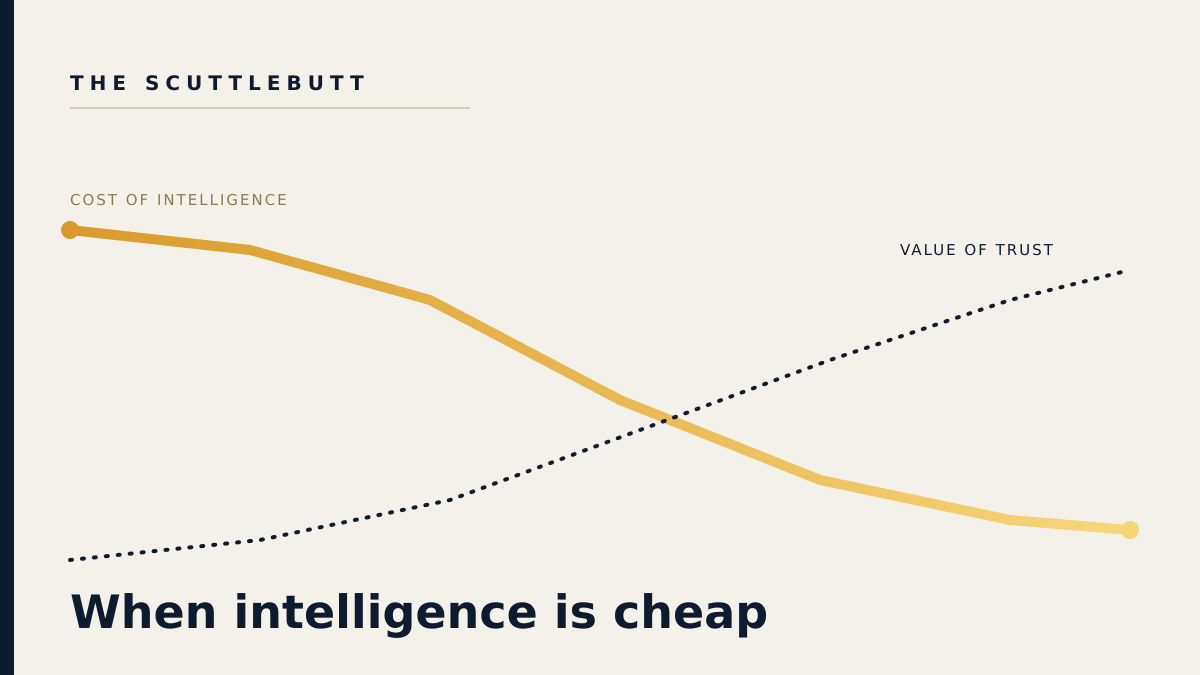
Summary: Today’s issue centers on a single tension: as AI makes intelligence cheap, where does lasting value go? Investors and economists weigh in on why humans still matter for trust and judgment, why AI’s deflationary payoff is real but delayed, and how the bond market is now speaking loudly to Washington about deficits and Fed policy. Rounding it out are the U.S.-Japan yen intervention, the ETF tax advantages reshaping how investors hold winners, and Robinhood co-founder Baiju Bhatt’s bid to power data centers from space.
Don’t miss the latest scuttlebutt and save 100+ hours each week with a daily digest of podcasts, interviews, and events featuring top investors, founders, and CEOs.
Macro
When intelligence is cheap, humans stay valuable for trust, touch, and accountability
“You need humans to persuade. You need humans to perform physical tasks. You need humans to assume legal liability, and you need humans to interact with politics. That would just be a bare minimum. You need humans to inspire, to carry charisma, and to teach others not information, but actual motivation. So human jobs of the future, I think, will be highly concentrated in those areas.” - Joel Hellermark, Sana founder, on Strange Loop Podcast by Sana
Forward guidance is a promise the Fed can’t keep
“The forward guidance simply tells us where [the Fed is] going to go next. And I do think that the Fed should get rid of that. It has caused more problems than it has solved over the years because whenever the Fed gives forward guidance, it’s viewed as a promise, and then the Fed’s kind of stuck because if the data changes, they either disappoint the market, and we’ve seen some wild moves because of that, or they follow through on an incorrect policy. Think transitory inflation.” - Jim Bianco, President & Macro Strategist at Bianco Research, on Bloomberg Surveillance
Raising rates could actually calm the long end of the curve
“There’s been no other experience in the last 50 years where we’ve had a major long-term cutting cycle and long-term yields have gone up. So, I think this, for starters, is the market signaling that it disagrees with the policy that long yields have been going higher. So, I’ve been arguing that if you want to see a peak in long-term yields, the Fed should panic a little bit and raise interest rates. That will calm down the long end of the curve and bring those yields down. All you’re doing is reversing some of the cuts.” - Jim Bianco, President & Macro Strategist at Bianco Research, on Bloomberg Surveillance
AI’s deflationary payoff is real — just not this year
“[Fed Chair Kevin Warsh] is a big AI bull, and he does believe that AI will eventually be somewhat deflationary or at least disinflationary over the time period. So, you could argue that he is looking at the inflation numbers that we’ve seen elevated for the last several years. We’ve had 64 straight months of it being above 2%. He’s thinking that AI might come in and help to push that number down. I agree with him, but I don’t think that’s happening this year or even maybe next year; eventually, the productivity you would expect from AI might evolve over a longer period of time than, say, the next 12 to 18 months. But before that we get there, I think what you’re going to see with AI is that it’s just going to lead to a lot of squeezes with data center builds and everything else. And it might actually, in the short term, be the next year or so, somewhat inflationary rather than deflationary. The fact that AI in the short term is inflationary.” - Jim Bianco, President & Macro Strategist at Bianco Research, on Bloomberg Surveillance
The economy is constructive, not roaring
“We still think the economy is in good shape here. There will be periods when we question where things are, but overall the economy is not roaring, though there are many constructive things going on. So we remain very constructive on the economy and on the policies that have been put in place, and we think this will play out over time. These are exciting, very dynamic times, and you can’t predict individual names here and there — things will fluctuate — but we like the economy here in general.” - Greg Faranello, Executive Director at AmeriVet Securities, on NYSE Live
Long-term yields face a tough path lower
“On the short end, we still have tightening priced in. On the longer end, it’s trickier because inflation is higher than expected, growth is good, and we’re running deficits of about $2 trillion a year. We watch 10-year yields closely, and I think it will be tough for yields to fall meaningfully from here given these dynamics. If yields move higher from here, that could be problematic for risk assets, but we’re not there yet.” - Greg Faranello, Executive Director at AmeriVet Securities, on NYSE Live
The job market is in decent, shifting shape
“I still think the job market is in fairly good shape here. We don’t need to create as many jobs going forward as we used to in order to keep that unemployment rate low. So we think the job market is in decent shape, although the number of jobs — we lost jobs, and the unemployment rate came down. So we’re shifting here. There’s no question about it, and I think that dynamic is going to continue for the rest of 2026.” - Greg Faranello, Executive Director at AmeriVet Securities, on NYSE Live
The bond market is speaking loudly to Washington
“There’s politics, and there’s Mr. Market. And to quote James Carville from the 1990s, when he dies, he wants to come back as the bond market because it’s all-powerful. I think we’re getting back to those days when the bond market can speak, and speak quite loudly, to Washington about its overspending and the prognosis for the economy. I think this goes right back to Chairman Walsh’s stated goal: for the Fed to step back from actively manipulating the market and let the market speak. And it’s speaking in a very loud way today.” - Patrick McHenry, former Republican congressman from North Carolina and former House Financial Services Committee chairman, on Bloomberg Radio
Debt is like heart disease — silent until it strikes
“I’ve been a long time fiscal hawk. My constituents stopped asking about it a few years into my service. It’s not been a serious issue for the political class. It’s not been raised by the public, this question of debt and deficits, because they haven’t felt the effect of it. I think of it as, for the body politic, much like heart disease. It doesn’t matter and it’s not evident until it strikes. And it strikes in a brutal way. And this is the wake up sign where we need to start taking statins, review our diet, and actually slim down on our overspending. This also comes at a time where the federal government’s on course to have the largest structural deficit it’s had outside of wartime as a percentage of the GDP and in total terms.” - Patrick McHenry, former Republican congressman from North Carolina and former House Financial Services Committee chairman, on Bloomberg Radio
International
Yen intervention
The U.S. intervened to stop Japan from selling U.S. Treasury bonds to support the yen and Japanese investments
“[The U.S.] has a trade deal with Japan where Japanese, over time, are supposed to be investing large amounts of money in the US economy. It’s much easier for them to do that from a position of strong yen.” - Paul Dobson, Bloomberg Executive Editor for Asia Markets on Here’s Why
Intervention alone is not a durable solution; the market requires confidence that the Bank of Japan will raise rates to support the currency.
“I think you got to get that policy, you got to get monetary policy to replace [intervention]... you’re going to be hawkish when you need to be. And I think out of Japan, we need to see that.” - Rick Rieder, BlackRock’s CIO of Global Fixed Income on Wall St Week
"The US did intervene, together with Japan, in the yen to stop it from weakening, and what's really interesting about all of this? I mean, we love big foreign currency stories anyway, but what's interesting is that this was kind of a new type of intervention. So, the US actually sold euros, which was very interesting, and they also used a Fed repo facility that I had completely forgotten about as well." - Brad Setser, Senior Fellow at The Council on Foreign Relations on Odd Lots
The success of the currency intervention depends on the Bank of Japan raising rates
“I think it will be enough if the Bank of Japan is going to raise rates and maybe raise rates several times… if the Bank of Japan is raising rates faster than the Fed from this point on, I actually do think this will work.” - Brad Setser, Senior Fellow at The Council on Foreign Relations on Odd Lots
Korean stock market weakness
The more the Korean stock market goes up, the weaker its currency
"The better the news is for Korea, the more of the Korean stock market goes up, the more foreign holders of Korean stocks have to sell cuz they're hitting concentration limits. And that has created a weird situation where good news for the equities for Korea's equities, Hynix and Samsung, was leading to an outward flow and producing record weakness in the Korean won." - Brad Setser, Senior Fellow at The Council on Foreign Relations on Odd Lots
Financials
ETFs beat mutual funds by keeping capital gains out of your hands until you sell
“What ETFs do that is especially better than mutual funds is that they generally don’t distribute capital gains unless you sell. So I actually think they’re taxed more properly. Mutual funds, on the other hand, are unfortunate in that whenever they sell, they have to cash somebody out, and that triggers a capital gain, and the people in the fund are then hit with a tax bill.” - Density Tsekova and Zachary Miner, Bloomberg News reporters, on Trillions
A 351 lets a big winner hide inside an ETF and defer the tax
“I’ve got some Nvidia stock. It went way up. If I sold it, I would have to pay a lot of tax. Maybe I can just stick it in an ETF, have the ETF sell it, and in exchange for something else I want to own and I can just put off paying a tax bill for some indefinite amount of time.” - Density Tsekova and Zachary Miner, Bloomberg News reporters, on Trillions
The banking lobby’s deposit-flight argument is a fiction
“The banking industry and the banking lobbyists in Washington have not stopped the death of small banks in America. We have 2000 fewer banks than we did pre-financial crisis. A lot of that has to do with the cost of being a bank in the United States. The banking lobby hasn’t addressed that in any substantive way. So they’re turning their ire toward crypto to stay together for the banking associations and their political power. As for deposit flight, these stablecoin yield products have been out in the marketplace for four and five years. You’ve not seen a deposit flight. Numerous studies from universities, the Federal Reserve, and other entities across our government have shown this. This fight against deposit flight is just a fiction of the banking industry, but they’ve got to shoot their shot.” - Patrick McHenry, former Republican congressman from North Carolina and former House Financial Services Committee chairman, on Bloomberg Radio
Technology
Predicting Human Behavior
“In simulating human behavior accurately, the power to predict it is the power to shape it. If you know why people do what they do, when they’ll do it, and how, you can change that.” - Ned Koh, co-founder of Aaru on NYSE Live
Shifting Bottlenecks in AI Infrastructure
“What’s been happening with the picks and shovels is that the bottlenecks are shifting from one place to another. It used to be that, going into this year, memory was a big bottleneck. Going into next year, we think optics are going to have the same sort of dynamics.” - Ivana Delevska, Spears & Co. founder and CIO on Yahoo Finance
The Surge in Optical Demand
“For optics specifically, most companies are planning to double their capacity this year and then double it again next year. But what we’re seeing from demand, it could actually be seven to 10 times bigger.” - Ivana Delevska, Spears & Co. founder and CIO on Yahoo Finance
Anthropic PBC is in talks to buy the artificial intelligence startup Decart AI for about $6 billion
"[Decart AI] work on world models... but the second thing that they do is have a software platform that makes chips better at running AI — optimizing, basically. And it seems like, based on our reporting, that's the bit Anthropic is interested in." - Ed Ludlow, Host of Bloomberg Tech on Bloomberg Radio
"...in a world where you know the economics of leasing out compute capacity, running your own models on your own compute capacity is so important, and there is a supply constraint — there is not enough compute to meet the demand for running AI models — that would make that software particularly interesting." - Ed Ludlow, Host of Bloomberg Tech, on Bloomberg Radio
Automation alone can’t build shared prosperity
“If the only thing that we do is automation, then that’s not going to be a firm basis for shared prosperity... What I am really worried about in the age of AI and robots is… if you prioritize automation and don’t do enough of the new task creation, new opportunity creation for labor, that’s when the labor share decline is going to become more severe, and the wage growth is going to be not there.” - Daron Acemoglu, Professor of Economics at MIT, on Conversations with Tyler
The AI revolution will spread sector by sector over a generation because institutions adapt slowly
“Well, there’s government, there’s a non-profit sector, there’s a lot of higher education. The worst parts of our health care institutions. Add those all up. You can debate the number, but I think it’s at least 40% of our economy. Maybe 50%. It’s just awfully sluggish. And it will take a long time. And in many cases, you’ll need startups to displace incumbent institutions. And that can take a generation.” - Joel Hellermark, Sana founder, on Strange Loop Podcast by Sana
AI is an evolution of the digital revolution, not a revolution itself
“AI is a fundamentally important technology. It is not a revolution — it is an evolution of the digital revolution that started in the mid-1960s with mainframes. The whole point of the digital revolution is to process as much information as we can, as fast as we can, as cheaply as we can. AI is the latest progression of that, and next will be quantum computing mixed in with AI. There are many positives and negatives to that. Some companies will flourish. People thought about cybersecurity software and said, let’s get out of cybersecurity — then all of a sudden they came back in, realizing that as AI gets smarter and smarter, we are going to need more and more cybersecurity protection.” - Ed Yardeni, president of Yardeni Research, on Bloomberg Television
CoreWeave ($CRWV) Co-Founder & CDO on Earnings, AI Contracts & Power Needs
Scaling the business compounds into profitability for CoreWeave clients
“I think what you’re observing is just an acceleration of our operating leverage. You’re seeing the business get to an immense scale. And that scale compounds into profitability, into margin expansion. And, importantly, it creates fantastic operating leverage for our clients as well. CoreWeave clients are some of the leading AI companies on the planet, and the value that they’re getting out of our platform is showing up in their growth rates across the sector.” - Brannin McBee, co-founder and Chief Development Officer of CoreWeave ($CRWV), on Schwab Network
Inference is the durable economic engine behind insatiable AI demand
“Inference is the economic driver of AI. We spent years deep in training, supporting our clients, and helping them get their models to a point where they could be monetizing their business models and inference. Today, it’s just a straight line up. There’s no other way to put it. That demand point keeps inflecting each quarter, just higher and higher.” - Brannin McBee, co-founder and Chief Development Officer of CoreWeave ($CRWV), on Schwab Network
State and local opposition shifts where, not whether, data centers get built
“That state and local opposition does not change the demand profile for AI, right? It might change where it gets built, but overall, the demand profile for AI is through the roof. It’s an insatiable demand for compute. There’s truly no way to solve it in the near term. So it could end up shifting where data centers get built, but it does not change the need to be building data centers in the US.” - Brannin McBee, co-founder and Chief Development Officer of CoreWeave ($CRWV), on Schwab Network
Industrials and Transport
From space solar power to data centers in space
“I left Robinhood a little over two years ago to work on space full-time. The original thesis was, and still is, energy in space, what the space energy infrastructure looks like, and building a native energy company in space. The company began with the idea of space solar power, an old 1970s concept focused on collecting power in space and beaming it to places without an existing power grid.
We’re going to do that later this year. Our first satellite will go to space to do space solar power, which we’re very excited about. It will collect power in space and beam it down to locations like White Sands, New Mexico, where we’ll convert it into electrical power. To do that, we built significant technology around optics, laser power management, and the ability to point a laser from space down to Earth. Our second mission to space will use that technology for data transmission. This marks the transition from focusing primarily on space-based solar power and power beaming to the other energy-in-space application: powering data centers.” - Baiju Bhatt, Robinhood co-founder, on Power Players with Brian Sozzi
What “data centers in space” actually means
“That means that these are satellites, spacecraft that are in low Earth orbit that are collecting power from the sun, using it directly on the spacecraft to do compute and then using different methods of transmitting the results back and forth from Earth or to other places in space.” - Baiju Bhatt, Robinhood co-founder, on Power Players with Brian Sozzi
The AI energy bottleneck it solves (expanded)
“I think it’s critical. We’re already seeing the effects of relying so heavily on our terrestrial energy grid for data centers. You see this in the "not in my backyard” movement, NIMBYs. As we look across the United States, I’d like to see our energy infrastructure used for people, and let’s build a big power grid in space for AI. Once this is up and running, bringing new chipsets online would shift from getting a land lease, working with the local power plant and communities, and all that—which takes a long time—to taking those chipsets, integrating them into a spacecraft, and getting it to the launchpad. We think we can do that in a matter of weeks, whereas right now it’s pushing five to seven years in many cases.”- Baiju Bhatt, Robinhood co-founder, on Power Players with Brian Sozzi
Nuggets of Wisdom
When intelligence is cheap, initiative beats credentials
“Initiative will matter much more. So just having gone to a good school won’t mean that much. Knowing a lot of things per se won’t mean that much. Having intuition, charm, charisma, initiative, a synthetic form of knowledge so you can see in your mind’s eye how a bunch of AI’s might fit together, and then how you can raise the money to get the company or venture going. That will be rewarded at enormous rates.” - Joel Hellermark, Sana founder, on Strange Loop Podcast by Sana
Don’t wait for the perfect idea
“If you want to do big stuff, a lot of the time the path to the right idea is just getting started with the idea that you think is the right.” - Baiju Bhatt, Robinhood co-founder, on Power Players with Brian Sozzi
De-risk the timeline every single day
“One of my sort of algorithms for this is asking the question, what is the thing I could do today that derisks that timeline the most? And what are the things that, if I don’t do them in short order, are going to really challenge that timeline?” - Baiju Bhatt, Robinhood co-founder, on Power Players with Brian Sozzi
Execution beats the idea
“The idea is important, but I think a lot of people get very fixated on the idea as if it were the only thing that matters. The thing that actually matters is the pace of execution and the tenacity.” - Baiju Bhatt, Robinhood co-founder, on Power Players with Brian Sozzi
What did you think of today’s edition? Hit ‘reply’ to this email, send us a message, leave a comment, or join the chat!

Share this newsletter with someone who needs to see it.
Gift a subscription to a friend.
Refer us to friends and receive free monthly subscriptions.