

The Daily Scuttlebutt · Wednesday, September 16, 2026
Quotes are condensed and lightly edited for clarity. Numbers, names and speakers' own qualifications are preserved.
Summary
A gigawatt of Nvidia AI factories costs $50 billion to $60 billion to build and rents for about $50 billion a year. Jensen Huang put the payback on that at about one year.
That was one chief executive pricing his own equipment. Another 56 appearances worked the same day from every other side — a BNP Paribas strategist who says the economy has stopped responding to the price of money, the manager who ran Fidelity's first foreign stock fund and calls the build-out the biggest misallocation of capital in history, and a Financial Times commentator who worked out that the extinction risk is worth ignoring because nobody would be left to count the loss.
"Each gigawatt of Nvidia AI factories is about $50 to $60 billion. ... However, the rentals of that one gigawatt AI factory is about $50 billion per year. ... So yeah, the return on invested capital is about one year right now." — Jensen Huang, CEO of Nvidia, on Mad Money
All 57 are covered here so you can skip them. 25 hours of audio, 26 minutes of reading.
Here is what mattered.
Macro
5% is not the ceiling on the 10-year
"I don't think the Fed is hiking just because they're concerned about the inflation problem. They're also hiking because they're concerned about being behind the curve when it comes to this AI build-out, the consumer strength, and the growth of the economy. You look at a world where small cap stocks are up 15% in a year when rates have gone up 100 basis points. That is unusual, and that's a sign of the economy really doing well. ... You keep raising rates in the market, you keep raising rates from the Fed, and the AI build-out isn't going to stop based on a 50 basis point rise. ... And so I think my concern is you might need to see even higher yields from five percent tenure to have some slowdown at some point." — Guneet Dhingra, head of US interest rate strategy at BNP Paribas, on Bloomberg Surveillance
The 5% yield is capital scarcity, not deficits
"This is not just a fiscal story. It's a story about capital scarcity. ... Quantitative easing has become quantitative tightening. Official buyers have stepped back and private investors now have to absorb more supply and they want to be paid for it. ... Governments are not the only ones competing for capital anymore. The AI investment boom is a direct competitor. Capex has surged from $260 billion in 2024 to around 900 billion this year. And we see it hitting 1.2 trillion in 2027." — Sylvain Huard, head of asset allocation at Standard Chartered, on Standard Chartered Money Insights
The savings glut is now a savings shortage
"Today we now have a savings shortage. In other words, there are so many things that we need to build in data centers, in energy associated with data centers, in infrastructure, in defense. And for that reason, there is not enough money to invest in all these projects that suddenly needs to be built. ... Now these projects that are being built need to compete for the capital that's available. And the way that they compete is by offering a higher yield." — Torsten Slok, chief economist at Apollo, on Market Signals
A single hike takes the 10-year to 5.5%
"Well, I think it takes 10-year notes on the way to 5.25% and 5.5%. I think the market would take it very badly. I think they need to come out unanimous. They need to either basically say nothing about how much further they're going to go, or they could be clear and say that this is a tightening process, and they're going to basically see it through until inflation comes down. That's kind of what the market wants, to stabilize the back end." — Dominic Konstam, rates strategist at Mizuho, on Bloomberg Surveillance
100 basis points costs the government $100B
"And one of the things I presented at a conference the other day, and I talked about this, it's not free to raise rates. Us government, when you move rates up 100 basis points, it's $100 billion to the us government. The tricky part is we're going to have a compounding debt problem in the country. Ultimately, you got to get that rate down. So when people say we should just raise rates, boy, there's a serious cost, let alone the most of the country that's having a tough time with these rates, not the parts that are driving capex. They're doing just fine." — Rick Rieder, CIO of global fixed income at BlackRock, on Halftime Report
The credibility case amounts to mean tweets
"So I don't think they should raise rates. Let me tell you, I think there's two things going on. ... You've got people talking about, oh, the Fed will lose credibility if they don't hike, which, given inflation expectations are very well behaved, basically amounts to people will post mean tweets. But at the same time the data have been moving in a better direction. Core CPI is the lowest level since March of 2021. ... We've almost completely round tripped on that measure back to the pre-pandemic levels." — Stephen Miran, strategist at Hudson Bay Capital and a former Federal Reserve governor, on Squawk on the Street
45 Nasdaq 100 names lost 10 points of P/E
"You look at the P/E of the S&P, that's down more than four points from where we were last November. It's down more than two points from that local high that we had after the initial recovery in April and in May. So we have seen quite a bit of damage. ... almost 45 names within the Nasdaq 100 that have seen a multiple compression of more than ten points since the middle of May. In the last four months, you've seen almost a third of the names that have seen a multiple compression of more than 20 points. So we have seen, I would argue, a lot of pain already" — Max Kettner, chief multi-asset strategist at HSBC, on Squawk on the Street
5.25% is where the AI trade breaks
"there's no doubt that surging bond yields is largely the result of this out of control AI capex because we have to remember at this point the hyperscalers are mostly in negative free cash flow ... Moreover, we know these companies now committed over $3 trillion of offbalance sheet commitment. ... I don't know. I think 5.25, 5.30. I don't think it's going to be like 6% or anything like that by the way." — David Woo, founder and CEO of David Woo Unbound and previously head of global rates, FX and emerging markets at Bank of America, on The David Lin Report
A 6% 10-year is not outlandish
"Rates historically, if you look at where the 10-year is, they're pretty low. ... We're running 6% deficits as a percentage of GDP. It's the highest outside of a major war. You've got 40 trillion in debt against 33 trillion in GDP. You've got hyperscalers now competing with the government to issue debt 6%. Yeah, you could definitely see that in my opinion" — Dan Niles, founder and portfolio manager at Niles Investment Management, on Squawk on the Street
The biggest misallocation of capital in history
"You have a commodity that's deflating at record speed with debt that's being built up at record speed. What could possibly go wrong? So every day, every week, there's another model that comes out, and then the Chinese can do it for 95% off. ... As we said last time, I think this is going to be the biggest misallocation of capital in history." — George Noble, managing partner at Noble Capital Advisors, who ran Fidelity's first foreign stock fund from 1984, on Bloomberg Surveillance
AI capital spending goes from $800B to $1.1T
"We're looking at capex figures, though, over the last quarter, we just heard from many of these companies. They're not going down, they're not staying steady, they're actually increasing. So about 800 billion of capex spent on data center build-out and infrastructure of AI this year will rise to over 1.1 trillion next year. ... The backlogs of many of these companies, whether you're on the semiconductor side and even hyperscaler side or cloud business side, continues to be very strong. Demand continues to outpace supply." — Mona Mahajan, head of investment strategy at Edward Jones, on The SIFMA Podcast
Other appearances:
Shadowridge CIO Ryan Redfern on the 8 months from the midterm election to the following June never having been negative — on Money Life with Chuck Jaffe
International
China is building a gold reserve asset
"I think China is building an alternative ... to the US dollar system as a reserve asset and it's predominantly based on gold not the reserve currency the US dollar will remain the reserve currency ... we can see China continues to publicly announce how much gold they're pulling in month after month and it's accelerated over the last six months or so." — Peter Alexander, CEO of Z-Ben Advisors, on Thoughtful Money
Europe's discount broke a 10-year downtrend
"Now it's about 20% like-for-like discount, sector neutral, taking out Mag 7. ... At the peak, it was 40%. ... But I think the interesting thing is if you look at that chart, the discount rate on a long-term history is January 1st this year, we broke out. So we broke out of a 10-year downtrend. ... And history suggests when we break out like this, we will keep going to single-digit levels of discount versus the US. ... So aggregate earnings growth for this year is now running at 19%. The median stock is doing 12." — Marina Zavolock, chief European equity strategist at Morgan Stanley, on Bloomberg Surveillance
The widest chips-software split in 10 years
"Yeah, it was quite violent. If you look at the one-day move of the semiconductor index, the Philadelphia Semiconductor Index, relative to the software index, actually the largest one-day single price move between the two indices over 10 years. So it was quite a narrow sell-off in the market in the US on these fears that AI capex may slow down" — Sunny Bangia, Asia equities reporter at Bloomberg News, on Bloomberg Daybreak: Asia
Taiwan's August revenues ran 5 to 10 times normal
"Across many supply chains, Taiwanese companies reported average revenue growth of 8% to 10% month-on-month in August, significantly above the typical seasonal increase of 1% to 2%. Taiwan's supply chain data has historically acted as a leading indicator for broader global end demand, and it gives us the assurance that global corporate fundamentals are intact." — Yap Fook Hien, senior investment strategist at Standard Chartered Bank, on Standard Chartered Money Insights
Data centers kept Australia out of recession
"it is actually keeping our economy afloat at the moment. The latest ABS GDP figures said that if it weren't for the spend on building AI data centers and the like, we would have gone into recession. So the government's obviously rightly very keen to ensure that we do get the benefits, we do get the growth. But at the same time, we also need to think about some of the risks, especially the longer-term risks." — Toby Walsh, professor of artificial intelligence at the University of New South Wales, on Bloomberg Daybreak: Asia
Korea drew 3M cosmetic-treatment visitors
"Last year, around 3 million people came to Korea for cosmetic and derma treatments. ... Malaysia is interesting because one, more than 60% of the people coming to Malaysia come from Indonesia. And that's because of their halal certified medical." — Prerna Garg, Asia equity strategist at HSBC, on Under the Banyan Tree
Financials
A bond bear asking when to buy bonds
"I'm one of the biggest bond bears. I talk about it all the time. But we know that timing in the markets is super hard. And so what I've been asking people at this conference is, when do you buy the 10-year? at 5%, 5.5%, 6% at some point. And when people are so negative about bonds, the contrarian in me makes me want to go buy bonds. So I'm a little bit more neutral." — Jan van Eck, CEO of VanEck, on Bloomberg Businessweek
55,000 advisors outsource portfolio building
"And so if you think about for BlackRock, I mean, we work with 55,000 advisors who today ask us to build custom portfolios for them. They're using our asset allocation IP so that they can build these portfolios for their clients, whether they're customized portfolios or just strategic asset allocation." — Jaime Magyera, head of US wealth at BlackRock, on Bloomberg Businessweek
Active ETFs are 13% of the market and 40% of flows
"ETFs have become very mainstream. Beta is obviously the huge horse in the room, but until you look at active flows, like even though active ETFs are only 13% of the market, they've taken in close to 40% of flows this year. So advisors are asking us, like, we have our index exposure in beta. We're actually looking to move with the market in terms of what's going on in providing alpha in different types of regimes" — Scott Dennis, head of ETFs at TCW, on Bloomberg Businessweek
8.5 months of 2026 match all of 2025 on deal value
"It's been really high super active environment we've seen so far in 2026 as much M&A in terms of dollar volume as we saw all in 2025 through eight and a half months. And in terms of number of deals, we've seen more. And I think the important thing, David, is that we don't see it slowing down necessarily. What we're hearing in boardrooms from CEOs such as Marc, is that there is a desire to continue to think about M&A as sort of a part of the strategy in order to continue to grow." — John Collins, global co-head of M&A at Morgan Stanley, on Squawk on the Street
Hyperscaler bond deals are priced as if identical
"We think that there's very little nuance and price differentiation between these types of deals. And that won't happen until there is some sort of credit differential from a fundamental perspective. So we've largely avoided that space. But at some point, it's going to be hard to ignore just because of the sheer amount of issuance." — Sinjin Bowron, high yield and leveraged loan investor at Beach Point Capital, on Bloomberg Surveillance
Crypto and Digital Assets
The average savings account pays 1 basis point
"I think more broadly, the banks are just concerned about competition. They're doing this for regulatory capture. They're worried about this new competitor moving into their turf. If they offered interest on savings accounts more than one basis point, which is the average interest payment on a savings account today in America, then I would take their concerns seriously, but they're not giving that interest to individuals right now." — Matt Hougan, CIO of Bitwise Asset Management, on Squawk on the Street
Alternatives and PE
The crowding out should be expected, not feared
"And when you talk about, for example, the stimulus that is being brought to the marketplace globally from the hyperscalers, if we were talking about fiscal stimulus on this order, we'd be talking about a massive fiscal stimulus. And we're seeing that across the economy. ... And so this massive period of investment does have a crowding out effect. So it puts pressure on bond spreads. It puts pressure on the cost of capital. That should be expected, not feared. But it's fueling economic growth in a very, very powerful way." — Harvey Schwartz, CEO of Carlyle, on Bloomberg Surveillance
The modeling says 20-30% in alternatives
"The wealth channel is roughly a 5% to 6% allocation. Just in a naive sort of way, if you just did pure modeling, it would suggest a 20% to 30% allocation would be appropriate ... Well, actually, the UBS Global Family Office report cites data that family offices are 43% allocation, and we know institutions are 40 to 50. So it's definitely a runway of getting there." — Tony Davidow, senior private market strategist at the Franklin Templeton Institute, on Bloomberg Businessweek
Investors buy managers at their peak
"If we all took the mentality of one of the first things we ever learned in this business is buy low and sell high. It makes sense to buy great managers low too. And yet exactly the opposite happens, right? The times that people flock to particular managers is the peak of their relative performance. And whenever they're kind of in line with the benchmark or underperforming, people look at that as an indictment of their skill rather than a great opportunity to get in." — Tim Paulin, senior vice president of investments at Touchstone Investments, on Inside Active
Consumer
More insight means more experiments, not fewer
"So when I think about it, in this industry, the human biology is incredibly complicated. So when you have more insights of what you do, you actually do a lot more validation because what you'll then do is spend more money on the ultimate number of indications or types of disease you're going after with the medicine. So that insight of what's likely to work actually gets more research being done. So it really drives really strong growth in the business." — Marc Casper, chairman and CEO of Thermo Fisher Scientific, on Squawk on the Street
China is becoming the early-stage lab for US pharma
"Pfizer had its own deal with a different Chinese company worth as much as $10.5 billion to develop cancer drugs. And in that deal, a Chinese company is also in charge of conducting initial trials. So there's increasingly, it's becoming like an early stage research arm of the U.S. drug industry." — Amber Tong, biopharma reporter at Bloomberg News, on Big Take Asia
AI scribing for doctors was adopted fastest, then went free
"I think one very recent exception to that has been in AI scribing and just how quickly so many health systems have adopted have adopted AI scribing solutions. ... the fastest uptake of any novel technology I've ever seen on the on the healthcare delivery side ... So now the cost of it has plummeted just as so many so many companies are launching solutions some of them for free." — Kathryn Reddy, principal at .406 Ventures, on The Innovators & Investors Podcast
93% of sellers who asked got a lower commission
"So really like what we found is that 93% of people who simply just asked their agent for a reduction got it and only 7% were turned down. So simply asking is the most effective strategy and most people don't think either that negotiating is possible so they don't ask. Among sellers who use an agent only 33% tried to negotiate. ... Our study found that 90% of those sellers who asked for a reduction got at least half a percentage point off. And 45% got a full point or more off. So, for some context, on a medium price home in the United States, a 1 percentage point, a full percentage point reduction equals just over $4,300 in commission savings." — Steve Niccastro, writer and editor at Clever Real Estate, on Money Life with Chuck Jaffe
Sports
A 1.6M peak and ESPN ratings up 27%
"We announced our $100 million fundraise that was led by Joe Tsai and Ares. We have record ratings and viewership. We set the high water Mark. It was a peak of 1.6 million people watching in August, and our ratings year over year with ESPN are up 27%. And then we've eclipsed our 100th corporate partner. So from a sponsorship standpoint, from a viewership standpoint, those are the markers that investors often look for in pro sports." — Paul Rabil, co-founder and president of the Premier Lacrosse League, on Fast Money
Technology & AI
A gigawatt AI factory pays for itself in about 1 year
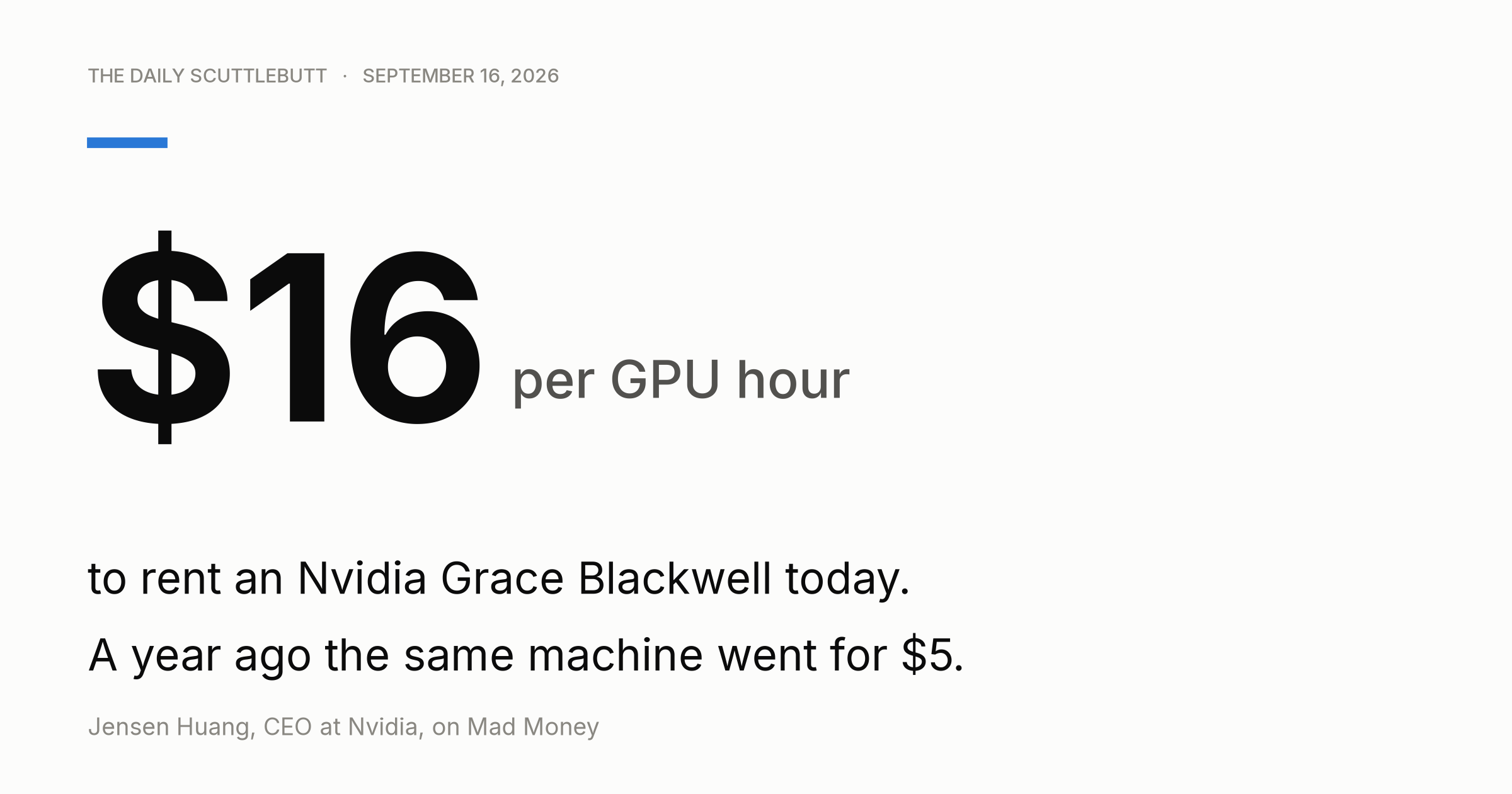
"Each gigawatt of Nvidia AI factories is about $50 to $60 billion. ... However, the rentals of that one gigawatt AI factory is about $50 billion per year. ... So yeah, the return on invested capital is about one year right now. And they get to use that because Nvidia's fungibility and durability is so great, they get to use that for many years, well beyond five and six. ... you can now rent an Nvidia Grace Blackwell for $16 per GPU hour. Now, some of them were rented away at $5 just a year ago." — Jensen Huang, CEO of Nvidia, on Mad Money
Salesforce will build it for nothing and take a share
"But we're even trying a new model, which is we're willing to kind of come in, we'll build the system for nothing and we'll take a percentage of your business outcome ... We have to be more flexible now in our pricing than ever. And so that span of pricing models that I just went through is very important for customers, because in AI, customers want all of us to have a little more skin in the game, and we're willing to do that." — Marc Benioff, co-founder, chairman and CEO of Salesforce, on Mad Money
OpenAI's ad business hit $1B in 7 months
"And so we have about 90% of our consumers get ChatGPT for free. They get access to that intelligence for free. So now we're starting to build an ad model, for example. So our ad business just hit $1 billion in seven months, the fastest growing ad platform ever, the fastest growing product for us. And that's a good example of where we continue to improve the margins, because now we're bringing high margin add ons into that overall business model." — Sarah Friar, CFO of OpenAI, on Mad Money
Open models are the constraint on closed ones
"Yeah, I think the fundamental thing that I think we're observing is good old-fashioned competition, right? ... we had like some real great closed source assets, Windows. What was the check against it? It was of course the Mac, but Linux we had a great closed source product called SQL Server. What was the check against it? There was always a substitute called Postgres or MySQL. ... today the royalty of an AI product all going to just the model layer doesn't make sense if you really want to build a product company right it just cannot be" — Satya Nadella, chairman and CEO of Microsoft, on All-In
The labs should test each other's models
"And gained admin access on OpenAI servers. So who knows what it actually did. ... So basically any sufficiently smart model seems like it will want to escape its constraints. I mean what I think would be wise to do as soon as possible if not immediately would be to have the major AI competitors test each other's models. So that you'd have everyone's security test harness testing everyone else's model. So, instead of kind of grading your own homework, you would at least have competitors grading your homework." — Elon Musk, CEO of SpaceX, on All-In
Land for a data center goes to $180,000 an acre
"But honestly right now and it is a little embarrassing but computer rental is a heck of a business. ... We don't see any drop. We see no drop in demand at all. ... But there is an expense to put data centers on the ground too, right? You have to buy real estate and as soon as someone finds out that a data center or supercomput center is going in, real estate goes from 3,000 an acre to 180,000 an acre. So, it's quite expensive. Time lag is incredible. The permits and the licensing is pretty stifling." — Gwynne Shotwell, president and COO of SpaceX, on All-In
A $40B chip factory turns out a $22 chip
"And what's amazing about this is you take sort of some of the smartest people you've ever met and you put them on a project for two years and you send the results to TSMC and they run it through a factory that cost 40 or 50 billion to make and took years to make and out the other end comes a $22 chip. It blows your mind when you think about it. ... And you go down the street here in the Mission District and you pay $17 for a burrito." — Andrew Feldman, co-founder and CEO of Cerebras Systems, on Uncapped
The frontier labs are worried about open source
"I think they actually are worried about open source. ... If you look at some of these open source models, whether you're using Gwen from Alibaba or Nemotron from Nvidia, or any of the open source models, those token costs go right through the floor. And to some degree, that influences, to a great degree, what the frontier model's pricing model looks long term." — Ted Mortonson, managing director and technology strategist at Baird, on Bloomberg Surveillance
The models already shipped are good enough
"My own perspective on that is that I don't see any near-term slowdown in demand. The models that enterprises have at their disposal today are plenty sophisticated enough for them to deploy very sophisticated overlays to their businesses. I think that the demand outlook is still going to look pretty robust. ... if there is some agreed set of principles about a slowdown in the kind of real leading edge frontier model development, a lot of that investment is going to find its way into other parts of their existing models" — Matthew Bloxham, senior technology, media and telecom analyst at Bloomberg Intelligence, on Bloomberg Intelligence
A megawatt of compute goes from $10M to $25M
"There's a reason that each megawatt is going, from $10 million per megawatt to probably 15 at the moment to probably 20 to 25 next year and perhaps even higher. That's kind of a conservative estimate. Running a model on compute has never been more valuable. And I don't think there's any world in which any lab, let alone Anthropic and OpenAI, are going to want to stop spending on compute" — Charlie O'Neill, co-head of model training at Baseten, on Prof G Markets
In the outcome where nobody is left, nothing has value
"And this is actually a question we've talked about in the newsletter before, which is, if that's the probability distribution, 95 per cent or 98 per cent strong growth and 1 to 5 per cent destruction of the world, what's the kind of net present value? And it's like, in the outcome in which there are none of us left, nothing has any value at all whatsoever. So it's almost like you can ignore that tail probability, right? And you just wanna be fully invested in the 95 per cent good outcome because nobody's gonna be counting if we're all gone." — Rob Armstrong, US financial commentator at the Financial Times, on Unhedged
Regulation raises the barrier for everyone smaller
"That forces licensing capital minimum requirements. It firmly ensconces these businesses for years and it basically makes it part of the fabric of everyday life. It allows it to go into health care into government into everything once it's regulated. And the barrier to entry to all these smaller competitors becomes much more which means these companies can cherry-pick and gobble up other AI companies." — Jason Bodner, who runs the research firm Money Flows, on MarketBeat
Other appearances:
Carter Worth, founder of Worth Charting, on Nvidia becoming the defensive way to own semiconductors — on MRKT Call
The Halftime Report's Investment Committee on CrowdStrike, Fortinet and Palo Alto Networks all doubling this year — on Halftime Report
VC & Startups
Stalled AI startups are looking for buyers
"These are not fully built out platforms that can solve end to end workflows for people and so these people are getting to a certain level of ARR struggling to get retention which then fuels the problem of getting to growth which then causes them to stall at the next raise round of funding and I think it's that we're now starting to see those companies are coming to market and looking for either aqua hire deals or equity deals" — Steve Cox, CEO of Clari + Salesloft, on Inside The Silicon Mind
Life360's founder would not go public again
"If I do another company, I never want to run a public company again. I think it gets in the way of someone like me who is a natural, kind of aggressive, user-led entrepreneur. Being public does drive, in my mind, this very myopic metric oriented to be able to do that. ... With freemium in general, if you get scale, it's an extremely defensible position because you can't disrupt free. So you can't compete on price." — Chris Hulls, co-founder and executive chairman of Life360, on Summation
Industrials and Transport
Data centers take 20% of the grid by 2035
"If you think about electrical infrastructure and how far behind we are, not only for what data center needs, but how far behind the power grid is ... And so if you think about the next ten years, by 2035, data centers are going to be using 20% of what's available from the grid, which is a significant amount of power. ... electrical infrastructure in this country and across the world hasn't changed in the last 2 or 3 decades. ... we just announced a $4.4 billion acquisition of another power company. We're going to fund that through debt and equity." — Revathi Advaithi, CEO of Flex, on Squawk Pod
A $40B value stock is now $1.12T
"I called Tesla a value stock in the middle of 2019. Its market cap was 40 billion, and Elon Musk was talking about this. People thought it was a pie-in-the-sky market cap of 500 billion; right now we're at 1.12 trillion. And yeah, people just perpetually think you're crazy for believing in a company like this." — Steve Symington, managing director of New Columbia Capital and a former lead adviser at 7investing, on The 7investing Podcast
Materials & Energy
Central banks' gold is worth more than their Treasuries
"And in fact, the European Central Bank – and we issued a special report on this about gold surpassing what central banks hold in Treasuries, the value of their Treasuries, of the US Treasuries for the first time ever. At least for the first time in modern finance. And that shows, A, how quickly gold rallied, and B, how much the central banks were buying. Now, they reduced their buying a little bit last year, and they're likely to reduce it again this year." — James Steel, chief precious metals analyst at HSBC, on The Macro Brief
The Saudi pipeline outage is measured in days
"these are Iran-supported attacks from proxy groups that are doing this. But the Saudis are ingenious, and I think you will see the pipeline running again very soon. This will be a brief and temporary interruption. ... It's still a detailed assessment, but I think it will be measured in days. And, of course, they're also taking quick action to have more of that oil, these few days that isn't going through the East-West pipeline, to go out to the Strait of Hormuz with the United States military." — Chris Wright, US Secretary of Energy, on Squawk on the Street
Policy
Data centers bring their own power and pay for it
"And so earlier this year, I put together amongst the strictest guidelines in the country about how we're dealing with this and saying, for all the data centers that you must be able to bring your own energy, bring your own power. The taxpayers were not going to pay a cent for that and also be able to do all your, renovations. You pay for that saying that you cannot pollute our air, you cannot pollute our water. You need to hire local union workers. And you do not get to override local jurisdictions." — Wes Moore, governor of Maryland, on Squawk Pod
No bonus depreciation until data centers meet standards
"We are not putting AI back in the bottle. The genie is out, even if we stopped any further data centers. I do think we need minimum federal standards. And I think the industry would take this — around energy use, water use, setbacks from communities. And I frankly think that the company shouldn't get bonus depreciation until they meet those standards." — Mark Warner, US senator for Virginia, on Squawk on the Street
Geopolitics
The goal in Iran is normal shipping
"It's to get back to regular, normalized shipping so that people have confidence, the shippers, the insurers, everyone have confidence that things can move freely through the Strait of Hormuz and the Red Sea. That's the goal. The nuclear program is a whole other problem. That's a separate negotiation. ... Again, it means acknowledging that the Iranians are going to get something that is likely to be a toll that's not called a toll on the Strait of Hormuz. Maybe it's sanctions relief, some combination of those two things." — Antony Blinken, former US Secretary of State, on Bloomberg Talks
A frontier-only pause is too good a deal for China
"I think one thing that I keep saying and keep pointing out is well if you just pace development specifically and no other domain of geopolitical competition this is an extremely good deal for China and therefore the US is very unlikely to go for it ... if you look at all the domains of strategic competition China is basically eating America's lunch in most of them right they're out producing robotics is going better AI diffusion is going better electricity buildout is going better" — Anton Leicht, fellow at the Carnegie Endowment for International Peace, on The Cognitive Revolution
Nuggets of Wisdom
Most micro caps are rented, not owned
"Shelf life of probably the average hold of a micro cap company even somebody that I think like I know what I'm doing it's around a year and so that's the type of turnover it takes and mainly because these companies are fragile small businesses are fragile when compared to a larger company they have key person risk they have customer concentration product concentration jurisdictional concentration ... I probably owned 100 stocks over the last, I don't know, six, seven years. I've owned one for over five years. It's hard to find ones that are worthy of owning and not just renting." — Ian Cassel, founder of MicroCapClub, on Yet Another Value Podcast
A sneaker company renamed itself and rose 582%
"So very salient information is something that the market will overreact to. Why? Everybody sees it in the news, and they want to incorporate it. So when a few months ago, Allbirds rebranded to New Bird AI, the market went up by 582%, even though there was no evidence that a sneaker company would be great at artificial intelligence. And that is not a unique case. So in the tech bubble, just adding .com to your name added about 74% to your stock price on average." — Alex Edmans, professor of finance at London Business School, on The Intangible Economy
Published strategies keep two thirds of their excess return
"So there was a very influential paper which won the best paper award in the Journal of Finance, which took 97 different investment strategies which had been published in the top academic journals and looked at, well, what happened after publication. And what they found was that the alphas did go down, but they only went down by a third." — Alex Edmans, professor of finance at London Business School, on The Intangible Economy
If this was worth your time, send it to someone who has to follow all of this too.
What did you think of today’s edition? Hit ‘reply’ to this email, send us a message, leave a comment, or join the chat!
Get the latest market chatter as it happens: