

Enterprises are slow to adapt to change and new technologies. They are risk-averse, inefficient, and overcrowded with bureaucracy. In this lesson, we break down the three-part process enterprises take to adopt and deploy new technology,
Find all the lessons in the Economics of AI here and the previous lesson below.
Lesson 3: The Competitive Landscape of Generative AI

Lesson 3 breaks down the commoditization of AI models, the lack of competitive advantages between AI companies, low user engagement, and the strategies companies are using to develop long-term, durable advantages and moats.
Enterprise Adoption: The Slow Path from Automation to Disruption
Enterprises deploy transformative new technologies in a predictable, three-stage pattern: Absorb, Innovate, Disrupt
Historically, enterprises deploy transformative new technologies in a predictable, three-stage pattern: Absorb, Innovate, Disrupt. The initial “Absorb” phase involves automating obvious, existing tasks. The “Innovate” phase sees the creation of entirely new products and services. Finally, the “Disrupt” phase redefines entire markets. Currently, the vast majority of enterprise activity in generative AI is concentrated in the first phase.
The “Absorb” Phase: Automating the Obvious
Enterprises are primarily applying generative AI to absorb it into existing workflows where the return on investment is clear and immediate. The most common use cases are:
Coding: Automating software development and testing.
Marketing: Generating ad copy, images, and campaign ideas.
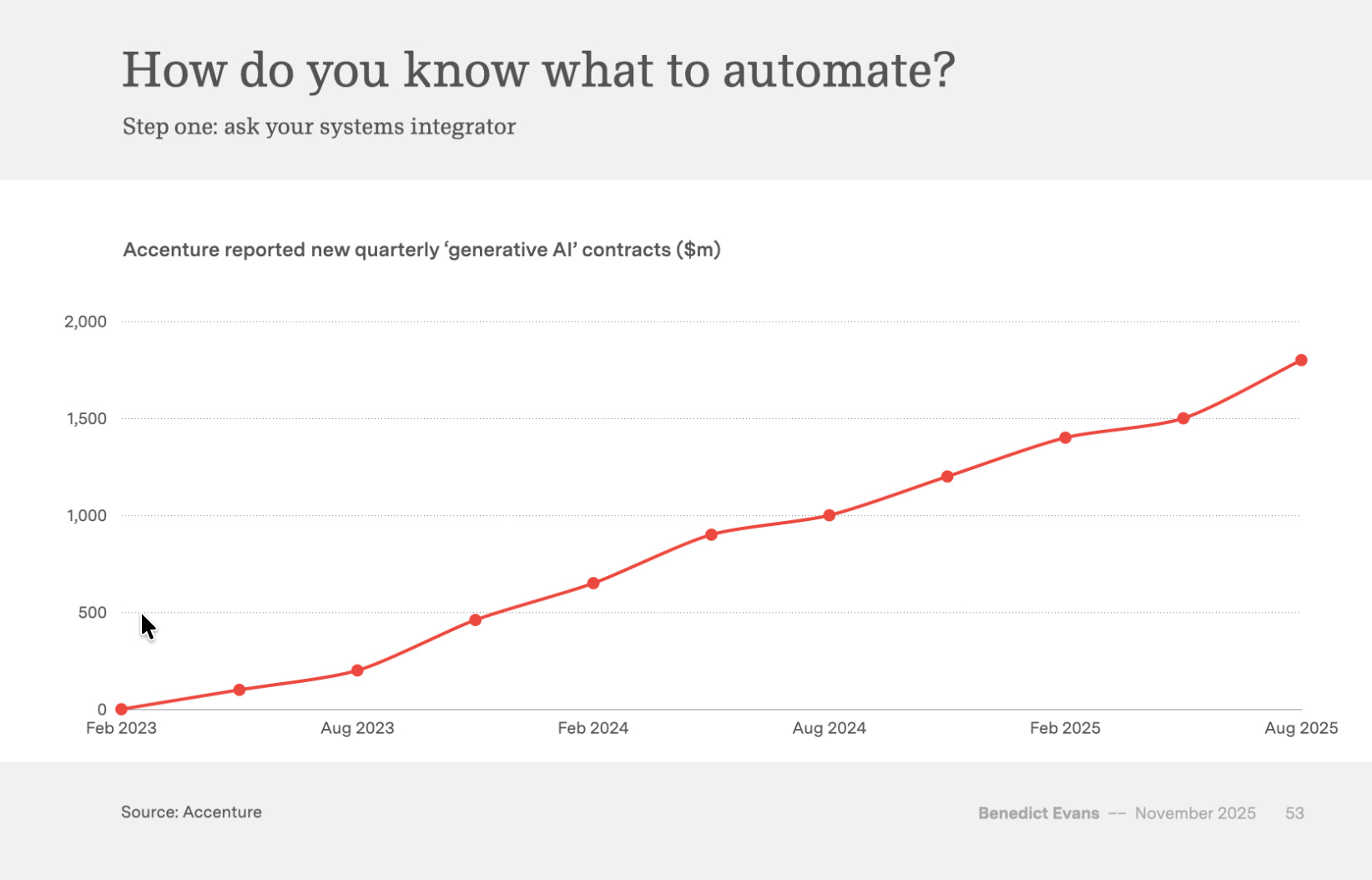
Customer Support: Powering chatbots and summarizing customer interactions. This phase is being heavily driven by consultants, with firms like Accenture reporting over $1.5 billion in new generative AI bookings per quarter as they help large companies identify and implement these initial automation opportunities.
The Reality of Deployment Timelines
Major technology deployments take time.
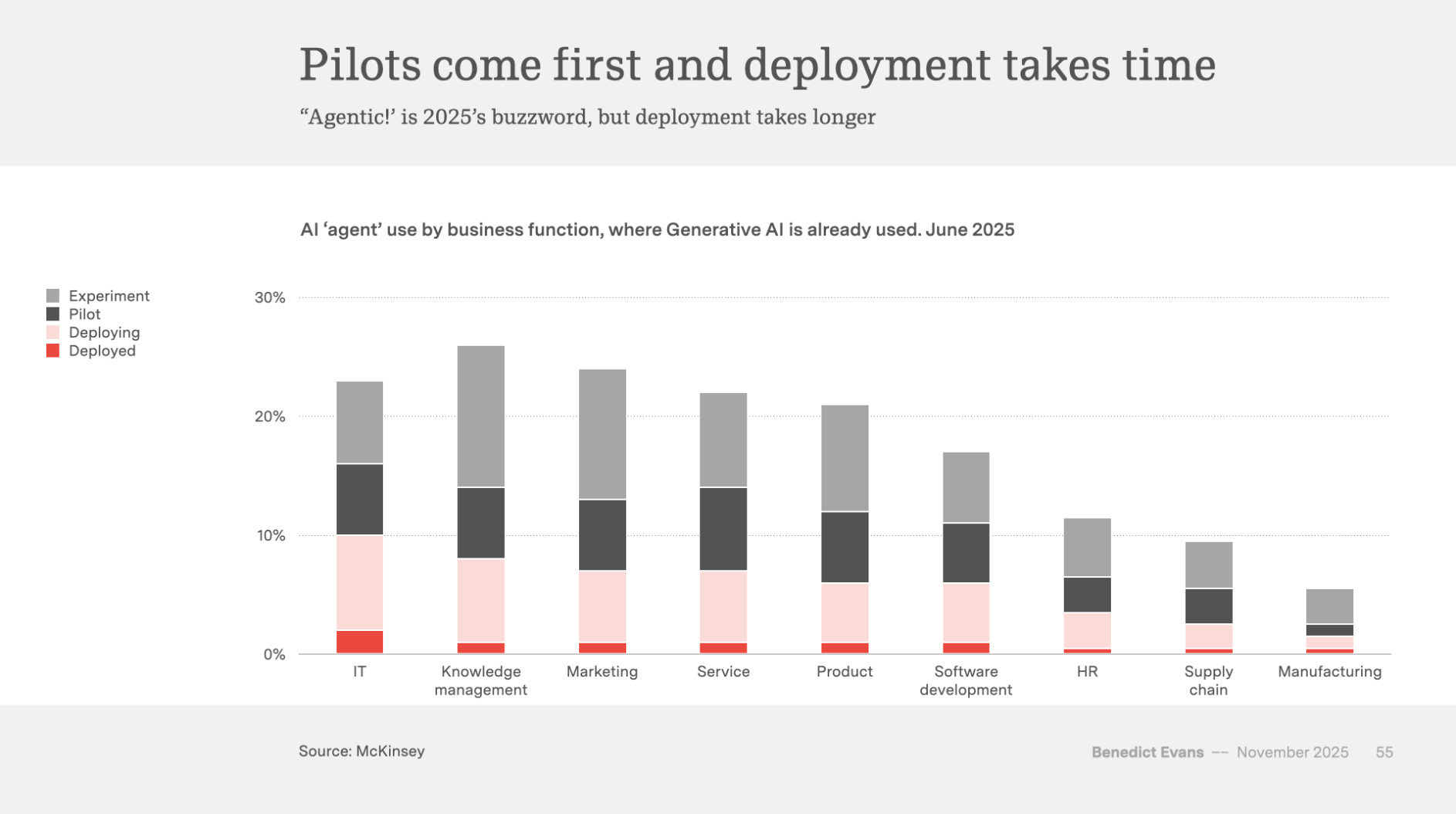
While the hype cycle is moving at lightning speed, the reality of enterprise technology adoption is far slower and more methodical. Several data points provide critical context:
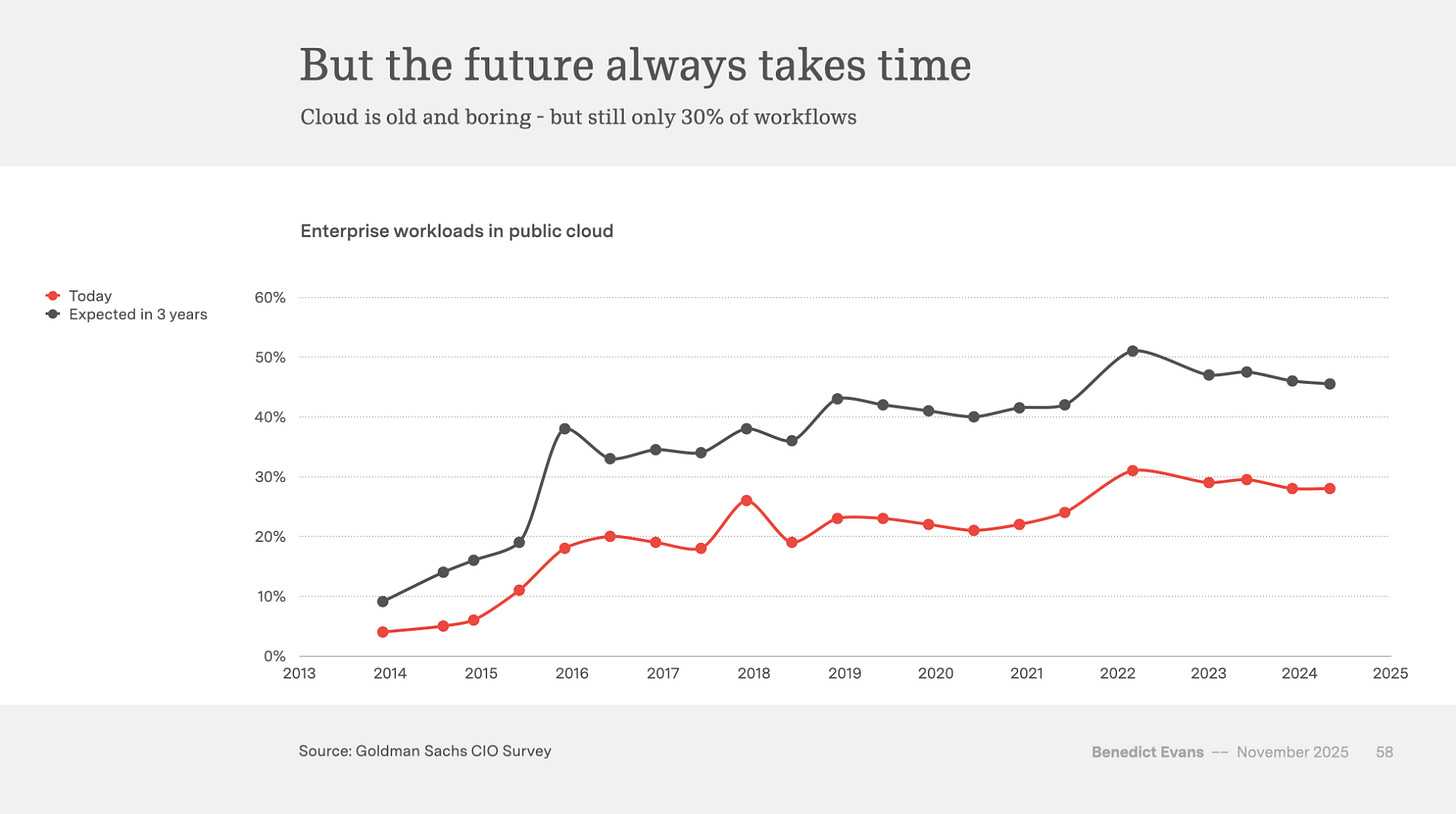
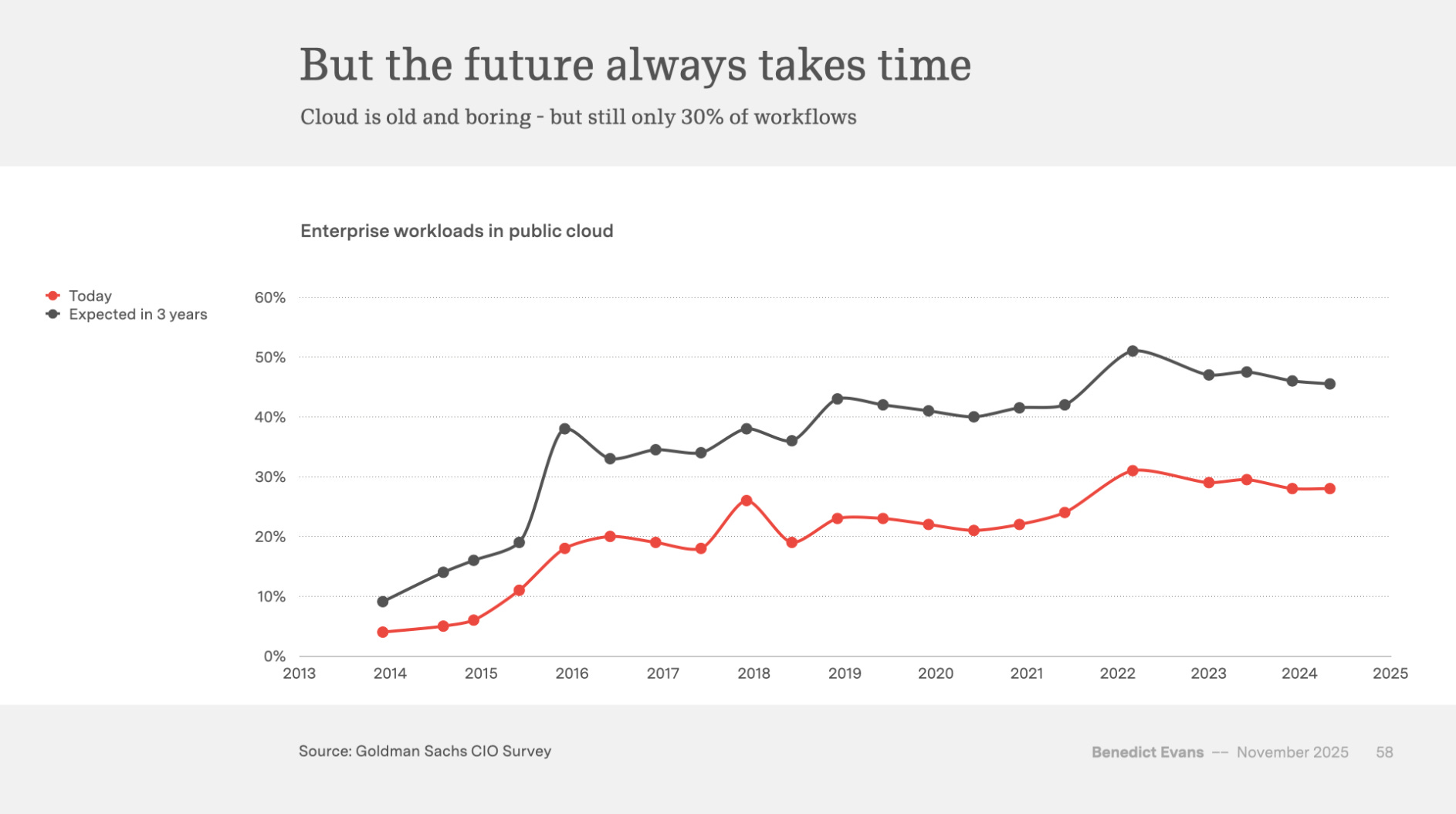
Cloud Precedent: Cloud computing is now considered an “old and boring” technology, yet it still only accounts for approximately one-third of all enterprise workflows. Major technology deployments take time.
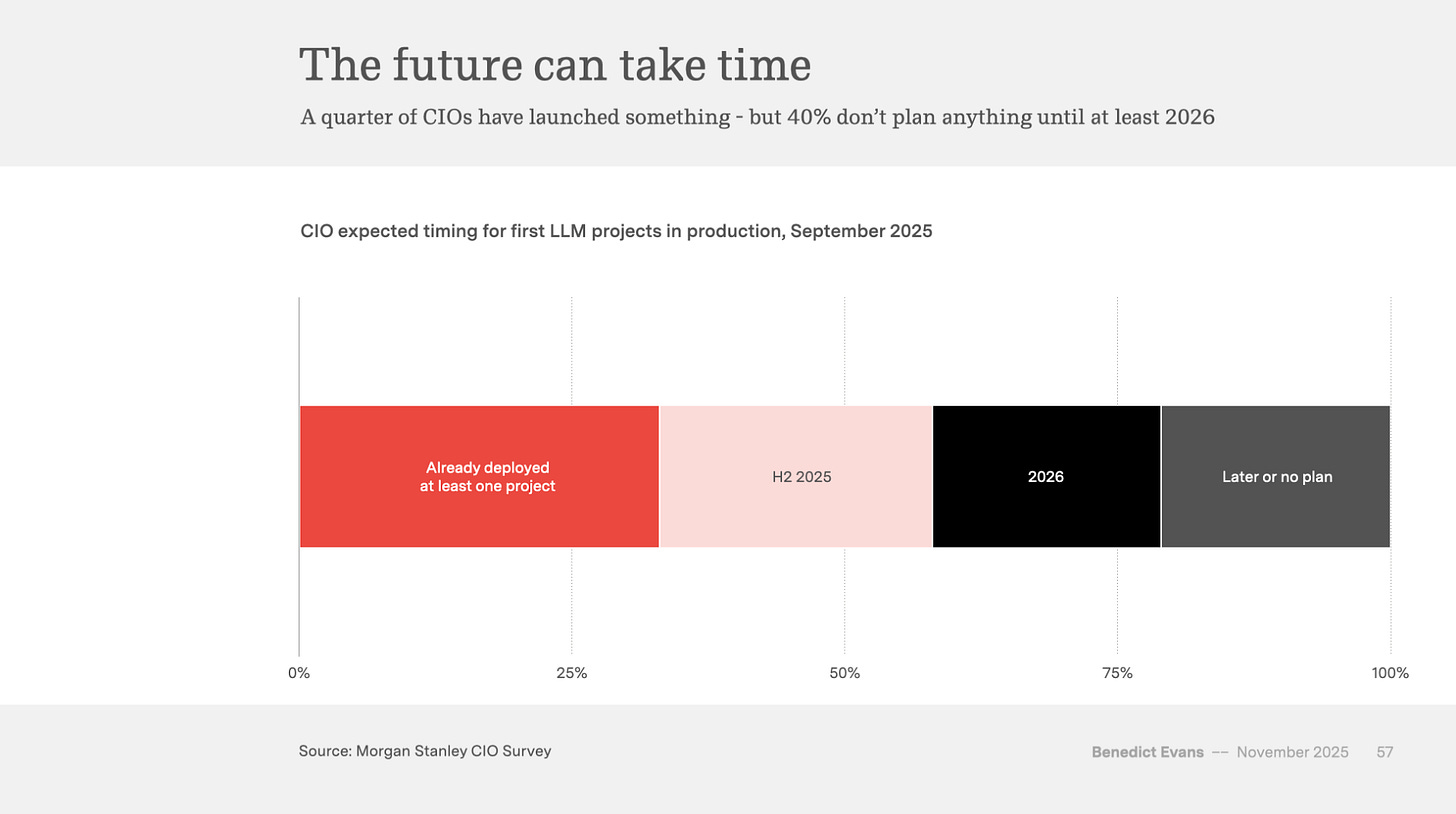
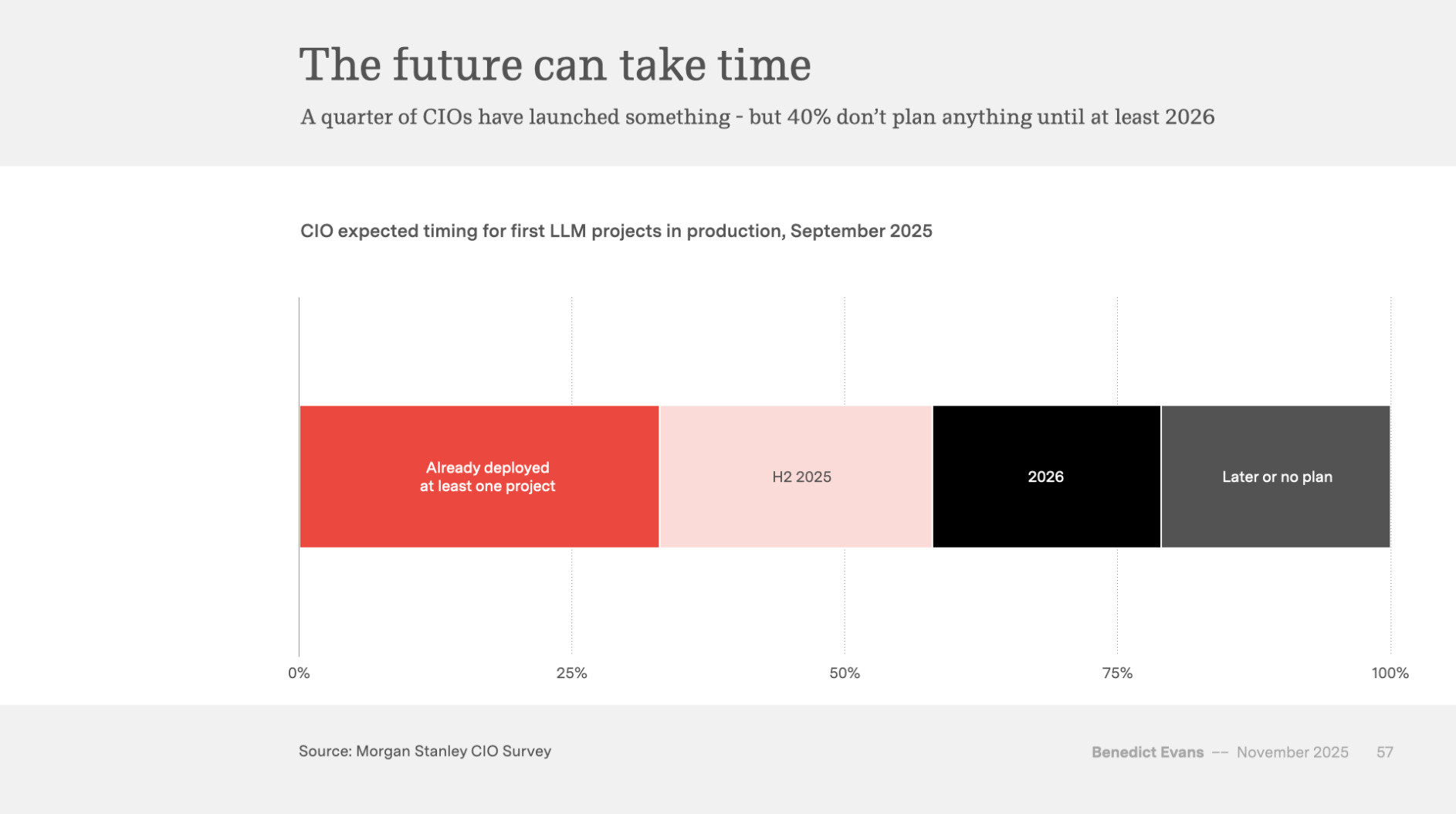
Evans, Benedict. (2025). AI Eats the World [Slide deck]. Current AI Deployment: Recent surveys show that while about a third of large companies have at least one generative AI product in deployment, another quarter state they have no plans to do anything “just yet.”
Evans, Benedict. (2025). AI Eats the World [Slide deck]. 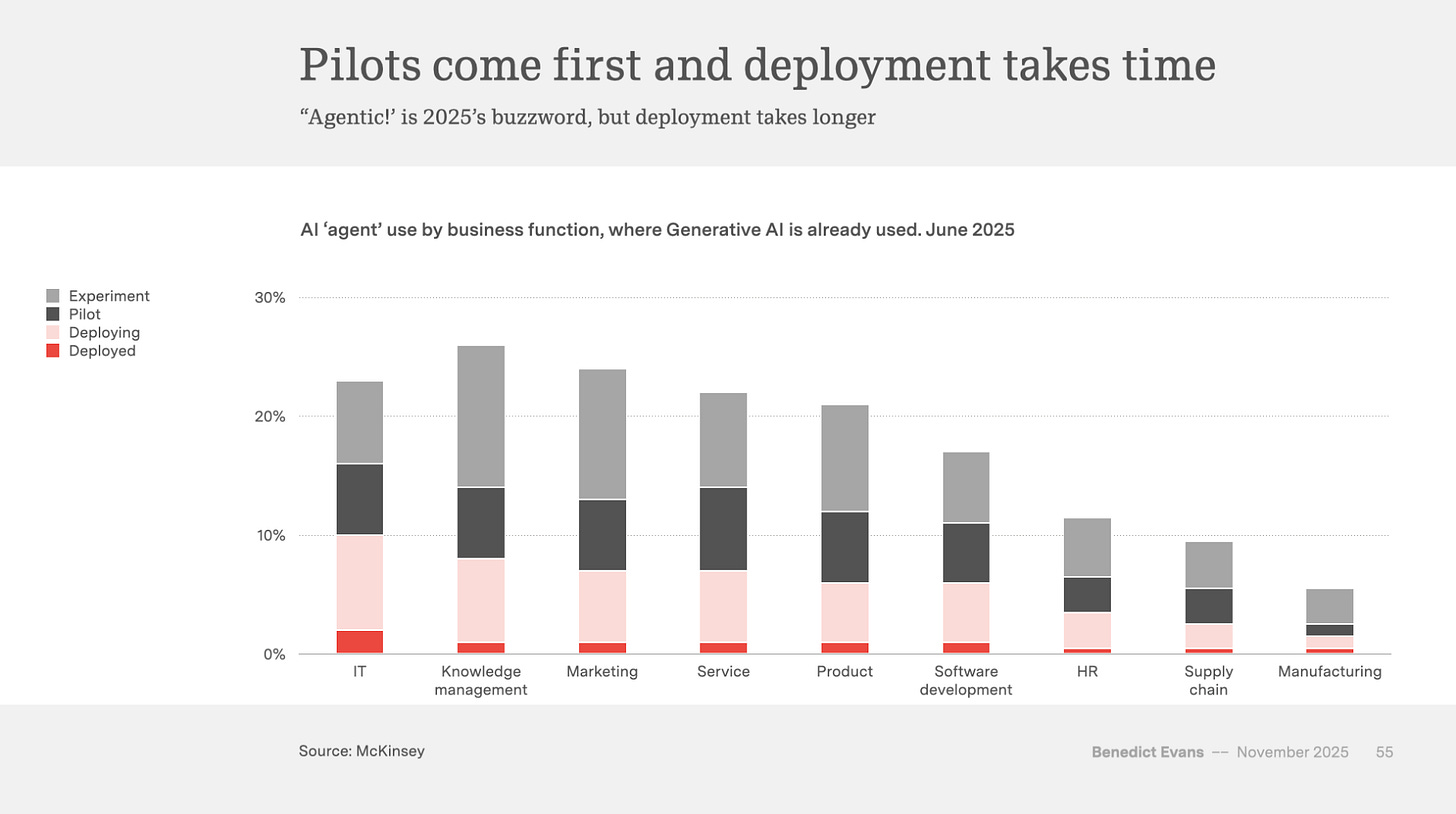
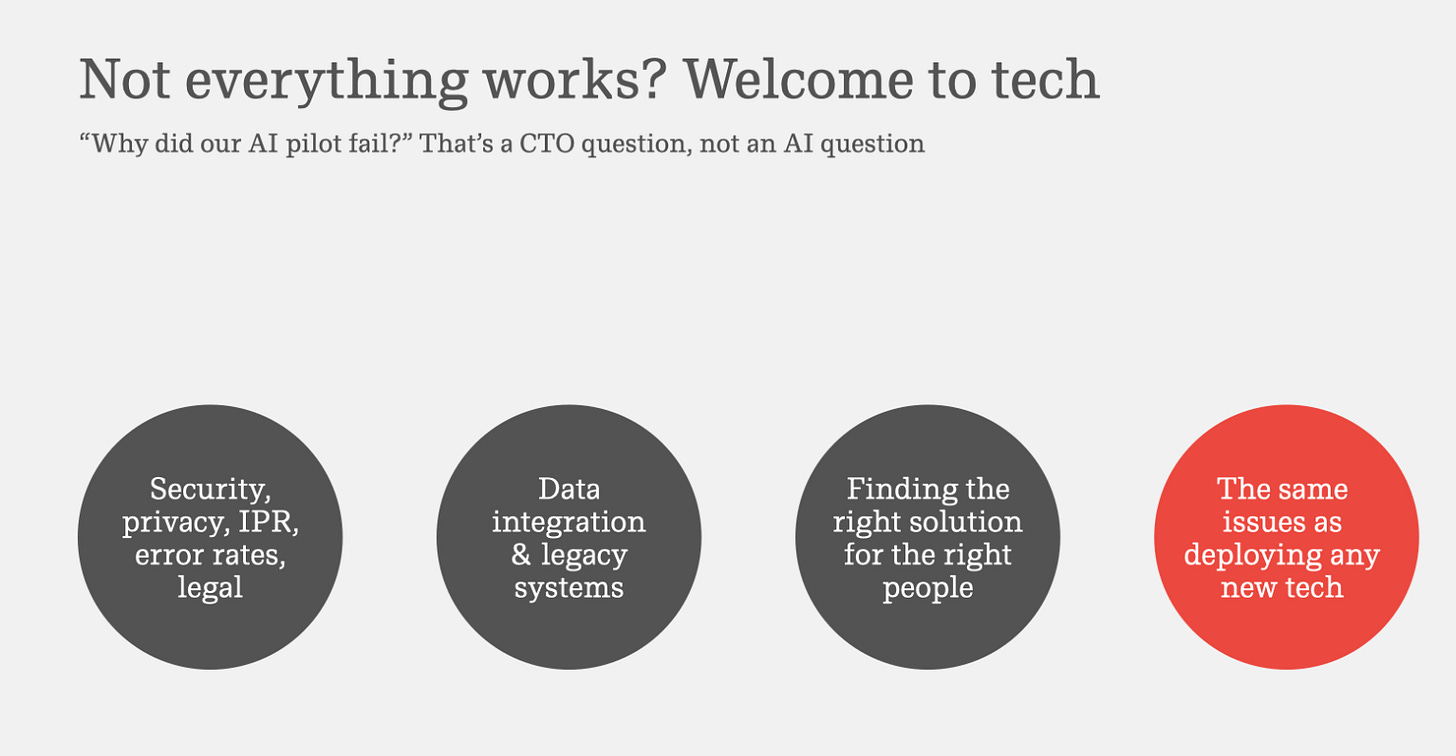
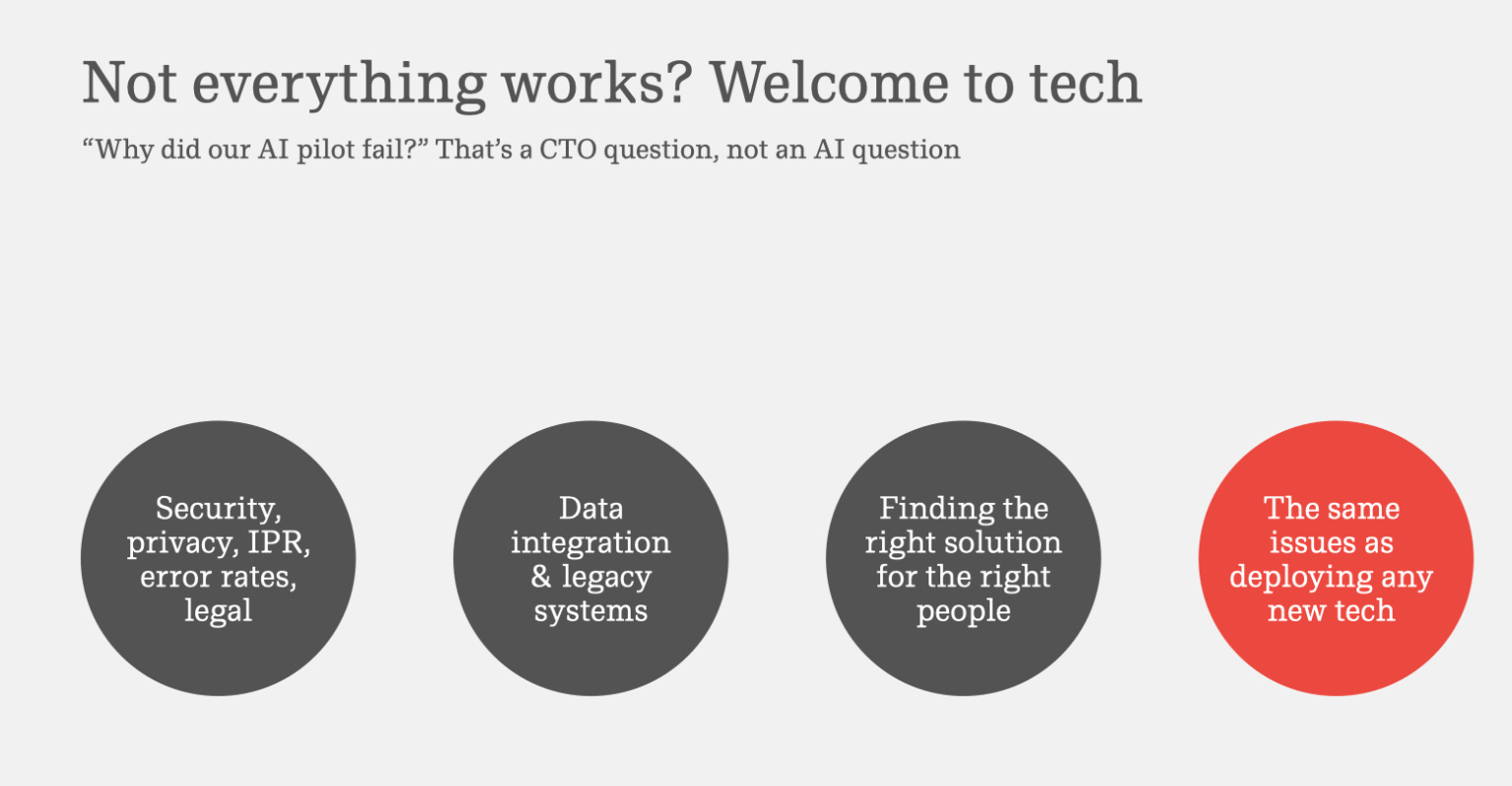
Evans, Benedict. (2025). AI Eats the World [Slide deck]. Pilot Challenges: An MIT report found that “95% of generative AI pilots at companies are failing.” However, these failures are not typically due to the AI technology itself but rather to the classic challenges of any major IT implementation: security concerns, data integration with legacy systems, privacy, and legal issues.
Evans, Benedict. (2025). AI Eats the World [Slide deck].
The Power of “Just Automation”
Simple automation, deployed at scale, can be profoundly disruptive.
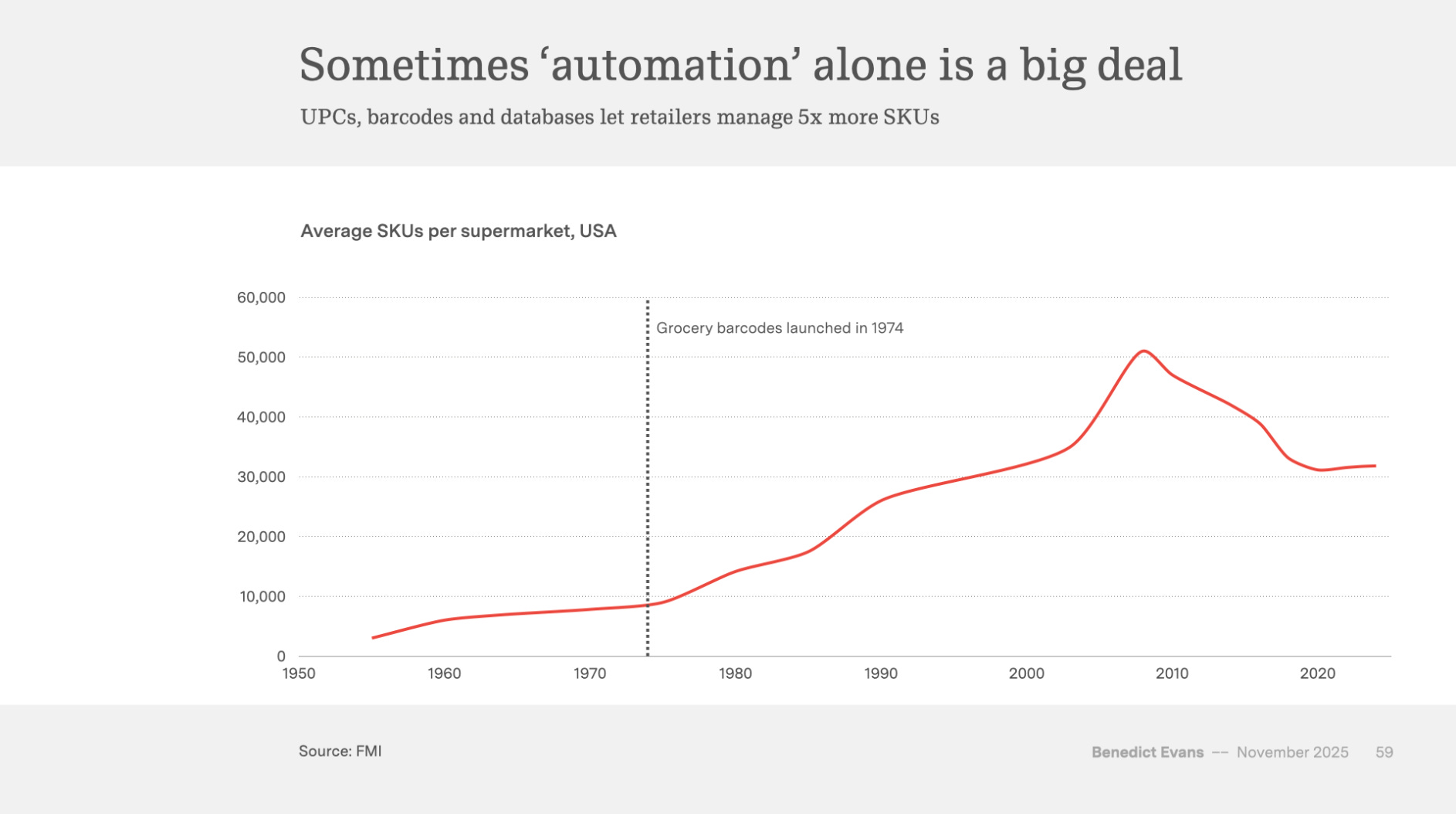
Dismissing the “Absorb” phase as mere incrementalism is a strategic error. Simple automation, deployed at scale, can be profoundly disruptive. The introduction of the barcode in the U.S. grocery industry in 1974 is a powerful historical analogue. This seemingly simple automation technology enabled retailers to manage five to ten times more unique products (SKUs), which in turn fundamentally restructured the entire consumer packaged goods industry. This historical precedent demonstrates that today’s “simple” automation is not the end goal, but rather the foundational layer upon which true market disruption will be built.
Next lesson in The Economics of AI course:
Lesson 5: The Great AI Unbundling, Disruption, and New Economic Models

The new technology shift has given us new tools to rethink value creation and capture, in other words, how we solve problems and how we get paid for solving them. We analyze the strategies of bundling and unbundling that businesses have historically used and that AI companies use today to invent new business models.
Let us know what you think
How do you use AI for work or personal reasons? Is it successful? What about your company?
Did we miss any other ways we should be thinking about AI?
What other businesses and industries do you think will be disrupted? How and why?
Share our community with others
We are building a community of innovators and proactive problem-solvers. Our aim is to establish a business and innovation incubator that supports individuals eager to innovate—helping them get started, connect with like-minded people, form teams, secure funding, and transform their ideas into tangible solutions regardless of industry, problem, or experience.
Disclaimer
We reserve the right to change our minds about anything published in The Golden Age newsletter as new information comes to light.
Nothing produced under The Golden Age brand should be construed as investment advice. The contents of this publication are for educational and entertainment purposes only, and do not purport to be, and are not intended to be, financial, legal, accounting, tax, or investment advice. Investments or strategies that are discussed may not be suitable for you, do not take into account your particular investment objectives, financial situation, or needs, and are not intended to provide investment advice or recommendations appropriate for you. Before making any investment or trade, consider whether it is suitable for you and consider seeking advice from your own financial or investment adviser. This publication’s authors are not licensed investment professionals. Views expressed on The Golden Age are exclusively those of editors and not of any affiliated firm or organization. Do your own research before investing.