

The Scuttlebutt · Friday, August 28, 2026
Quotes are condensed and lightly edited for clarity. Numbers, names and speakers' own qualifications are preserved.
Summary: Nvidia guided to 70% revenue growth for the fiscal year ending January 2028, and the argument moved from whether the demand is there to who borrows to pay for it. Ed Zitron counted 70% of the company's accounts receivable sitting with five customers, 16% of revenue with one, and 44% of the first half's revenue with three. Robert Schiffman of Bloomberg Intelligence said bondholders are not celebrating the print, because the revenue gets paid for with borrowing. Max Gokhman said the marginal capital spending is now funded through debt, much of it in off-balance-sheet vehicles and private credit, and George Mateyo said the switch from cash flow to debt happened about a year ago. The same day, Kevin Warsh's Jackson Hole speech gave a standard rather than a forecast. Tom Orlik said the market read it as raising the chances of a rate rise in September, Claudia Sahm said she left the hold camp this week and now wants the Fed raising, and Beth Hammack, the Cleveland Fed president, said the Fed has one blunt tool and it is interest rates. Meta settled with the state attorneys general for a sum Eric Goldman puts at a quarter of its 2025 net income, and conditioned part of the payment on those attorneys general going after its competitors next.
Macro
The Fed has one blunt tool and it is interest rates
We have one blunt tool. We have interest rates. That is our main policy tool that we have. We have the balance sheet. We have our communications. That's kind of the full suite. But primarily, we use interest rates. And so when I see an economy that, to me, seems like we've got inflation too high for too long ... what monetary policy would tell you to do is to raise interest rates.
The strange period was 2008 to 2020, not today
And so I think you have to normalize. You know, I think when we go back and look at the history, I think what we'll see is that period from 2008 to 2020 was the abnormal part. Not this period we're at today.
The dissent was against front-loading cuts on the hope that inflation passes
The reason I dissented in the last meeting of the year when they cut rates was I'm not comfortable front loading the rate cuts, counting on this inflation to be transitory and go away. I want some evidence that it is going away, that we are headed back to 2%.
Data centers only matter for policy once they leave their own lane
Sectoral AI is going up, and some other industry is competing for electricians and construction and complaining bitterly about that, that's not the same thing as the economy's overheating. It has to get out of its lane of just direct competition and drive up wages, drive up prices outside of just its lane. ... If that starts happening in the aggregate, we're not restrictive enough.
She left the hold camp this week, and it was the headlines that did it
I think we're shifting to a place where it would be most appropriate for them to start raising rates. I have been in the hold camp up until about this week, and it's not just on the data. I think the inflation data are mildly encouraging. We're seeing some improvement. The headlines are not good, right? Trade war with Canada, Middle East progress completely stalled out, and a lot of demand for the AI build-out that's pushing up chip prices. If I look at the outlook a year out, I am not confident we are moving to 2% on a steady clip, I think it's probably time for the Fed to do more.
Inflation is not sticky, it is still pressing forward
And so I think as people are looking at this inflation data, it is not turning in the direction that the committee had hoped. It is continuing not only to be sticky, but to press forward. And that, of course, requires a response. And what everyone's watching for is to say, what exactly is that response? Is it words? Or is it an action with the tool that the Fed has?
The public's faith in the Fed is not evergreen
Well, I think they do have faith in the Fed, but that is not an evergreen situation. It does require the committee to follow through and to take the actions.
The market read the speech as raising the odds of a September rise
Now, in his speech, Warsh reiterated his philosophical opposition to forward guidance. He said he doesn't like it. But he did provide the market with a little bit more clarity about how he's thinking about inflation and what that means for the immediate rates outlook. ... Now, the markets interpreted that, and we've interpreted that as a pretty clear signal that the chances of a rate hike in September have moved up.
In a normal world the market would already be priced for a September rise
So, you know, you're talking about, in their view, an economy that's at full employment. You're talking about an economy where inflation is above target and not coming down, and you have financial conditions that aren't restrictive. In any normalish world, the market would very quickly be priced for a hike on the 16th of September. So, I wouldn't be surprised if we see a continued gradual grind in that direction, given we're still only around 50/50.
The sell-off in yields is global, and it is not the debasement trade
But right now, we're seeing really a global sell-off in yields. So there are global factors at play, not just the Fed. In fact, if anything, really, since Liberation Day now 15, 16 months ago, the dollar has been flat or even in the last several months after hostilities in the Middle East going up. So I'm certainly not in the debasement trade.
The AI spend flipped from cash flow to debt about a year ago
Well, we've been arguing, I think, now for the better part of a year that the switch flipped around this time last year, Steve, when many of these big companies that we talked about funding that AI spend have kind of flipped from using their cash flow, right, the amount of cash that their business generates effectively, to use that to spend as aggressively they have been, and instead they've been more reliant on debt and other — they've actually issued equity too.
Google's free cash flow is gone, so the capital spending has to be borrowed
So you know, Google was making money and then using the money they made to, you know, sort of invest in this capex. You know and what's begun to happen is that the free cash flow is now gone because they're spending so much and that means they have to come to market to get the money. Now not only do they have to come to market to get the money but actually they're coming to market to get the money as the amount of money they claim to spend is going up and up.
Buying back bonds makes the level a floor rather than a ceiling
I think now the same way that the Japanese did with 160, you end up making the market a little bit more of a floor than a ceiling.
Five percent on the 10-year is the warning shot, seven is what hurts
I think five is your warning shot and seven is the one that really hurts. Japan had a big run in the 1980s, some people will recall. If you look at that episode, it was not quite seven. I think it was 6.8% was the peak in Japanese government bond yields where the Nikkei, which had that epic run, kind of finally ended.
The safe half of the portfolio is the half that already broke
But the answer has definitely not been long-term government bonds. 20-plus-year Treasury bond ETF is down 40% since the summer of COVID. Even if you were in the seven to 10-year window, I think you're down more than 10% on a total return basis.
Fiscal space is an asset to be preserved, not an invitation to spend
Well, Chrystia, public finances are not ruined in times of crises. They are ruined if we fail to exit the crisis management efforts. And there is a temptation. If public debt is cheap or has no visible price, you can hardly explain colleagues in cabinet or the public opinion why you should stop further spending. Too often fiscal space is misunderstood as a kind of invitation. But it is not. Fiscal space, in my view, is an asset we have to preserve to deal with crises.
The deficit, not inflation, is why real interest rates are this high
The main reason that real interest rates are so high is secular in nature, and it is the deficit.
Governments should cut deficits now rather than wait for the crisis to do it
But we have to recognize that we live in a world of popular desire for the government to spend more. Why? Because the government has done it over the last couple of crises. Did it after COVID, did it after the energy shock from the war in Ukraine, and food shock, price shock at that time. So people are saying, hey, you did it, continue. Not affordable. My message to everybody is delay no longer. Why? Because debt levels are now above where they were after the Second World War.
When the market pushes rates up, neither the Fed nor the Treasury can answer
Well, I mean, it's the debt level, the level we're at already is difficult. The crisis comes when a shock happens and you're not resilient. The Iran war was a mini shock, really, compared to what could happen. But over the next five years, it could be a cyber war. It could be some kind of artificial intelligence thing, most likely China and Taiwan. But a war kind of shock, that's the scenario that pushes up interest rates. And that makes it hard to, the Fed can't just cut interest rates if the market's pushing them up. The government can't just print money if the market's pushing them up.
Shrinking share supply added about 0.7% a year to US returns, and it is reversing
And there's a paper from a asset manager which basically reckon that between 2015 and 2025, the shrinking supply of shares added roughly 0.7% a year to US returns. So it's been helpful. It's been positive and that's great. Is essentially that process turning around more IPOs more issuance of equity less buybacks less takeovers of equity. And therefore so the supply is increasing.
Gold is down 90% against the S&P 500 from its 1981 high
And when you look at the next chart, gold versus the S&P 500, this is just the pure commodity. It's not equities, right? It's just a pure commodity. From the 1981 high, you're down 90%, nine zero. Right. Relative performance. That is not a bubble. That's not how bubbles get made.
The only thing that has historically made a recession is the Fed
The only thing that we need to be on guard for and the only thing that causes higher unemployment, earnings degradation and creates a recession historically has been the Fed raising rates too high, keeping them there for too long breaking something in the credit system, breaking something in the money market system putting us into recession. That is not happening.
Other appearances: Chief Investment Officer for EMEA of Standard Chartered on Standard Chartered Money Insights, Senior Vice President and Portfolio Manager of Chase Investment Counsel on Money Life with Chuck Jaffe, Director of research ratings of Weiss Ratings on MarketBeat, Investment Director of Fidelity International on FidelityConnects
International
Forward guidance goes wrong when it stops being conditional
There is always uncertainty and therefore our decisions are always conditional. I think the problem with forward guidance, and I think Chair Warsh put his finger on this, is that it tends towards making unconditional statements about policy. And I think that's the problem, and I think that's the danger, and I agree with him.
A September rise from the European Central Bank is close to settled
So, on the ECB, the growth numbers are surprising them on the upside. Very, very clear. I think on the inflation side, the data are coming in a bit closer to their expectations, which is above target. And therefore, I think combination of stronger growth, which reduces the risk of hiking, because you're less worried about it choking off the economy with above target inflation. I mean, it just makes a September hike an absolute no-brainer. I think that's almost a done deal.
Asia lends to the world now, so higher rates pay it rather than squeeze it
Today, most Asian economies are actually lending money to the rest of the world. They have excess savings to lend to the rest of the world. And that makes you put in much different position because if you borrow money and interest rates go up, you get an economic problem. If you're lending money and interest rates go up, you're actually making money.
Zambia's 10-year yields fell more than 100 basis points while the currency slid
On the one hand, Zambia held a local currency bond auction last week, which was well oversubscribed. And the yields on that debt, more specifically on the 10-year benchmark bonds, fell by over 100 basis points. So, investors do seem to have roundly welcomed the re-election of President Hichilema. He's seen as very market-friendly, very pro-business, and generally well-liked by investors. But then, on the other hand, we've seen a gradual depreciation of the Zambian kwacha, which, until now, is still Africa's best performing currency this year. But yet in recent days, it's depreciated every day for the past five days and weakened to a level last seen in April.
Two chipmakers are more than half of Korea's benchmark index
The country's benchmark index has swung so wildly that investors have given it a new nickname, Rollerkospi. It was the world's top-performing stock market last year with a 76% gain. By mid-2026, its homegrown chip giants, Samsung Electronics and SK Hynix, accounted for more than 50% of the Kospi's value.
Chinese carmakers launched about four new or refreshed models a day
So because there's so much competition, the automakers are in a race to release new products. About 650 new or refreshed models were introduced in the first half, and that is nearly four per day. This intensive competitive pressure has met with an even weaker demand leading to lower profits for all the auto manufacturers.
The glass supplier took global share while its customers lost money
So Fuyao Glass spent four decades making car windows and today is, as I said, the world's largest manufacturer. The global share has risen from 20% in 2015 to 35% today. So their market share in China, which is the world's largest auto production market, is about 70%. So it's highly dominant.
A cable maker squeezed by the boom it supplies
They're being financially squeezed by the very megatrend they are trying to supply.
A record jewellery year turned into $50.5 million of unpaid invoices
The second and much larger culprit draining their operational cash flow is their trade and other receivables. This category increased by a massive $50.5 million.
Training a useful humanoid may take 11,000 years of real-world data
It's thought that we might need to collect something like 100 million hours of data from the real world in order to train robots. That's more than 11,000 years of data. So suffice it to say that we are really far away from collecting enough data to make humanoid robots smart.
Financials
A fee schedule can be copied overnight; a liquidity pool cannot
A fee schedule can be copied overnight, but a liquidity pool can't. And what an exchange sells isn't really execution, which is almost incidental. It's the assurance that the other side of the trade will be there at a fair price today and in five years when you want out. Every contract that stays put deepens that assurance.
Inflation sends budgeters to Affirm and growth sends spenders
And in times of inflation, we see more demand because folks are budgeting. They're more thoughtful about how they want to use their money and we're there to help. And in times of faster growth in the economy, more, you know, feelings of abundance, people come to us for more discretionary purchases. So we see demand— we've grown for 30-plus% for the last 11 straight quarters and show no signs of slowing down. I think we'll be here for all economies
The index pays about 4% above a fair price for every stock it adds
You know, the simplest of all ideas is if you're trying to buy a stock at the same time everybody else is, that's probably not a good trade. You know, the intuition would tell you that. And I think our most recent studies shows that the run-up was about 4%. When it goes into the index, the index pays about 4% more than a fair price.
The top of the index used to be diversified and now it is one bet
Now the top 10 companies account for 25% of the value of the fund. In the past, when you had top 10 companies accounting for a big proportion, then you had like one bank, one mining company, one retailer and so on. Now they're all tied into AI, which changes the risk profile.
Other appearances: Chief Executive Officer of Affirm on Bloomberg Talks
Crypto and Digital Assets
Quantum computing makes Bitcoin worth less even if nobody uses it
But if you were the owner of a quantum computer or if you had access to a quantum computer, Bitcoin, this is a small fish. You have got much, much bigger fish to fry. But you might not go after people's Bitcoin wallets because you couldn't be bothered. But you could. But you could. And the very fact that you could surely makes Bitcoin of less value than previously.
Alternative Investments & Private Equity
Private equity paid 20 times EBITDA while small caps traded at 12
So purchase prices in private equity reached almost probably 20 times EBITDA when public markets were trading at probably 15 and small caps at 12 and now multiples have kind of come in from there. And as long as money was flowing into private equity you know you could sell to the next fool. But when money stopped flowing in, you had to sell it to somebody real. And turns out nobody else wanted to pay those crazy prices.
The listed fund interests are as volatile as small caps
And they turns out their volatility is like 24, 25% annualized, which is like just a little bit more than small cap.
Credit spreads are at all-time tights and the ocean cannot be held back forever
Credit spreads are an all time tight. We've seen enormous issuance. We've seen enormous issuance around new technologies. Sorts of things tend to lead to excesses, which tend to lead to accidents, blowups. And so we haven't seen a true credit cycle for a good long while now. And we can't hold back the ocean forever.
No two outsourced-CIO performance composites are comparable
Looking across providers becomes a challenge in that case, because no two composites are ever going to be the same. They might be at the broad level 60/40, but like you said, right, it's policies, it's preferences, it's how much governance control they have, all of that.
A 70/30 multi-alternative fund holds about a quarter in bonds
Across all of the instruments. A portion of that would be the 30% that's bonds. So, if you just extend that to say that the bond fund would probably be somewhere around 90% net on a footprint of 30. So, we can infer maybe like a 25 to 27% net exposure to fixed income.
Opportunity zones become permanent in 2027
...the exciting thing is rules have now been updated such that this will now be a perpetual program starting in 2027.
The tax break requires building, not buying
You can't just buy an existing real estate, commercial property, office building, apartment, and just say, "Okay, I'm going to get all the benefits." You actually have to improve it. You have to basically double the cost basis.
Consumer
A melanoma readout that could be the biggest cancer advance in 25 years
It could be one of the biggest advancements in cancer that we've seen in the last 25 years. If Moderna continues down this path that they're going down, this could really just kind of totally change how we treat cancer.
The oncology program started because a hedge fund manager mailed a check
And Bancel, the CEO, says, "Sorry, no, it's going to be way too expensive. Even just to hire a couple of researchers, it's going to cost $500,000, half a million dollars."
Sports
Nothing on 28 August.
Technology & AI
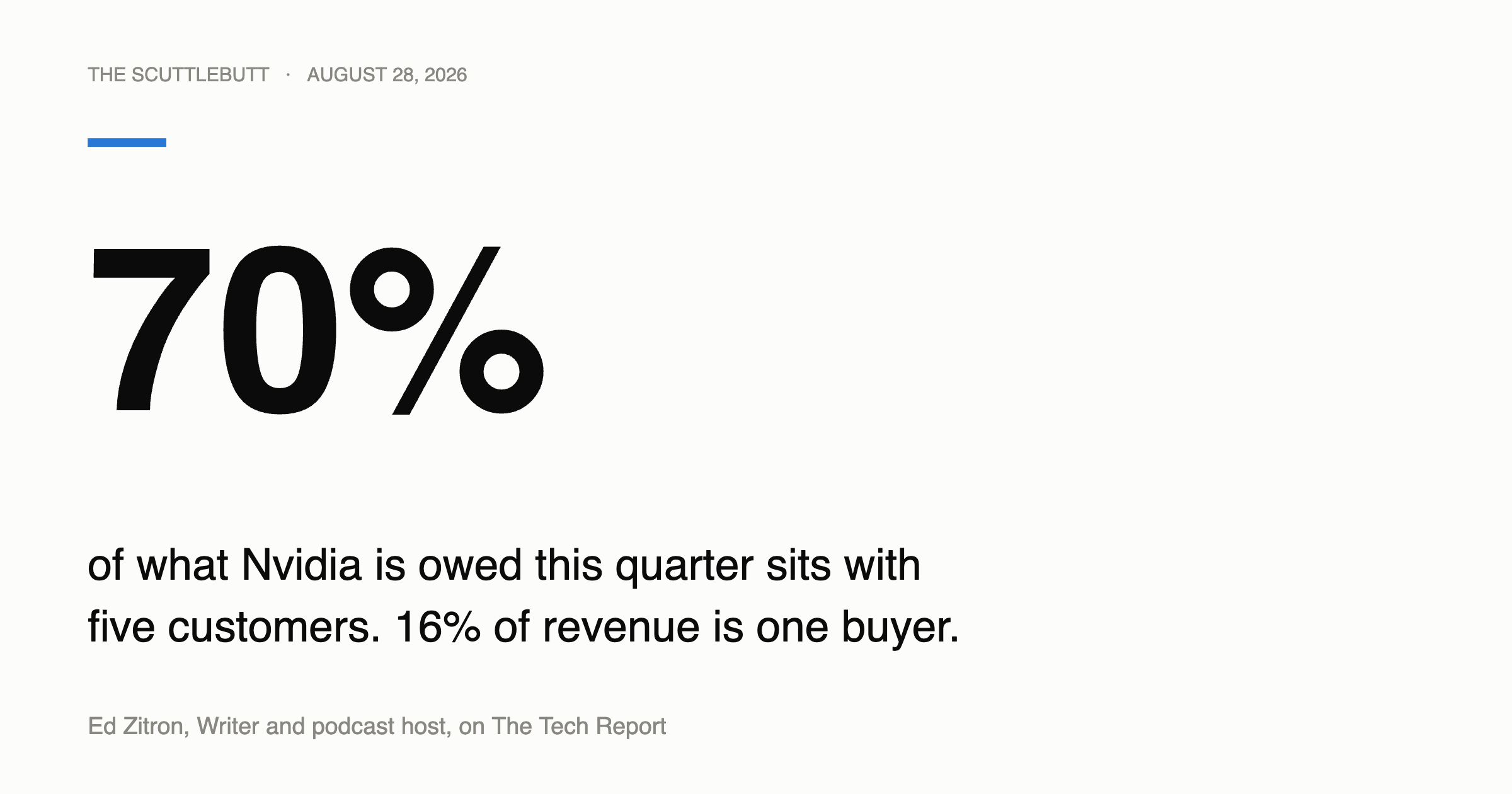
Five customers account for 70% of what Nvidia is owed
I want to be really clear, Nvidia is not doing anything weird really. So 70% of their accounts receivable this quarter was from five customers. 16% of their entire revenue was from one customer. And for the last 6 months, 44% of their revenue is from three customers. So the money is real. But in a regular business, you want diversified income.
A record quarter with 16% of it from a single unnamed buyer
The Groundhog once again saw its shadow with Nvidia reporting record earnings, continuing to inflate an ever more dangerous AI bubble with $96 billion worth of revenue and 16% of that coming from a single unnamed customer. For the first half of the fiscal year 2027, 44% of Nvidia's $177.8 billion in revenue came from a mere three customers.
Analysts have $440 billion of cloud revenue coming from two loss-making startups
But then what happened is the hyperscalers have now become financially dependent on the growth of OpenAI and Anthropic. Analyst expectations from UBS, Barclays, and Wells Fargo have $440 billion of cloud revenue across Google, Amazon, and Microsoft coming just from OpenAI and Anthropic, two unprofitable startups who need to constantly raise money.
Bondholders are not celebrating, because someone has to borrow to pay the bill
Well, listen, first from the equity perspective, if you're a bull, are you not entertained? This may be the best print in the history of the stock market and the best forward guide in history. So that's great. Why are bondholders not loving it? Because it means there's going to be a lot more debt being issued. How is everyone going to pay for all of Nvidia's revenues? They're going to do it through borrowing.
The marginal capital spending is funded off balance sheet and in private credit
What we've seen is we've kind of run past the free cash flow that the hyperscalers have had. And now most of this capex, or I should say most of the marginal extra capex is getting funded through debt. A lot of it in off-balance sheet vehicles and private credit.
The whole AI food chain rests on two companies that lose billions
So in a sense, the way I think about this is the entire AI ecosystem food chain is dependent upon the future health and success of Anthropic and OpenAI. And by the way, that also means that the US economy hinges upon the health and future success of Anthropic and OpenAI. I think it's a little nerve-wracking that the entire US economy is dependent upon two companies that lose billions and I would say between the two OpenAI is the weak sister.
Nvidia's ecosystem checks lock the supply chain away from its rivals
I think by locking in supply chain he's locking his competitors out. Yeah. So he is using his investing dollar in my opinion, doing two things. One, diversifying his customer base so that he's less dependent on it. And then the second thing he's doing, he's locking in his supply chain so that his competitors cannot build product to compete with him.
Tokens are deflating faster than any commodity in modern economic history
Tokens are the first hyper deflationary commodity in the history of modern economies. Because they're under immense price pressure, both because of the technology curve they're riding and because of the massive amounts of capital flowing in, we should expect a series of waves. The way I think about it is that as tokens brush up against other parts of the economy, they do huge damage to it because it's like being brushed up against by some magic deflationary force.
One GPU warehouse is running at 35 to 40% utilization
The GPU usage is only sitting at around 35, 40%, which should be sort of eye popping in terms of utilization rates because you ask yourself, wait a minute. I was told a story about scarcities and rising prices.
Blocking data centers costs the industry about ten hours of progress
The efficiency gains, both from software and from hardware, are about an order of magnitude more than the capacity gains from literally new physical buildings.
Researching your own product's harms is what creates the liability
...were stuck in a very complicated trap where their own research into what the harms actually were and how to combat them was being used against them to show that they knew there were harms and they weren't doing enough. And so, Zuck's response to this was we should stop doing this research. Every platform's response to this is we should stop doing this research. Yeah. Because if you create the knowledge that something bad is happening, then you have created the liability that you didn't do enough to stop it.
Software is dead, then it isn't, and the sector is flat on the year
So it's fascinating. I mean, again, in terms of thinking back through this year and this story, it is kind of a perfect round trip of software is dead, Claude code hype back in like February, March, April, vibe code your CRM and now back to, no one knows what's going to happen. And we're back to flat for the year.
Nvidia's quarterly revenue beats the annual revenue of most of the S&P 500
To start with the Nvidia quarterly revenue, I want to give you a sense of how outrageous this company is. Nvidia's quarterly revenue now exceeds the annual revenue of roughly 480 of the S&P 500. That is a crazy statistic, how big it is. Nvidia is printing about just over a billion dollars in cash every single day that it operates.
A small scientist model is handing its code to a much larger one
And right now, Faraday, the model we talk about in the paper is, as you say, a 27B model driving a much larger model, and Faraday is doing the scientific work and handing off the implementation work to GPT-5.5 Codex. But in the future, this ratio could be very different. We don't know. We'll have to see.
The base Mac Mini now costs $900
They update it to M6. Now the base Mac Mini costs $900.
VC & Startups
Nvidia bought the place open-source developers already work
This is the biggest story of the year. Nvidia taking over all of open source. They've agreed to acquire Hugging Face for 12.9 billion. US open source equals Nvidia. Chinese open source equals Kimi. Now we have our US champion.
An unmetered rack on the customer's own floor is what the frontier labs cannot price against
Unmetered is the word we're going to be talking about in 2027. It's not going to be token maxing. It's going to be unmetered. Two ways to be unmetered. You're going to buy a rack from Jensen and that means massive headwinds for Anthropic and their coding products and the coding products are toast. The frontier model coding products are going to have a really hard time competing with an unmetered option. This is going to be in the S1 for Anthropic and for OpenAI as their number one risk factor.
Every GPU coming off the line is already sold
Remember in the internet days when we were doing massive build-out, the majority that was actually being put in the ground was speculative and was dark. Remember the dark fiber in here. Basically, every GPU that's being created is already pre-sold.
Above a certain rack density, alternating current stops working
Well, first of all, when you get to that level of power per rack, AC power doesn't work anymore. So like that's a pretty wild thing. So now you're into DC power, which, by the way, also requires its own cooling.
Industrials and Transport
Automating the light bulb is how Corning kept General Electric out
And so almost overnight, this innovation of automating the light bulb manufacturing changed the dynamics completely, and so it became possible to make hundreds of thousands of bulbs in a day in a factory, whereas before, by hand, they might make 100 bulbs in one hour with one skilled glassblower. And so that was a way for Corning to keep that business in-house. And because of that industrial innovation, General Electric and the other companies that might have taken their business away from Corning were simply not able to compete economically.
Lawrence Hamtil, Co-founder and principal at Fortune Financial Advisors, on Preferred Shares Podcast
Materials & Energy
The call is a commodity supercycle, and robotics is what starts it
And so what I think is going to happen is we're going to see an absolutely roaring commodity super cycle. I'm making that call now.
China, not the White House, sets the oil price into the midterms
Like Trump is actually in a position now where China controls the oil price. One hundred percent.
Policy
Meta paid the state attorneys general to go after its competitors
The second thing is that Meta conditioned a large chunk of the payments on the state AGs going out and getting the competitors under the same program. In other words, essentially, Meta has now deputized the state AGs as its police against its competitors, and is paying them to do its dirty work.
The largest child-safety settlement ever is a quarter of one year's profit
The settlement amount is a huge, absolute number. There's no doubt that this is a major financial landmark. At the same time, this number is not a number that materially changes Meta's business. I don't want to say it's pocket change for them, but it's a quarter of their 2025 net income. They can afford this.
The charge against the Air Force major is old and almost never brought
So it's an old charge, but it's a charge that has been used in a very selective manner over the years since that time. And what I mean by a selective manner is that we have seen generals and admirals, sometimes in their retired states, but they're still subject to the UCMJ making disparaging words against the president. ... But there have been hundreds of others who've done it and haven't been charged.
Data centers are the issue the far right and the progressive left agree on
And I think it's incredible because speaking of crossover again, which obviously is like the dominant theme here, this is something that people on the far right and the very progressive left seem to agree on, which is this hesitancy at best and a full-out opposition at worst for these companies against these data centers being built in their communities with no say-so, no transparency they feel on their behalf of what's happening.
Geopolitics
The trade fight with Canada is ego rather than industrial policy
It feels like a bar fight. I mean, you know, I don't know, are they drunk? Like, there's a huge amount of ego going on here that Mark Carney and Little Canada, Canada's, you know, less than a tenth the size of our economy.
Canada is willing to take more pain over this than the United States is
There are all kinds of things where we can pressure them, and they value their independence. And I think the Canadian calculation is they are willing to take a lot more pain over this than we are.
Other
Other appearances: Coach and therapist on The Art of Quality, Iconographer and designer on Y Combinator, Wealth advisor and author on Founder's Story
Nuggets of Wisdom
Discipline has to beat conviction, and the trigger is a 20% gain
Discipline must always trump conviction. That means that we like to start trimming at 20% up, we'll trim between 5 and 10%, another 20%, same thing. If we really want to be able to be in shape to be able to buy some back, we must do that.
Over two decades the steady investor beat the one waiting for a cheap entry
Another long-term study compares two approaches. The first investor steadily invests his money in the market over time. The second investor has some cash on the sidelines waiting for the market to appear cheap. Now, you might expect the patient investor who's waiting for markets to be cheap to have achieved better results. But over more than two decades, the steady investor actually came out ahead.
Getting 53% of calls right is doing extremely well
Hubris and arrogance leads to death of asset management companies. It's one of the most important things. And it is a very humiliating industry to work in because you are wrong so often. You know, if you get 53% right, you are doing extremely well.
What did you think of today’s edition? Hit ‘reply’ to this email, send us a message, leave a comment, or join the chat!
Get the latest market chatter and takes as they happen:
X | Threads | Instagram | YouTube | TikTok | Facebook