

The Daily Scuttlebutt · Tuesday, September 1, 2026
Quotes are condensed and lightly edited for clarity. Numbers, names and speakers' own qualifications are preserved.
Between July 2024 and July 2026 the American labor force participation rate fell 1.34 percentage points, which works out to 3.7 million workers who are not there.
That was one line from one interview. Thirty-nine other people said something worth your time yesterday: a Fed president who hears auto borrowers running 60 days late so they do not lose the car, a bond manager who thinks sovereign borrowers are now competing with hyperscalers for the same capital, and Nvidia's chief executive putting a figure on what a gigawatt of AI capacity pays his company.
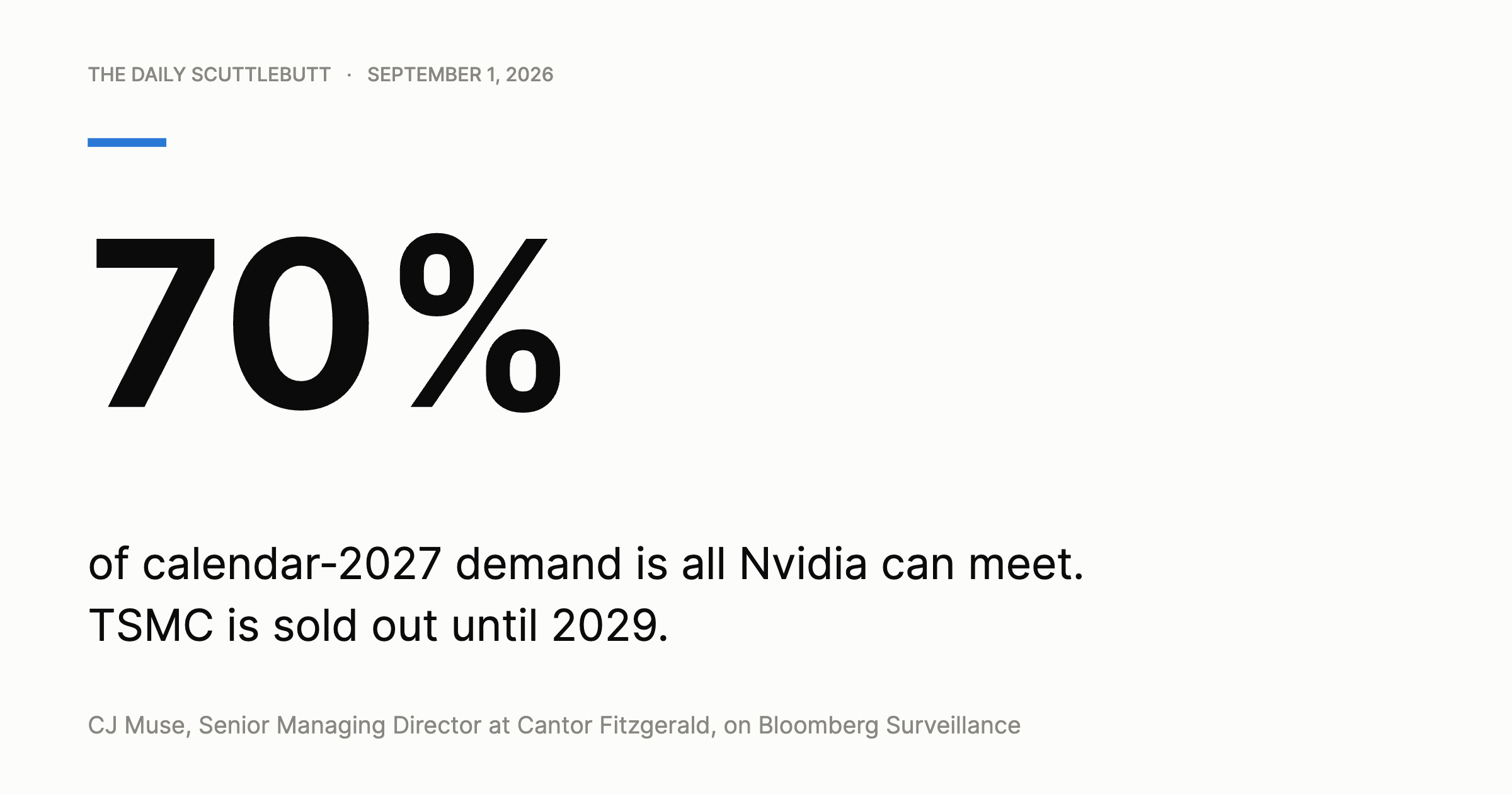
"We heard from Nvidia last week that they can only meet 70% of the demand that they have for calendar 27."
I listened to all 40 so you can skip them. 17 hours of audio, 25 minutes of reading.
Here is what mattered.
Macro
Households are keeping spending up by deferring bills and borrowing against the future
And I've talked to auto lenders who talk about people being 60 days delinquent, not 120 days delinquent, because they need to find the money, but they don't want to lose their car. I've talked to gas providers who say people aren't paying the gas bill during the summer because no one's going to have a problem with gas in the summer. It's the winter that matters. So people are finding ways to effectively borrow from the future, savings rates down. And I think that's what's keeping the spending going.
Tariff costs pass through in business-to-business sales but stall at the consumer
So the B2B companies I talk to, to a person, they're convinced they're passing it through. ... But those people who sell into the major big box retailers, they tell me they're having a devil of a time trying to pass it through. And the mindset of those retailers is I need to find some price to give to my customers. So, I think the consumer pushback is very real. It's most real B2C. It's most real low to moderate income, B2C.
Treasury says the American bond market is this month's best performer
Everyone’s talking about the U.S. bond market. U.S. bond market this month will have been the best performing bond market. The 30-year, the yield is down. The 10-year, the yield is flat. No other major bond market can say that. We are, the 10-year yield is flat since President Trump came in. ... And if there were a problem in the U.S. bond market, Sara, then people would be selling U.S. bonds and buying other countries’ bonds. But we are the best performing market.
Sovereign borrowers are now competing with hyperscalers for the same capital
The backup in real yields tells you that bond investors want to be compensated for a couple of things. One is the competition for capital. You've got sovereigns globally, not just the U.S. looking to fund themselves. They're competing with hyperscalers. And the second is, frankly, policy confusion. We still don't know what the Fed Chair's reaction function is. We hear different things from the Treasury seemingly every week, and also the geopolitics keep moving around. So us in the bond market want a higher real yield to accommodate that.
Growth near 5% means last year's three cuts should be reversed
But late last year, the Fed at the time cut rates 75 basis points because they're worried about the labor market. ... It looks like third quarter growth, current quarter growth could be up near 5%. If that's the case, we don't need those extra rate cuts last year. So I think the Fed chair knows that and will cut rate, sorry, will raise rates and to reverse those cuts.
Supply-driven inflation will not respond to the hikes that are coming
We'll probably get one to two rate hikes this year, even if Chair Warsh is inclined to sit on his hands. I think we have an FOMC that is far more inclined to hike rates in the shorter term. ... Keep in mind that some of the inflation we're seeing today is being driven by supply shocks, not demand. And it's a lot harder to control that via monetary policy tightening.
Kristina Hooper, chief market strategist at Man Group, on Bloomberg Surveillance
The starting yield is the best predictor of what a bond portfolio returns
We always tell our advisors that the best predictor of forward returns in the bond market is the starting yield. And with yields on the ag close to 5% right now, you can have pretty good clarity that you can earn 5%. ... But if we do get into an economic slowdown and rates did go back down to that 4% level or 375, you're looking at potentially double-digit returns. So I really like the optionality here. I think bonds look compelling.
Tracey Manzi, senior investment strategist at Raymond James, on Bloomberg Surveillance
Food and fertilizer costs are the inflation a rate rise cannot reach
We've got some issues that are going on with the growing season because of weather. We've got some issues that are going on because of fertilizer. So higher commodity prices are something that is concerning. The problem is that raising rates doesn't necessarily attack that, except by lowering demand, and then that hurts your employment picture.
Sarah Hunt, partner and chief market strategist at Alpine Saxon Woods, on Bloomberg Surveillance
A 1.34-point fall in participation is 3.7 million missing workers
While these raw population numbers should be treated with a great deal of skepticism, the labor force participation rate, which is based on the monthly current population survey should be less problematic. Between July 2024 and July 2026, it fell from 63.18% to 61.84% or by 1.34 percentage points. While this may not sound like a huge change, it amounts to 3.7 million missing workers. That is to say, if the labor force participation rate hadn’t fallen over the past two years, the U.S. labor force would have grown by 157,000 more people per month and would now be 3.7 million larger.
Weak wage growth makes a price-wage spiral impossible
In addition, the weakness in wage gains is very important for the inflation outlook. If higher prices for goods and services don’t flow through to higher compensation, it is impossible for the economy to generate a price-wage spiral. ... All of this suggests that the economy is somewhat slower-growing and less inflation prone than portrayed by Chairman Warsh on Friday. Given this, markets may have been premature in now assigning a 60% probability to a September rate hike, up from 40% at the start of last week.
Mr. Kelly, on Notes on the Week Ahead
Other appearances: Head of Global Investment Strategy at Wells Fargo Investment Institute on Bloomberg Surveillance
International
Baillie Gifford sold LVMH because it cannot see the next China
I’m worried about the long-term structural outlook for luxury. So the last two decades has been the formidable rise of China, and that’s made luxury more pervasive in Asia, and it’s been an uplift for LVMH and many of the other luxury names. I’m worried about what is the next China. ... I’m really struggling with what’s the structural outlook for luxury spend longer term. I think there will be some spend, but I just don’t think it’ll be at the levels that we saw the last 10, 20 years.
A Polish retailer is adding 700 stores a year to a base of 4,000
The one to home in on is one I’ve met recently, as I mentioned, is LPP. And you can think of this as sort of being the Primark or Zara of eastern Europe, all the way on through into Central Asia. They’ve got 4,000 stores. They’re in just under 30 countries. ... So they want to add 700-plus stores a year on that base of 4,000. It’s super cash-flow generative. I really like the returns profile. ... And what’s also quite special on this one is it’s founder-run.
Mr. Faraday, on Short Briefings on Long Term Thinking
Chinese electric cars sell abroad at a third of the price
But for the countries that aren't, I mean, is just it's like a no brainer if you're in Malaysia or in Indonesia or, any country who hasn't decided that they need to preserve their domestic car industry. It's like a huge consumer boon to have access to an automobile which is like, one third of the price with the same or if not better quality. I mean, they break less too.
Jordan Schneider, founder and editor-in-chief of ChinaTalk, on TBPN
Financials
Goldman sees little systemic risk yet in the debt behind the AI build-out
At the moment, I don't see a lot of risks in the system. A lot of the credit issuances coming from very, very large companies that have fundamentally strong underlying cash flow characteristics, and they're choosing to take their earnings from other businesses and invest it in this growth cycle. Are there going to be places where we probably go too far? Will there at some point be a recalibration? This absolutely. But we're watching it closely, and I'm not overly concerned at the moment.
David Solomon, chairman and chief executive of Goldman Sachs, on Squawk on the Street
Goldman's New York headcount has not grown in twenty years
Again, if you go back and you look over time, there's been a very, very significant evolution of financial jobs that historically might have been in New York to other parts of the country. I mean, Goldman Sachs is a great example. Our headcount in New York is still a little less than 10,000, but it hasn't grown in the last 20 years.
Mr. Solomon, on Squawk on the Street
Passive holds about 64% of American equity assets and is still gaining
In the equity asset class, passive now has about 64% market share, and it's picking up 2% to 3%. Some of that I really think has to do with the complexion of the market over a relatively long period of time now where the largest market cap companies have persistently delivered the best performance.
An exchange differs from a sportsbook because no house sets the odds
So I view betting as something you do against the house, where the house always wins, it sets the odds, its incentives conflict with its customers, right? Not a marketplace where traders are engaging with each other and there are market prices for outcomes. And I think the other important thing to mention is that the states and casinos are pursuing a zero-sum outcome here. ... But if they also qualify as derivatives, they can be listed on federally regulated exchanges subject to CFTC rules.
Brian Quintenz, board member of Kalshi and a former CFTC commissioner, on Bloomberg Talks
Aon is paying peak-cycle multiples for USI as broker margins fall
The space as a whole was trading at peak PE or EV to EBITDA multiples over the past couple of years because growth was really good. Margin expansion was really good. Those margins have come down a significant amount. This deal was still kind of struck. on an unadjusted basis at those higher levels. So I think good business, good strategic piece for Aon, more compelling strategically than financially, I think, for Aon.
Matt Palazzolo, senior analyst covering property and casualty insurance at Bloomberg Intelligence
Alternative Investments & Private Equity
T. Rowe Price is ready to put private assets inside target-date retirement trusts
We're operationally ready to launch a trust that incorporates private market assets at certain points along the glide path. We're seeing some client interest. I think at the outset, it will be a sub-segment of the market. ... So if you look at historical returns, even if you can get a contribution that elevates your compound return by a half a percent or a percent by incorporating private market assets at certain points along the glide path, it really does create a more differentiated outcome in retirement for that participant.
Apollo's annuity engine is a bank in everything but name
Like their promise, say, 5% a year on their money for seven or 10 years. And Apollo was taking that money and investing it, lending it out at 10 or 11% and then probably using some leverage on top of that. You know, the argument has been made, and I explore this in the book, about whether or not really what Apollo is just created is a different form of a bank.
A four-star fund's holdings trade at 4.5 times their no-growth value
You know, we aggregate all the underlying stock ratings to get a valuation metric for the overall mutual fund. And when we look at that, we see that they're trading at a price to economic book value of 4.5. So essentially, the underlying holdings are trading at four and a half times higher than their no-growth value. You've got a market implied growth appreciation period, you know, how long the companies have to grow ROIC greater than WACC of 58 years. Each of those are above the benchmark.
Consumer
Spending data suggests the consumer is fading while the market watches AI
And there, actually, you see a lot of interesting softness under the surface. I mean, the PCE numbers were pretty weak. The retail sales numbers were pretty weak. Suggests some exhaustion. And more timely numbers, whether it be TSA or Bloomberg Second Measure measures, suggest actually the consumer is starting to fade pretty quickly. That would be a big surprise for the equity market in the second half.
Eli Lilly reviews ten acquisitions a week and keeps every deal small
It's interesting, all of those things that you're citing, the numbers, they've told us that they look at 10 different acquisitions every single week. And so they're pulling the trigger a lot, but they're pulling it at a very low rate, right? ... I think the biggest deal that Lilly has ever done is sub $8 billion, you know, like. It is comparatively to the size of the company. It's very small potatoes.
Michelle Cortez, senior editor for global business at Bloomberg News, on Bloomberg Intelligence
Technology & AI
Nvidia's take per gigawatt has gone from $18 billion to more than $40 billion
Well, inside a gigawatt, if we were just to extrapolate, in a gigawatt, Hopper was about $18 billion of economics for Nvidia per gigawatt. Grace Blackwell is about $25 billion. And the Vera Rubin generation, it's about 40 plus billion dollars per gigawatt of total Nvidia compute economics. And the reason for that is because we've been expanding beyond the GPU to one type of switch after another type of networking. And now the amount of chips, there's like seven different types of Nvidia chips that has to go into an AI factory.
Jensen Huang, founder and chief executive of Nvidia, on Bloomberg Talks
Nvidia will open its rack to rival custom chips rather than shut them out
If they would like to put a specialized XPU into a data center, why not make it easier for them to connect it to the Nvidia infrastructure? And so this way, if they would like to build us something, we make it easier for them to build it, and we benefit as well. ... And so we're not intimidated by this. We're in fact welcoming it and opening our platform so that they could connect XPUs into it.
Digital twins let a finance team test pricing without live consumers
Number one is hard to reach audiences. Right? Not able to get to them. We'll build those twins of them. You can talk to them anytime at, unlimited capacity. ... Number two is we say that, like, anybody in your company can access them. It's like if your finance person's working on new pricing model, you don't want to like give your finance person like the ability to go research with real consumers necessarily.
Almost a quarter of Upwork's clients are moving work back to humans
A recent survey we did showed that 23% of our own clients have actually already moved work back to humans from AI or are about to do so. So I think this pendulum, it will keep swinging. When we've actually done testing of clients trying to use agents directly to deliver work products through our platform, the failure rate of agents is incredibly high. They almost never succeed in delivering even fairly simple tasks from clients end to end. But when you just add a little bit of human expertise and a few back and forths with an expert, suddenly the success rate goes up more than 70%.
Private credit, not the chip vendors, is financing the data centers
I know a lot of smart people who work at Blackstone and KKR and Apollo. And they're the ones that are financing it. ... And I think one reason that's happening is useful lives just keep getting extended. ... So, I mean, the true equity payback like might be way inside of a year.
Heavy paying users of AI may number fewer than ten million worldwide
And so, yeah, your 30 million is probably way overstated. It might be sub 10. And so there's this question of like, where are we at in diffusion? There's a one and a half billion knowledge workers. Like it feels like we're nowhere on the demand side and we're massively supply constraint.
Scaled compute providers went from three to ten, which caps the multiple
You know that market is dramatically changed from basically three vendors with you know thousands of customers to now there's probably nine or 10 scaled providers of compute. You include Oracle and SpaceX and the labs who are procuring directly and the Neoclouds and CoreWeave and Nebius at least. So you have a market that went from maybe three to 10. They still have scale advantages, but you have fewer customers. So I understand why those stocks are not trading at higher multiples given their growth.
The cash-flow statement is where an AI bubble would show up first
Forget about the most popular financial statements, which is P&L and the balance sheet. It's the statement of cash flows, guys. You got to go down a third of the way. Cash flows from operations. That's called final demand. ... The most important statement is not the balance sheet. It's not the income statement. If you're worried about this AI bubble, it's the statement of cash flows.
Vijay Marolia, chief investment officer at Regal Point Capital, on Money Life with Chuck Jaffe
TSMC is sold out to 2029 and Nvidia can fill only 70% of 2027 demand
If you look at the supply side, TSMC is effectively sold out until 2029. Memory, similar. ... Compute is sold out, right? We heard from Nvidia last week that they can only meet 70% of the demand that they have for calendar 27. They obviously have visibility into 28 and 29. And so our view is that this spending will continue until 2030 minimum.
Frontier models make 30% of the tokens and 90% of the profits
You know, I think the truth today is that the frontier models probably do about 30 percent of token generation, yet earn about 90 percent of the economic profits. You know, I think true real intelligence will garner the lion's share of the economic profits. ... But there is absolutely a need for other models. ... And so I absolutely think we're in a world of closed frontier plus open, will be our future.
Mr. Muse, on Bloomberg Surveillance
The MediaTek stake front-runs Google's plan to widen its chip supply
Not left out, but Google was planning to ramp up beyond Broadcom with MediaTek. And so this is kind of front-running Google to say, hey, Google, we will make sure we lock every capacity that's out there, whether it's with TSMC or with MediaTek or any fab provider. And I think this is Nvidia flexing its balance sheet to say, we can lock in any supplier that's out there that could help Google to ramp up capacity.
Mandeep Singh, global head of technology research at Bloomberg Intelligence
Apple will charge for AI inside the hardware, not for the model
Well, Apple is a company that makes money off of the hardware. They have not shown an ability to roll out AI products that you're going to be willing to pay for on a standalone basis, like people pay for Claude or ChatGPT. ... Apple's not going to do that. How are they going to make money? By making AI at the very core of the hardware and software and services features that people are willing to pay for. ... And I think on top of that, you are going to see them try to monetize Siri AI eventually, whether that's paying for more advanced versions of those plans, also paying for third-party app integrations, taking a slice of revenue from there.
Other appearances: Bloomberg News semiconductor reporter on Bloomberg Tech
VC & Startups
Regent's $240 million round sits on orders with nonrefundable deposits
We just wrapped up our $240,000,000 series b. ... But one of the unique things about Regent is we have firm orders, like actual orders, nonrefundable deposits. ... And on the defense side now, up to about 20,000,000 in orders, majority with the Marine Corps, but we have some really big announcements on the horizon here. So the defense business growing really fast.
ClickHouse expects to end the year above $500 million in revenue
So ours was a bit more gradual. We went zero, 12, 50, 200, and we'll finish this year north of 500. Which in the database world is faster growth than we've ever seen, including all of the competitive companies that I mentioned earlier today in terms of the first three years of revenue growth. ... The basket of AI companies that's using us and nearly every AI company is built on ClickHouse from Harvey, Sierra, Decagon, Anthropic, OpenAI, etc. represents less than 12% of revenue. And so even if half of that goes away, the winners are going to offset the loss from the losers.
Anthropic has to be on file publicly by early September to price this month
For the company to price and debut in September, it needs to publicly be on file by the Tuesday after Labor Day. So that's like kind of a best case scenario. If we believe our understanding when we talk to bankers and people around the steel to be true, they still haven't finalized their revolving credit facility. That's a big step. ... And they also have to have an analyst day so the analysts can model out what they're expecting with Anthropic.
The cohort that raced to list before SpaceX lost 10% on average
When you look at SpaceX, which we saw back in June, we crunched the numbers, the 14 notable deals to go public in the month before SpaceX, so kind of racing to hit that pre-SpaceX window. Weighted average loss is almost 10% from the offer price. You're supposed to buy IPOs to make money, not lose money. ... But you don't want to be on the road at the same time.
Ms. Lipschultz, on Bloomberg Intelligence
Industrials and Transport
There are as many ferry passengers a year as airline passengers
And very few people know this, but there are as many ferry passengers per year as airplane passengers, which is like wild as an American to think that the coastal market is that big. For cargo, there's 90 plus percent of cargo that goes over the coastlines. Almost half the world lives in coastal populations. ... So it's not just an island hopping machine. It's like anywhere there is coastline and humans live and trade on coastlines, that's our commercial market.
Materials & Energy
Superconducting magnets revive a Manhattan Project enrichment machine
So we have a machine called the Calutron, which was originally invented by Nobel laureates for the Manhattan Project. So they've already delivered to our country once before. But they were sort of decommissioned because they're not very energy efficient. Very large magnets. Now magnets don't consume power if they're superconducting for instance. And so it's very rare in the engineering fields that you'll find the major problem can actually go to zero. So yeah, we stand on the shoulders of giants in that way.
Actinide already sells refined medical isotopes at $30,000 a gram
Generally, we refine atoms, and some of the first refined atoms that we made were for the medical industry. ... They go for about $30,000 per gram, which is like a paper clip sort of material for you patriots out there. And we delivered that to Oklo Isotopes. We've had a few commercial deliveries to them. ... Obviously, there's a big sort of gap between doing it once and being able to scale it up on both the technological and regulatory fronts
Solar and storage are most of what China is adding to its grid
China's got a graph that looks like this for their energy production. And guess what? All of their energy is also solar now. The news the new stuff coming online. 80% plus of China's energy is solar and storage. ... People don't really understand how much BESS and battery electric storage has been a huge godsend to the grid.
Stephen Balaban of Lambda, which builds and operates AI data centers, on TBPN
A lower oil price would cut the gas supply that powers cheap electricity
And to really help people think, one of the issues here is they keep talking about lower and lower oil prices. And what they miss is there's an inverse correlation between oil prices and natural gas prices. So the long-term issue here is electricity for AI. And one of the huge advantages the U.S. has is the cheapest natural gas in the world. One of the reasons for that is because the elevated oil price keeps drilling high. And you have enormous amounts of free natural gas, associated natural gas prices that comes out from that relationship.
Policy
One Kansas City data center will pay $47 million in property taxes
And so, for example, we've got a data center out in Kansas City and 300 folks worked on it during the construction period and 50 full time jobs. Many of these making over a $100,000 a year. ... So for example, going back to that Kansas City data center, it's a 10,000 GPU data center. And we are going to over the next five years, at the very least, be paying $47,000,000 over five years in property taxes.
Meta's settlement costs 2.5% of domestic revenue against tobacco's 17.5%
So it would be even lower if you look at overall revenue, but is a good you can think about it as tobacco had to pay 17.5% of domestic revenue. Social media, 2.5 of domestic revenue. ... And so it's important to reiterate here, says Eric Seufert over at MobileDevMemo, that the MSA payment, the master settlement agreement payment schedule, is inflation adjusted and tracks unit sales. Meta statement settlement has no such mechanism. So let's say that Meta doubles revenue, their percentage they'll pay is lower.
John Coogan, co-host of TBPN, relaying Eric Seufert's analysis at MobileDevMemo
Geopolitics
The blockade leaves 30 million barrels of Iranian oil on the water
But I would push back on that false narrative, that somehow the media has jumped on this, oh, you can’t do it without China. That, well, you can, because one of the things is there’s only the 30 million barrels of Iranian oil left on the water because of the blockade. So even if they were to get remittances from China, that’s going to run out. And we have more in common with the Chinese on Iran than we disagree on.
Mr. Bessent, on Squawk on the Street
China will not use its leverage over Russia to end the war
Having said all of that, I'm not optimistic that Xi Jinping will do so because, as I think you insinuated, Russia and China both feel they need each other against us, against the Western world. And ultimately, they've got each other's strategic backs. ... But I don't think they're going to use leverage in any meaningful way. China's not going to stop providing machinery to Russia with which it can build weapons or it's not going to stop buying Russian oil and gas.
Iran is waiting to see whether depleted reserves lift oil this fall
But there's also, as you're well aware, a lot of concern among economists and specialists in oil that this fall could be worse, that we could start really hitting the lower levels of strategic reserves and other kinds of issues could really drive prices much higher. I think Iran wants to see if that happens and if that can then put them in a better position for any negotiations that happened down the road
Mr. O'Hanlon, on Closing Bell Overtime
Washington has more economic pressure to apply before it strikes again
So far, we've seen isolated action against branches of an Egyptian bank in Dubai, but the full extent of some of the measures that the Treasury Secretary laid out still really yet to hit. Yes, Iran's economy is hurting, but you also get the sense that there is perhaps a lot more economic pressure that the United States can apply here in the absence or maybe in the alternative of going back to more direct military action, which you also get the sense the White House would prefer to avoid.
Dan Murphy, CNBC correspondent reporting from Abu Dhabi, on Squawk Pod
The rare-earth counter showed what the tariff hand was actually worth
And I think that one of the most interesting moments for Abe and I was last year, when we saw the Big Tariff Day and we saw people like, again, Bessent talking about how they impose these massive tariffs on China. And Bessent more or less says that we have all of the aces in our hand. China only has low cards to play. And a couple of weeks later, China plays the Rare Earths card and through the Critical Minerals card, and suddenly the United States realizes that it has a busted flush.
A country's credibility, not its flexibility, is its largest asset
If you are a country that wants to get things done, you actually need to be in certain ways pretty fundamentally inflexible. That is, you have to be capable of creating binding guarantees and binding threats. You have to think a lot about your credibility. ... And I think this is the world that we are in with the United States. On the one hand, people still take the United States' capacity to use coercion quite seriously, but they don't take seriously its capacity to do anything that involves long-term thinking.
Nuggets of Wisdom
The real divide is fundamental against quantitative, not value against growth
And I think they did a huge disservice. They probably did a great service for their business, but the consultants did a huge disservice by separating those two, because that's the wrong separation. You could argue that fundamental and quant, or fundamental and momentum, or fundamental and something else is the difference. That's really—you're either a fundamental investor, or you're a quant driven investor, or you're a high-frequency trading investor, or something like that. That's the better cleave between the two.
The capital asset pricing model is elegant and statistically wrong
And then you've got Fama, and Fama says, wow, if we play with this then there's an efficiency here, and guess what, we're going to essentially—we can diversify away this, those idiosyncratic risk. And that—and then and you have Lintner and Bill Sharpe come up with that capital asset pricing model, and sort of all that comes together. The nice part about all that is it's mathematically very elegant. Statistically wrong, but mathematically very elegant.
Mr. Johnson, on Talking Billions
What did you think of today’s edition? Hit ‘reply’ to this email, send us a message, leave a comment, or join the chat!
Get the latest market chatter as it happens: