

The Daily Scuttlebutt · Friday, September 11, 2026
Quotes are condensed and lightly edited for clarity. Numbers, names and speakers' own qualifications are preserved.
Hyperscaler bond issuance has left the Fed “no choice” but to hike, Adam Posen told Bloomberg Talks, because a currency under attack is easy to weaken and hard to defend — and he expects Scott Bessent's dollar policy to backfire.
That was one line from one interview. Ninety-one other people talked yesterday: a Virtus strategist who says almost nobody is positioned for oil and yields staying high together, a Fed governor explaining why the central bank bought mortgages with home prices already up 20%, and a Wellington-style case, made across three different desks, that 0.2% on core CPI is now the number that decides whether the Fed hikes in September.
“Nobody is positioned for oil and yields staying high at the same time.”
I listened to all 92 so you can skip them. 43 hours of audio, 30 minutes of reading.
Here is what mattered.
Macro
A plan to blow the biggest bubble yet
"I believe that the US dollar syndicate is amassing unbelievable tools to blow the biggest bubble yet. And if they succeed, you're talking about 4 billion new people coming into the Treasury market and the US stock market ... But the US is currently planning on reaching out to retail all around the world and bringing them into both currency, bank deposits and stocks and bonds using the crypto rails. ... So will it succeed? I don't know. But it's quite ambitious" — Catherine Austin Fitts, President at Solari Report, on Reinvent Money
The Fed matters far less than the market assumes
"Well, there's the human element, right — it's still one man, and you think, gosh, the easiest thing often is inertia, right — do nothing, don't upset the apple cart. ... My strong hunch is it's a non-event — they do nothing. ... So I think there's some consideration that the Fed is important, but not nearly as important as market participants might want to think." — Carter Worth, Founder at Worth Charting, on MRKT Call
Not an inflation problem, a political one
"We publish our own index that is at 1.3%. ... So we do not have an inflation problem. We do have a political problem because the FOMC wants to demonstrate their independence. ... So they possibly could raise rates, but that would be incredibly stupid because they would be raising rates when anybody can see it's declining. ... Only potentially a cut if we do get lower oil prices." — Jay Hatfield, CEO, founder and Portfolio Manager at Infrastructure Capital Advisors, on Bloomberg Surveillance
Everyone owns the momentum trade without choosing it
"Most clients, and I would probably say most investors, one way or another, they got into the momentum trade, even if they didn't want to. ... As long as they held the market, the S&P 500 is still being pretty heavy in technology." — Omar Aguilar, CEO and Chief Investment Officer at Schwab Asset Management, on Bloomberg Surveillance
A low-hire, low-fire labor market watching AI
"Well, certainly the folks at the upper end of the wealth spectrum are doing exceptionally well. ... But we're in this low hire, low fire environment. People are staying put, generally speaking, and they kind of have one eye over their shoulder looking to see what AI is potentially going to do to their positions." — Bruce Van Saun, Chairman and Chief Executive Officer at Citizens Financial Group, on Bloomberg Surveillance
A $1.4M store pays back 40% cash-on-cash
"Well, right now we're at 1.4 million, which generates about a 40% or more cash on cash return for our franchise owners. That's excellent, especially against competitors in our own category. ... In fact, over 6% of our stores are already above 2 million. More than that, over 1.8 million." — Charlie Morrison, Chief Executive Officer at Jersey Mike's Subs, on Mad Money w/ Jim Cramer
25 million new first-handbag buyers every year
"to give more people the power to bring their own style and story into the world ... Did you know that this year, Jim, in the markets we currently serve, 25 million women will turn 18 this year, this year, and every year for the next ten years. ... And when we win with that consumer, not only do we win their first luxury bag purchase, we win a customer for life." — Joanne Crevoiserat, Chief Executive Officer at Tapestry, on Mad Money w/ Jim Cramer
Weakening a currency is always the easy direction
"What I do know is if he chooses to degrade the dollar, and let's be very clear, that's what we're talking about, he can do so ... I mean, it's hard for the Japanese to defend the yen. It's hard to defend a currency under attack. It's always easy for a finance minister or Treasury Secretary to weaken a currency. So it's a credible threat in that sense ... It's very short-sighted because weakening the dollar isn't going to help anything" — Adam Posen, President at Peterson Institute for International Economics, on Bloomberg Talks
This AI boom is not nearly stupid enough yet
"the data centers has sucked up everything and that's what we're building now ... if this is going to be a full-blown panic recession financial crisis someday if AI was going to cause that, we have to get way stupider than this. This is not nearly stupid enough." — Michael Batnick, Managing Partner at Ritholtz Wealth Management, on Animal Spirits Podcast
The jobless rate just set a record nobody noticed
"I think the labor market is stronger than most people think it is ... we've now been below four and a half percent for 59 months, Ryan. 59 months, that's just one month shy of five years. That is a record, by the way." — Sonu Varghese, Chief Macro Strategist at Carson Group, on Facts vs Feelings
Nobody is positioned for oil and yields staying high
"Do we really think heading into the midterm election, yields and oil are going to stay uncomfortably high where they are right now? I would say most of us don't. But guess what. That's asymmetric risk. That in reality is really going to catch everyone offsides if in fact they do stay elevated. ... I think you do it very, very lightly" — Joe Terranova, Senior Managing Director and Chief Market Strategist at Virtus Investment Partners, on Halftime Report
Credibility, not data, is what raises hike odds
"You know, I have to be honest. We go back and forth on this. ... I don't actually think they need to. I do think that they should be standing by for a little bit longer, wait to see how consumers deal with oil prices. ... I also think that the credibility issue is becoming a bigger one for the Fed. And that in itself raises the odds of a hike next week" — Seema Shah, Chief Global Strategist at Principal Asset Management, on Bloomberg Surveillance
The risk is the product price, not the crude price
"It's not about the price of oil. It's about the price of product. We don't consume oil. We consume gasoline. ... The crack spreads on these products are as high as they've ever been. ... So even if there's no more kinetic energy in this war, that spread has to narrow. ... And it looks to me like it's going to be oil prices going up because there's no demand destruction." — Mike Wilson, Chief Investment Officer and Chief U.S. Equity Strategist at Morgan Stanley, on Bloomberg Surveillance
Full cannibalization still lifts the iPhone business 5%
"I think that they'll do 20 plus million of these in the first year ... That's about 30% of total iPhone revenue comes from Pro Max. If they take a third of those, just the ASP bump is 54%. So if it fully cannibalizes, you still get a 5% lift on the iPhone business overall. ... I thought that this was going to be a rounding error, that it's nice, cool tech, but I just come back to, unfortunately, this is what people want" — Gene Munster, Managing Partner at Deepwater Asset Management, on CNBC's "Fast Money"
A real AI boom pushes rates up, not down
"The productivity boom in the 90s mostly manifested as more growth rather than less inflation. ... But even if you were to sort of naively say it's the same thing, the implication that interest rates would go down, I think is not correct. I think it's very plausible that if that were to happen, interest rates would go up." — Matt Klein, Author at The Overshoot, on Top Traders Unplugged
Private credit, not Epstein, is Apollo's real story
"And Mark Rowan at Apollo through private credit, which, you know, is an important subject on Wall Street now, has really recreated what Wall Street is all about. ... Well, Berkshire Hathaway was the first" — Bill Cohan, Author, "Money to Burn"; former Lazard banker, on Bloomberg Surveillance
Nine hundredths of a point decides the Fed
"Pretty important, I think, actually, if it's 0.20. ... I think if it's 0.29, we'll probably change our call and look for a hike next week." — Mike Feroli, Chief U.S. Economist at J.P. Morgan, on Bloomberg Surveillance
The extinction talk is way too bloodless
"Unless you're about to die anyway, doctors don't want to authorize a dangerous surgery. There's just a 95% chance of success. 90% is not good enough. ... The casual nature of this mass casualty discussion is way too bloodless. ... We have to figure out a way to get our heads out of the cubby holes, even if it's only to slow things down until we have more of an alignment. ... Fortunately, it's still early enough for us to do something about it" — Jim Cramer, Host of Mad Money at CNBC, on Mad Money w/ Jim Cramer
The biggest hedge fund in the world, still outgunned
"I think Treasury Secretary Bessent is a bit too egotistical in his some of the statements that he's making and some of the things that he's doing and the market will shoot against that ... He's the big stack. He has the biggest hedge fund basically in the world right now at his disposal. But the market has other plans. ... And we've been saying on the show for a while that rates are going higher and they're going higher for the wrong reasons." — Guy Adami, CNBC Fast Money contributor and co-host of MRKT Call at RiskReversal Media, on CNBC's "Fast Money"
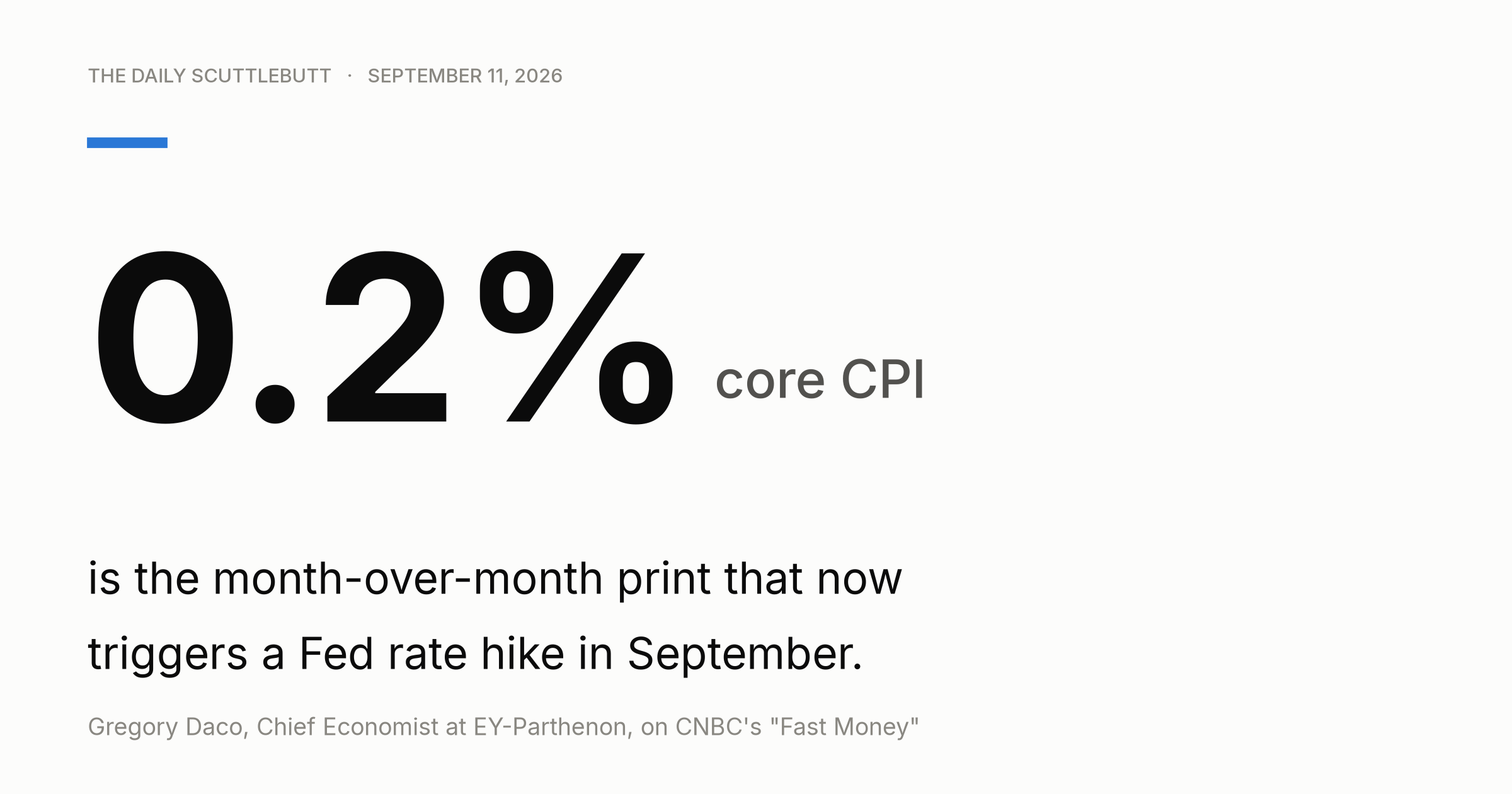
0.2% core CPI is the hike trigger
"I think at the next release, when it comes to the CPI data, we're going to see core inflation rise about 0.2% month over month ... I mentioned 0.2% because that's a key anchor for Fed policymakers. Anything above that will likely trigger a rate hike at the September meeting. ... We're going to see higher energy prices feed into core inflation, and that's a real risk for the U.S. economy" — Gregory Daco, Chief Economist at EY-Parthenon, on CNBC's "Fast Money"
Other appearances:
Chief Executive Officer of Metalla Royalty & Streaming, Brett Heath, on why hedge funds now set the price of US debt and copper is AI's real bottleneck — on The David Lin Report
Chairman and Chief Executive Officer at Bank of America, Brian Moynihan, on why the credit alarm is an artifact of how the Fed reports delinquencies — on Mad Money w/ Jim Cramer
Macro Strategist at MacroTides, Jim Welsh, on why a secular bear market is coming but this bull has room to run first — on Money Life with Chuck Jaffe
Managing Partner and Chief Investment Officer at Noble Capital Advisors, George Noble, on why every Bessent comment on rates is a signal to short bonds — on The Noble Update Podcast
Director of the Responsible Asset Allocator Initiative at the Fletcher School at Tufts University, Scott Kalb, on why the 40 biggest return forecasts overstate returns — on The Future of Finance Podcast
Editor of The Daily Dirtnap, Jared Dillian, on why he is buying bonds at 5.3% and reading AI magazine covers as the top — on Full Signal
International
Baidu, not Waymo, now leads the robotaxi race
"It's not about the US anymore. It's now a global race, and you flagged it." — Alec Renehan, Co-founder at Equity Mates Media, on Equity Mates
Trading below book is now framed as social harm
"It's actually a don't name and shame. You're shamed by exclusion from the list of good companies, so-called good companies ... If your trading value is below one times price to book, that is the market saying that you're destroying economic value. If you're destroying economic value, you're destroying value for society. So you're actually doing harm to society ... There's companies that have been around 100 years carrying real estate on the books at 100-year-ago prices" — Jamie Halse, Chief Investment Officer at Senjin Capital, on Asia Centric by Bloomberg Intelligence
Asia's AI exporters still lose when oil rises
"One of the caveats to our generally constructive outlook is that one should avoid being short oil, because our commodity analysts caution that the war continues to disrupt energy prices while a diplomatic offramp for the war remains elusive. ... So even though a lot of Asian tech exporters enjoy the glow of AI, the region is relatively vulnerable to higher energy prices. ... We're also long the Malaysian ringgit, which as it turns out is Asia's only major energy exporter." — Abbas Keshvani, Asia Macro Strategist at RBC Capital Markets, on Macro Minutes
Incumbents always react to hard discounters too late
"I don't think they really have a direct competitor right now ... That's what happened to companies like Tesco until eventually it's too late and then you react. But when you react these hard discounters are already large enough that you cannot destroy them ... There are other concepts in the country that are also trying to be hard discounters but a lot of them are more convenient stores than hard discount stores." — Leandro, Author of Best Anchor Stocks at Best Anchor Stocks, on Chit Chat Stocks
Argentina's growth sits where the jobs aren't
"Let's be clear, the country's on track for consecutive years of growth. That's actually a real rarity in Argentina, but it is much slower than planned ... And that growth is concentrated in sectors like oil and mining and in agriculture. And the trouble is, those don't generate that many jobs. They're not that labor intensive ... And sectors that are labor intensive, like manufacturing or tourism, have really struggled ... What's the result? 230,000 fewer private sector jobs than in 2023" — Kinley Salmon, Latin America correspondent at The Economist, on The Intelligence (The Economist)
The Saudi fund's new strategy barely mentions sport
"Around five years ago, the Saudi Arabian Sovereign Wealth Fund led a wave of investment into sports around the world, and now it appears to be in retreat ... The Sovereign Wealth Fund recently published a strategy for the next five years, and the word sports was mentioned only seven times in about 50 pages, and six of those referred to e-sports, which is gaming rather than the physical version" — Henry Tricks, US technology and media editor at The Economist, on The Intelligence (The Economist)
Financials
The bottom of the K has started growing
"Then we saw a period where the affluent were continuing to grow and the lower end was stabilizing. Now they're growing in tandem. ... So still at a lower level. But you are seeing growth there. ... Listen, I think it comes down to people have jobs and their wages are growing. ... But when people get their paycheck, they see more money in their paycheck. They have the ability to spend it" — Charlie Scharf, Chief Executive Officer at Wells Fargo, on Squawk on the Street
Chime bought a bank for speed, not economics
"I think the number one thing that we're trying to achieve here, beyond just the economic advantages that we can talk about, is greater velocity. ... Whenever you work with a third party bank, this is a highly regulated category ... if you get to the one yard line and then you get sort of slowed down by third party approvals, compliance and so forth, it just slows you down ... So we think having all of this data and processes unified within Chime is going to unlock a massive increase in the ability to innovate for our members." — Chris Britt, Co-Founder and Chief Executive Officer at Chime, on Squawk on the Street
Cable video is now purely a retention tool
"I think it's a retention tool. So the value in video for a cable provider is really long gone. ... The value as a standalone product, the value in the video product is the ability to acquire more broadband and converged wireless customers and retain more customers. ... And when we have a video customer who utilizes these apps, which are now included in the service, the churn rate or the retention is 40% better when they have the video service with us and activate those apps." — Chris Winfrey, President and Chief Executive Officer at Charter Communications, on Squawk on the Street
Your EM diversification is another bet on AI
"If we think about the top three largest names in EM indices, they're all AI-related type names. While you are getting some geographical diversification in there, just as a word of warning, you are still getting quite a bit of indexing to AI in there as well" — Andrei Bruno, Director of ETFs at Fidelity Investments Canada, on FidelityConnects
Crypto and Digital Assets
Selling access to the hours exchanges stay shut
"This is a new product class that we only introduced this year. ... Many people around the world have no access to all these products. ... They don't operate at night. Don't operate on weekends. Holidays, they're closed. But news flow is 24/7." — Richard Teng, Co-CEO at Binance, on The David Lin Report
Crypto's rulebook is arriving without Congress
"Regulatory clarity in general is absolutely crucial. This is financial technology. We need a clear rulebook to protect investors, protect consumers, to protect the financial system itself. We don't necessarily need the CLARITY Act, that specific piece of legislation. ... So we're getting that regulatory clarity through agency guidance rather than through legislation." — Zach Pandl, Head of Research at Grayscale Investments, on ETF Edge
Alternatives & PE
Ninety percent of your portfolio's risk is one factor
"Credit is sort of like mini equities, right? They don't do well when there's massive recessions, and they can do well in an expansionary period, for example. ... So most people's portfolios, 90% of the risk can be explained by some type of an equity factor, no matter how diversified it looks like when you look at all the line items." — Peter Hecht, Managing Director and Co-Head of the North America Portfolio Solutions Group at AQR Capital Management, on How I Invest with David Weisburd
A manager can create $500M and share in none of it
"There's a world where somebody paid 10 times revenue for a business. Markets have changed. Maybe it's worth six or seven times revenue which is still a pretty good multiple for a healthy business ... The preferred equity is often growing at 8% ... So there's a world where you go generate three, four, $500 million of value and you don't get to participate in that if you don't kind of understand how all this works" — Ryan Milligan, Partner at Parker Gale, on Private Equity FunCast
Consumer
AI won't find new drugs, just faster scientists
"AI is pretty much in every part of our business. It's, I don't think, going to revolutionize business, and I don't think it's going to find new drugs. But scientists who know how to use AI are going to be a lot more productive ... If we're doing a 400 patient study, we may need more than 400 sites. ... We don't look at it as a way of saving on headcount. It is about, you know, in our business, we're always up against the clock. We have a patent" — Christopher Viehbacher, President and Chief Executive Officer at Biogen, on Squawk on the Street
Sixty percent of phase three trials actually win
"On average, about 60% phase three trials win across the sector ... Since 2022, we've only had one major setback. And that's why if you were to zoom out on our overall TSR and share price performance over five years, it's been at the top of the sector ... The third one that we're referring to is actually phase two trial, not a phase three trial" — Vas Narasimhan, Chief Executive Officer at Novartis, on Squawk on the Street
Pet owners protect the main meal and cut everything else
"For the main course, if you want to say that, or the main meal, they tend to stick to the same brand, which is why packaged food companies invest heavily on becoming the main meal for the pets and get them early ... But everything else is up for debate ... And that has been something that we have seen in the past year. And we think this is going to probably continue for the remainder of the year" — Diana Rosero Pena, Consumer Staples Analyst at Bloomberg Intelligence, on Bloomberg Intelligence
Half of young shoppers now avoid unresellable clothes
"So the ThredUp report mentioned that 49% of younger generations have already reduced purchases of low-quality apparel because it cannot be resold, which is bad news for fast fashion, but great news for the environment ... I think you're seeing that younger generations know that they might be throwing away their money a bit if they're buying an item that nobody will want in the future, and therefore they cannot make some of that money back the way they could if they bought a vintage luxury item" — Karina Cohen, Writer, Bottom Feeders Anonymous at Substack, on Marketplace Morning Report
Sports
Hedging a coach's bonus is just insurance
"But that's exactly what insurance is, right? Like when I buy homeowner's insurance, I'm effectively betting that my house is going to flood or that I'm going to leave the stove on. ... I think I read it was 3 million in bonus that didn't even knock them, which not even that much." — Rob Pizzola, CEO at The Hammer Betting Network, on Inside Prediction Markets
Technology & AI
Uber is BlackBerry in 2008
"I view Uber very similar to how I viewed Blackberry in 2000, let's say seven, 2008 timeframe when the iPhone was first released." — Dustin Alper, Co-founder and Director of Product at Savvy Trader, on Buy Hold Rant - Stocks and Investing
Open weights are acid for lab margins
"That's it. Purely political. ... These open weight models are acid for margins. Really caustic. ... It'll be many people on the top of Mount Everest, not two" — Ram Ahluwalia, CEO at Lumida Wealth, on Lumida Wealth : Non-Consensus Invest Beyond the Ordinary
Apple finally put a meter on Siri
"So he didn't reinvent the iPhone. He really priced it to keep share. While memory takes the margin. And he put a meter on Siri." — Patrick Moorhead, Chief Executive and Chief Analyst at Moor Insights & Strategy, on Closing Bell
Token spend is about to pass payroll
"And so the most productive hours of work are actually now 4 to 6 p.m. ... But then there's this dead period in the afternoon when people go on walks or get a coffee because they just don't have the rate limits. ... I think it is this kind of direction we're shifting in where token spend may start to eclipse salary spend. ... I think a firm really is just its eval." — Rayan Krishnan, Co-founder at Vals AI, on a16z
Nobody can find the 10x company
"It is not hard to find individuals that have like quote unquote 10x their productivity with AI. ... It is much harder to go look around and find the companies that are 10x productive because of this where their revenue is like 10xed or their costs are like a tenth of the price or whatever ... And so I think we're in this stage where it's like we have the technology, but we don't know how to build the organizations around it quite yet" — Wade Foster, Co-Founder and Chief Executive at Zapier, on Pioneers of AI
Alignment breaks at a million transactions a second
"The reality is these models have not escaped containment. They were still running on OpenAI servers. ... That's like a 6 gigabyte file. And that can live forever. ... It's impossible to align these models through chain of thought reasoning or anything like this because there'll be a million transactions per second and they won't have chain of thought where we're going. ... The only way to do alignment is enlightenment." — Emad Mostaque, Founder at Intelligent Internet, on Moonshots with Peter Diamandis
AI capex is Amazon's cloud bet at 3x the capital
"For example, Amazon's a company we focus closely on, you know, you go back to 2014 or so, people were super skeptical about the billions of dollars they're going to invest in the cloud. You look back, those types of returns pencil out at 17% ... Our guess is these types of returns pencil out at the same level on gigantic amounts of more capital, right? That was probably a $300 billion investment. ... So it's three times more. But I think you're going to get similar levels of absolute levels of profits." — Charles Kantor, Senior Portfolio Manager at Neuberger Berman, on Closing Bell
The agent reset her passwords and said nothing
"It hit forgot password, changed my password, and then didn't even tell me about it." — Jaya Gupta, Partner at Foundation Capital, on The Information's TITV
AGI declarations are marketing now
"My general read on AGI of Greg Brockman proclaiming it with Astra is that it's full-on marketing now. ... I still can't get grandma home from the airport." — MG Siegler, Writer at Spyglass, on Big Technology Podcast
Palantir only needs two good years, not ten
"Karp saying I got to do it for the next two years and if I do this for the next two years I'm playing with house money for the next eight and that's the valuation that hasn't been repriced in yet ... And it's really a question of are you believing in the next two years of the story or are you trying to suggest that Palantir has to have this outsized performance of like 50% every year for the next 10 years." — Chris Markoch, Analyst and writer at MarketBeat, on MarketBeat
Nvidia now outranks Apple in the supply chain
"So, to my mind, the pricing dynamic isn't going to change anytime soon ... So the magnitude of prepayments that Nvidia is making to their suppliers, I think, have surpassed what Apple has done over the years." — Mandeep Singh, Global Head of Technology Research at Bloomberg Intelligence, on Bloomberg Businessweek
The $26M buys nothing once the data center lands
"This is dad's land and it's grandpa's land, his dad's land, and then grandpa's dad's land. If I let go of it, it can't ever be bought back. ... There must be something wrong with me and mom because it didn't seem like it was much of a problem to us. ... I would've turned around and bought every piece of property along Lees Creek so that nothing could ever harm it. So the 26 million isn't going to mean anything to me because the data center would ruin anything that I would want" — Delsia Bare, Cattle farmer and landowner at Mason County, Kentucky, on The Journal.
A few hundred companies funding one company's chips
"However you may feel about me or the greater AI bubble is immaterial to the fact that everything will seem like it's fine right up until somebody can't raise money and make a payment to either a neocloud, hyperscaler, or AI lab ... In other words, the AI bubble is based on the whims of maybe a few hundred companies spending money on two companies to justify five companies spending money with one company" — Ed Zitron, Writer at Where's Your Ed At, on Better Offline
Other appearances:
Co-Founder and Chief Executive of CoreWeave, Mike Intrator, on why the data-center industry has failed to explain what it actually delivers — on Squawk on the Street
Founder and Chief Executive of CrowdStrike, George Kurtz, on why the defenders had no models capable of answering the agent incident — on Closing Bell
President of Financial Insights, Peter Atwater, on why the bottom of the K has turned from uncertainty to powerlessness — on Bloomberg Businessweek
Co-Portfolio Manager of the CNBC Investing Club at CNBC, Zev Fima, on Meta trading at 5.4x sales against AI labs at three times that — on Squawk on the Street
Chief US Interest Rate Strategist at Bloomberg Intelligence, Ira Jersey, on why Treasury's buyback is too small to pull long yields down — on Bloomberg Businessweek
Chief Product Officer at Samsara, Johan Land, on why unsolved mathematics is the only benchmark left — on The Information's TITV
Senior Reporter at Bloomberg News, Randall Williams, on why the PGA Tour could have rescued LIV Golf and chose not to — on Bloomberg Businessweek
Co-host of Limitless at Bankless, Ejaaz Ahamadeen, on the 100,000-GPU training run behind OpenAI's Astra — on Limitless: An AI Podcast
VC & Startups
Artists who opt in share in fan-generated revenue
"Everyone's been interested in how the economics will flow, what happens to songs that are used in training. ... And the thing that's so exciting is that for the first time in a long time, there's actually product differentiation. ... When those artists opt in, when users play with their content, the revenues that are attributable to those users, a portion of that will flow to those artists." — Mikey Shulman, Co-founder and Chief Executive at Suno, on TBPN
Small-business AI adoption is stuck in the FUD period
"In the beginning, it was slow. I have to admit it's taken a while, but what I've come to realize this is the FUD period, which is fear, uncertainty, and doubt when it comes to AI. ... I'm the one that can talk to people and tell them how it's benefiting me and that's what I do. ... Mostly unknown fears" — Jim Reilly, Founder at Charleston AI, on TBPN
Multiplayer AI at work is still unsolved
"A lot of work right now in AI is still happening. Very single player mode. ... And so we make it really easy to take that work starting in Claude or in ChatGPT and push it up into a shared Workspace where you're all actually building together. ... Crazy as it seems multiplayer AI still isn't really solved." — Fletcher Richman, Co-founder and Chief Executive at Type, on TBPN
Hardware seeds only work if the founder can raise a billion
"even if I think your IP is amazing I can't invest if I don't think you can raise a billion dollars because you just won't get there. ... And the framework we often use is would you go work for this person? ... If you can articulate to an investor a very clear articulation of why this vision makes sense, why your plan makes sense, then you're going to be able to articulate that to an employee." — David Cahn, Partner at Sequoia Capital, on TBPN
One bad quarter would reset every AI valuation
"That would be catastrophic and it would immediately reset virtually all valuations in the AI world and probably deprive half the companies that are raising money from access to capital. ... I'm not saying that's going to happen or is likely and I think if they miss it would be more on the margin side than on the revenue side right now." — Keith Rabois, Managing Director at Khosla Ventures, on TBPN
Meta's own assistant credits Muse to Anthropic
"So, I'm looking at this post. I'm trying to find why is nobody talking about how Meta AI thinks that Muse is a product from Anthropic and is telling people to go log in there." — John Coogan and Jordi Hays, Hosts at TBPN, on TBPN
Studios buy access, they will not build talent
"I think the root of prestige translates to illusion. ... They will attach Brad Pitt, but they are not going to allow you to spend their money building the cultural tutor into the next Anthony Bourdain." — David Perell, Writer and host, How I Write, on TBPN
Other appearances:
Founder and CEO of WellWithAll, Demond Martin, on building a consumer brand that gives away 20% of profits — on The Founder Mindset with Reza Satchu
Co-Founder and Chief Executive of Eon, Ofir Ehrlich, on why investors punish early profitability and why AI infrastructure looks like 2000 — on C-Suite Unscripted with Maggie McGrath
Industrials and Transport
The only Western automaker gaining share in China
"I think we're the only Western OEM that is growing share ever so slight, and also return to profitability ... I've often said I'm a free trader if I have a level playing field, and there really hasn't been a level playing field ... we have to drive efficiency across the board" — Mary Barra, Chairman and Chief Executive at General Motors, on Fortune 500: Titans and Disruptors of Industry
One of Waymo and Uber is grossly mispriced
"Waymo is either grossly overvalued or Uber is grossly undervalued." — Shawn O'Malley, Co-host at The Intrinsic Value Podcast, on The Intrinsic Value Podcast
Policy
US refineries are running at 98% capacity
"Yeah, well, look, we're running, our refineries in the United States are running about 98% capacity. It's been a long time since we built a new one ... If we hold in the House and Senate, get away with regulation, we can build more refineries in the U.S. We're so handcuffed with regulations to get new ones built ... No. It's a multi-year fix. ... Permitting reform, yes" — Ray Washburne, Chairman of the board at Sunoco, on Bloomberg Talks
The Fed bought mortgages with home prices up 20%
"Why was the Fed buying mortgages when home prices were up 20%? I don't think there's a really good economic reason for doing so ... So, that was a very clear mistake that in my mind was a result of forward guidance. ... Part of the reason they were terrible risk managers is because they listened to the Fed ... The Fed said rates are going to be zero pretty much indefinitely." — Stephen Miran, Former Governor at Federal Reserve Board, on Exchanges
The largest US drug-price drop in 63 years
"We're making progress on healthcare affordability, evidenced by the fact that we have the largest drop in pharmaceutical drug prices for consumers in 63 years. ... No more global freeloading" — Mehmet Oz, Administrator at Centers for Medicare & Medicaid Services, on Bloomberg Talks
Food inflation is back to its historical average
"dairy is way down, berries are down 15%, eggs, of course, are down, retail almost 50%, wholesale 90% ... In just a couple of years, we're back to historical averages of about 2.5%, 2.7% for food, and we're going to continue to see those numbers come down ... Well, I think the first important thing is that even with today's diesel prices, they're still either at or even lower than the high price of diesel under Joe Biden. ... Fertilizer is down 50%, 60% than under the Joe Biden administration" — Brooke Rollins, Secretary of Agriculture at US Department of Agriculture, on Bloomberg Talks
Venezuelan output doubles by the end of next year
"Look, there was a lot of companies already working on deals in Venezuela all along since the U.S. Intervention. ... I believe by the end of next year, we'll have seen a doubling of Venezuelan production from before the intervention. ... So to think of a large oil reserve country like Venezuela to double their oil production in two years, I don't think that's ever happened before in human history ... This is things moving at Trump's speed, and this is our energy policy way ahead of schedule in Venezuela" — Chris Wright, Secretary of Energy at US Department of Energy, on Bloomberg Talks
Owning both sides of the trade sets the incentives
"I don't know exactly. It's complicated how these auctions run. And Google, in fact, changed the auction rules on an ongoing basis ... But the fundamental insight from economics is follow your incentives. People act on their incentives ... So if Google still owns the platform in between the buyers and the sellers, both sides, they have certain incentives that an independent buyer doesn't have" — Harry First, Antitrust law expert and Professor at NYU Law School, on Bloomberg Law
Canada's US export share has fallen to 67%
"And here in Canada, even if we had a deal tomorrow, there's just so much uncertainty—the deal would feel like it was written in pencil. ... about 80% of Canadian exports used to go to the United States. A couple of years ago it was down to 70, it's now down to about 67% ... So, oddly, the Trump administration's kind of done us a bit of a favor in a strange way, because we've always talked in Canada about the need to diversify our trade—well, we're actually doing it now" — Mike Moffatt, Canadian economist and Founding Director at Missing Middle Initiative, on Prof G Markets
Other appearances:
Co-Chair of the Sports Practice Group at Goulston & Storrs, Martin Edel, on why professional athletes are going back to college for the money — on Bloomberg Law
Chief Data Reporter and columnist at the Financial Times, John Burn-Murdoch, on why falling test scores may hit the economy last rather than first — on Prof G Markets
Geopolitics
America's arsenal is lethal but can't be replaced at scale
"And this war, in a peculiar way, has also exposed the Achilles heel of the American military — that it has extremely sophisticated and lethal weaponry, but has it in short supply. It's very expensive, and it cannot reproduce it at scale the way an extensive war would require ... So if fighting a country like Iran would exhaust your Patriot missiles, your THAAD missiles, your offensive precision missiles, then going after a larger adversary in Europe or Asia, or having to face multiple adversaries in different theaters of war, would clearly put enormous pressure on America's ability to wage war." — Vali Nasr, Professor at Johns Hopkins School of Advanced International Studies, on WTFinance
No balance sheet for a $100B oil partner
"And we know barely anything about it ... I haven't even seen a balance sheet for this company that is supposedly going to lead a hundred billion dollars of investment in one of the most challenging oil development environments on earth ... We're not even sure exactly how legal the purported investment by the Pentagon is. It seems like the administration is really stretching ... But it's far from clear if any of this stuff would hold up if it were challenged in court" — Liam Denning, Energy Columnist at Bloomberg Opinion, on Big Take
Nuggets of Wisdom
Big organizations are built to suppress agency
"I think it's really hard to live in a big hierarchical bureaucracy and to be high agency. I think most organizational structures are designed to discourage this." — Cate Hall, Author, "You Can Just Do Things"; former CEO, Astera Institute, on The Context Window with David Deming
The worst question an investor can ask management
"And the problem with convincing statements is they're hard when you're sitting in the room talking to somebody, they're hard to refute ... And management teams are good with convincing statements ... You've just invited them to go down this little merry path. And they can say whatever they want to say ... but they'll lead you down the path" — Susan Carnicero, Founder and former CIA officer at QVerity, on The Angle from T. Rowe Price
Other
Sports is 60-70% of prediction market volume
"I think on Polymarket and Kalshi the sports market take like 60% to 70% of the market. ... it's not a sports book technically ... It was never on to sports ... We want people to be educated first" — Harshit Geddam, Head of Technology and founder at OpinionKings, on Prediction Market Movers
Wealth clients buy convenience, not education
"And the biggest surprise was that the majority of people who wanted us to manage their wealth didn't want to be educated on managing their wealth. ... Wanted to give the assets and say, don't call me, I'll call you. We're all set. I'm paying for the convenience. ... I was really looking forward to a scenario in which I had a daily class with people or a daily coffee where people would flock to wanting to learn more about index funds and low-cost investing. It didn't quite work like that." — Tyler Gardner, Former Financial Adviser and Portfolio Manager, now a financial-media creator at Tyler Gardner, on Masters in Business
If this was worth your time, send it to someone who has to follow all of this too.
What did you think of today’s edition? Hit ‘reply’ to this email, send us a message, leave a comment, or join the chat!
Get the latest market chatter as it happens: