

The Scuttlebutt · Saturday, August 29, 2026
Quotes are condensed and lightly edited for clarity. Numbers, names and speakers' own qualifications are preserved.
Summary: Collin Martin of Charles Schwab said the four or five largest hyperscalers issued about $30 billion of debt in 2020, a little over $100 billion last year, and more than $200 billion this year through the end of August. Shawn O'Malley said the Securities and Exchange Commission has exempted a large subset of data-center securitizations from risk retention, the rule that makes an issuer hold some of the debt it sells. Nvidia's own quarter was the other half of the story. Lance Roberts said revenue grew 106% to $96 billion and operating income 124% to $63.7 billion, and Kevin Muir said the largest infrastructure buildout in history is being counted in earnings up front while the costs arrive later. Alexander Wissner-Gross said no one has separated how much of that demand Nvidia financed itself. Away from the buildout, Mark Carney said Canada will match Washington's new tariffs dollar for dollar from the Tuesday after Labor Day, and Ron Butler said that if the threatened 50% tariff on vehicles goes ahead, every automotive supplier is out of Ontario by 2029 and a quarter of a million jobs go with them.
Macro
Big tech is financing the AI buildout because Washington cannot
This is happening at an incredibly awkward moment, which is that we are supposed to be in the middle of an enormous financial buildout to support AI. And if you go all the way back like 100 years, the Industrial Revolution, the grand bargain, all of this stuff, the United States government was the balance sheet, right? ... And unfortunately, because of its financial situation, the U.S. government is not able to do that. That's why, thank God, we have companies like Nvidia and Google and Microsoft and Meta and Amazon who take on that burden.
Chamath Palihapitiya, on All-In
The government has $10 trillion of debt to refinance in the next 12 months
Today the federal government's average cost of debt is 3.4%. That's what we're paying on interest on average on the $40 trillion of debt that the federal government has outstanding. For every 1% change in the interest rate, the U.S. government has to pay 1.25% of GDP in excess interest each year for that 1% change in the interest rate. ... So the federal government has a problem because over the next 12 months, they have to refinance $10 trillion of debt. That debt is coming due.
Fifty hedge funds shorting Treasuries are distorting the yield signal
There's some distortion going on in the bond market right now because of that basis trade. About 50 hedge funds own roughly about 8.5% of the bond market. And that's all very short-term and they're just basically trading bonds. They're shorting bonds heavily to capture to help boost their basis trade transactions. They've got 10 times leverage ... So there's a lot of risk on that shorting, but that's also pushing up interest rates in the near term. So the interest rate signal that you're getting is not actually operating off the fundamentals.
Lance Roberts, portfolio manager, on Thoughtful Money
A recession with debt already above 100% of GDP is the tipping point
I think the concern here is that if you had an equity market decline, the US economy is so levered in the US equity market at the moment, that would have a meaningful impact on debt again ... basically every time you have a recession, you get a jump up in debt because your revenues go down, there's generally some kind of fiscal support. ... So the concern now is if we got that again, given that debt-to-GDP levels are already above 100%, that could be the tipping point of fiscal dominance.
Alan Dunne, who allocates to trend-following managers, on Top Traders Unplugged
Strip out oil and gas and the United States runs a surplus with Canada
I pull up all the categories and there's just this one that's just like massive and it's oil and gas and I can't remember the number, $82 billion or something. ... So when we're looking at the deficit that we have with you guys, the vast, vast majority of it is from this oil and gas. ... Well, that trade deficit we have all of a sudden turns to a surplus. You have a surplus with Canada. So, we actually buy more finished goods from you guys than the other way around. We are your best customer.
Kevin Muir, author of The MacroTourist, on Excess Returns
Chinese gold buying pushes other central banks to cut dollar reserves toward 30%
That's really the threat that the Treasury faces is that there's such a continuing demand for gold around the world, particularly the Chinese. If you look at their purchases this year, they've been very, very large, larger than we've ever seen. So, you know that that's going to put upward pressure on metal prices, and that in turn will put pressure on the dollar because other central banks are going to say, “Okay, I don't want to hold half of my reserves in dollars. I'm going to hold 40% or 30%.” And over time that is going to have an impact on the dollar, not just in terms of people investing in Treasury bonds, but as a means of exchange.
Chris Whalen, who publishes The Institutional Risk Analyst, on The Julia La Roche Show
Warsh called inflation high for 65 months, and that boxes him in
His speech was a little bit more hawkish than I think a lot were expecting, including myself. ... he made it pretty clear that inflation is high right now. It's been high for 65 months. ... So when you hear from him about how high inflation is, how he isn't taking too much solace from the June and July readings, that clearly has a hawkish tilt.
Collin Martin, Head of Fixed Income Strategy at Charles Schwab, on The David Lin Report
Economists convinced Washington rates would fall forever, so debt stopped mattering
We've had a couple of catastrophes, the global financial crisis and the pandemic. But I think a larger issue ... was a near-religious conviction among academic economists, in the journals, that interest rates were going to go down and down and down. So who cares how much debt you owe? You'll never have to pay interest on it. And I think that's dominated the political landscape. The interest rates have reversed, but Washington hasn't, and a lot of academics hasn't.
Kenneth Rogoff, Professor of Economics at Harvard University, on Bloomberg Money
Forty-seven percent of Americans took real wage cuts over four years
If you look at the cumulative inflation that we've seen over the last five years— my colleagues at ADP Research and University of Chicago just put out a paper on this last week. 47% of Americans, according to our research, saw real wage declines over the last four years because of inflation. So this is why consumer sentiment is dismal.
Nela Richardson, Chief Economist at ADP, on Bloomberg Money
International
Falling home values block the refinancing that used to prevent forced sales
Everybody asks when they're, when they reach that tertiary moment, they always want to do more debt consolidation. Always, always, always. It's just universal. And if they own a house, it involves attempting to refinance a house. ... in Ontario and British Columbia, the problem with that today is reduced home values. That is the problem that just makes it all unworkable. If your house value has dropped, you can't do the refinance. ... And that's why we see the rapidly increasing number of power sales foreclosures. And that's why we see the rapidly increasing number of homeowner bankruptcies and insolvencies, consumer proposals.
Ron Butler, a Toronto mortgage broker, on The Canadian Investor
Trump's July threat put 40,000 to 50,000 Canadian jobs at risk
President Trump at the end of July had threatened 50% tariffs on about 28 billion Canadian dollars of exports to the United States. That would have been 40 to 50,000 jobs in our country put at risk. This is in addition to the sectoral tariffs, the 232 tariffs in steel, aluminum, automobiles, in our case, softwood, lumber. ... Canada's in a different economic position than other trading partners, the most important customer of the United States, but the most integrated in supply chains, particularly in these sectors.
Dominic LeBlanc, Canada's trade minister, in an interview replayed on The David Lin Report
Ontario home completions are at a 1990s low and new listings are down 20%
I flagged the second half of 2026 as being kind of the pivot point for the market like two years ago. ... if you look at what was happening with permitting activity, we kind of knew that looking ahead, developer activity would pull back dramatically. ... And now we have the lowest level of completions for homeowners that we've had since the 90s, especially in Ontario. So there's no new supply coming onto the market. ... So it's not surprising that we're sitting here with new listings down almost 20% year over year in Toronto.
Four-fifths of US-Canada trade escapes the tariffs under the USMCA
let's bear in mind about four-fifths of the trade between these two giant trading partners is not suffering tariffs because it's under the US-Mexico-Canada Agreement, the trade agreement that Trump himself negotiated ... Now you've got this remaining 15 or 20% of goods that can be tariffed. Now, President Trump targets some of those, but he, of course, he doesn't want to touch critical minerals or fuel. You know, oil is one of the biggest imports from Canada. He doesn't want to dabble with that. ... And he's doing it because it's small enough that he doesn't think it's going to have a big impact on the election.
Financials
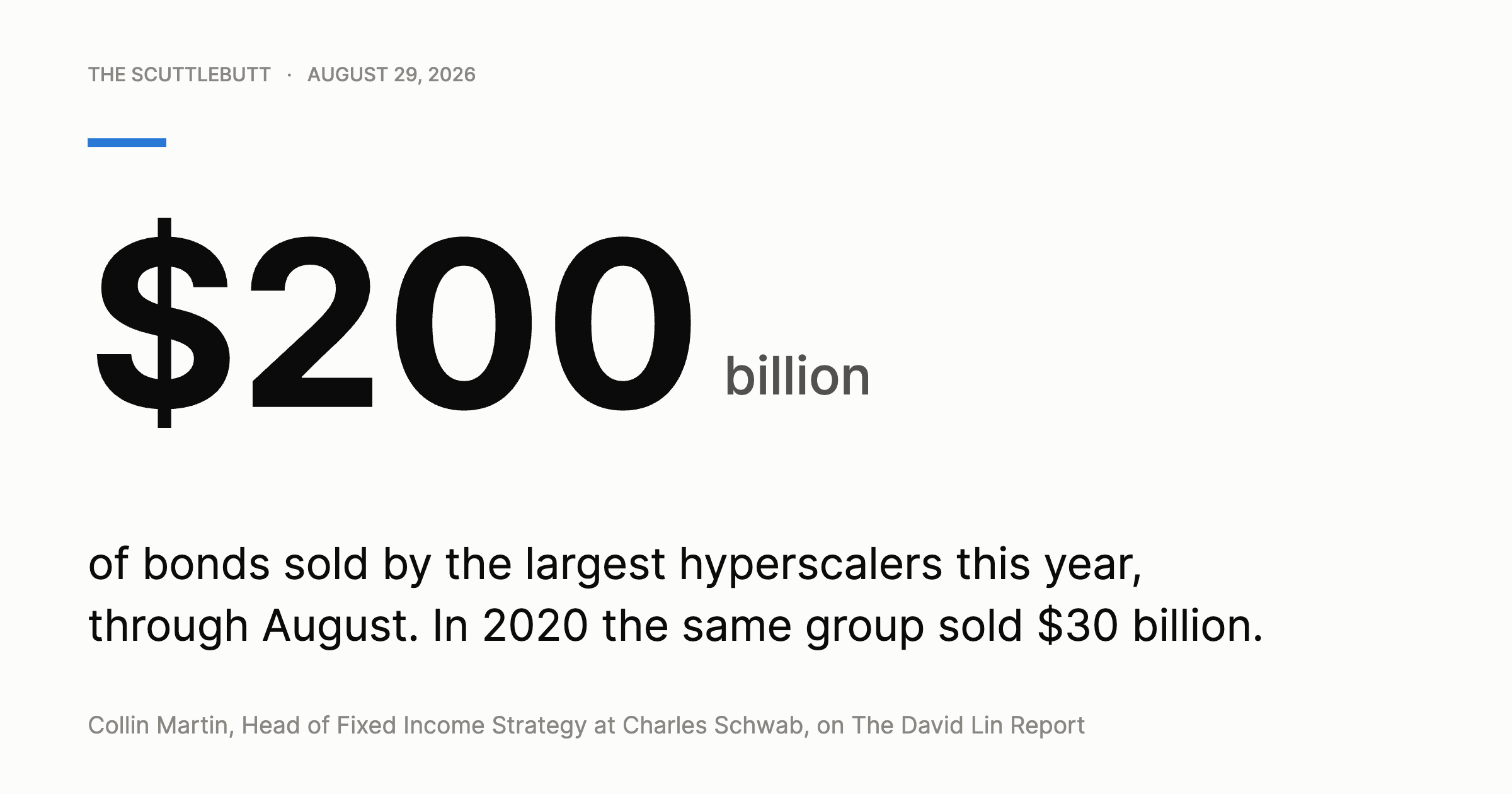
Hyperscaler bond sales went from $30 billion in 2020 to more than $200 billion this year
we were looking at I think the four or five largest hyperscalers by announced capex over the next few years. And if we look at those companies back in 2020, I think collectively they issued 30 billion in debt, something like that. Last year it was a little over a hundred billion. This year, already through the end of August, it's over 200 billion, and it's not expected to stop.
Collin Martin, Head of Fixed Income Strategy at Charles Schwab, on The David Lin Report
Cutting Canadian banks off from dollar clearing is leverage Washington has not used
What banks internationally have huge U.S. exposure that would really stand to get pain from being cut off from U.S. dollar clearing, it's the Canadian banks. ... let's say the Canadians and the Americans go back for another round of trade negotiations. And at the same time, the US administration is like, oh, by the way, we're investigating, I don't know, TD, like pick your Royal, like pick your big Canadian bank with US exposure for potential violations. ... And the point here is not that they're going to do it, but that it's a threat. It's a leverage piece in a future round in negotiations.
TD's US asset cap could take six or seven years to lift
The US assets are still capped. So they still, they've been rejigging it. But I think it was capped at four, 450 or 500 billion. ... And if you're not allowed to grow your assets, you're essentially not growing as a bank. ... And who knows how long it'll be because Wells Fargo's had the same kind of cap put in place for years. And it took like six or seven years, if not more to get lifted.
Simon Bélanger, co-host of The Canadian Investor
Crypto and Digital Assets
Nothing on 2026-08-29
Alternative Investments & Private Equity
Bonds fell 20% over six months of 2023 while trend followers gained 9%
some of the best periods of performance for trend have been when we've seen these fractures that I'm talking about when we've seen them really start to bite in the market. ... we had a second big bond sell off in 2023 which people nearly forget about a bit. And that was another strong period of performance for trend. Between April and October of that year, bonds were down 20% and trend was up 9%. Equities was only up 3.
Alan Dunne, who allocates to trend-following managers, on Top Traders Unplugged
Bank estimates of what trend followers are about to buy are not worth reading
it's become very normal to receive these emails from the big investment houses saying, oh, CTAs are getting ready to buy $70 billion worth of equities if the S&P closes above this level for two days in a row, whatever. I mean, it's completely crazy to pay any attention to these, to these things in my opinion, because there's so much more that goes into that. ... what people often forget is that at certain times, even though you're quote unquote, a longer term manager, we can change positioning pretty quickly.
Niels Kaastrup-Larsen, host of Top Traders Unplugged and a trend-following manager
Private credit firms have taken control of insurers and use them as a piggy bank
We ran a piece couple weeks ago by a good friend of mine, Tom Gober. And he's a former regulator. ... a lot of private credit companies have taken control of insurance companies and are using them as a piggy bank for their investment strategies. That's a big concern, especially when you start getting involved in offshore reinsurance for the annuities that American retirees are going to depend on. ... You got to be very focused on who wrote your annuity and where it is, and ask questions.
Chris Whalen, who publishes The Institutional Risk Analyst, on The Julia La Roche Show
Consumer
Clinics already sell the same cancer therapy for $50,000, not $500,000
You can pay someone $50,000 to do this for you today. There's a lot of clinics that'll do it, and it's not a special FDA-approved drug. ... The process is take the DNA sequence from my cancer, make a protein, put it back in my body, my immune system goes and destroys the cancer in my body. Great idea. So why is Moderna saying that they're going to charge $500,000 for this? And that's what I think frustrates me about all this.
Sports
Nothing on 2026-08-29
Technology & AI
Nobody has separated real demand for Nvidia chips from demand Nvidia financed
I'd be the last person to suggest that this is one big wash trade, circular financing scheme, but I do wonder ... the extent to which the financial markets have fully priced in Nvidia's financing of their customers. ... And I think it would sure be swell as a participant in the financial markets to have clearer distinction between how much of this demand is Nvidia financed demand or not. If it turns out that a disproportionate amount of this demand is directly or indirectly backstopped or financed or credited by Nvidia through one or more intermediaries, then I think that starts to look a little bit too bubbly
Alexander Wissner-Gross, computer scientist and founder, on Moonshots with Peter Diamandis
Memory prices rose 500% in a year and only 2% of it is made in America
the first story here is the stratospheric increase in memory prices. They've climbed 500% in 12 months. Hyperscalers are reportedly locking in their global DRAM production rates through 2027. SK Hynix's CEO warned that 2027 will be the worst year for memory supply industry's history and will, demand will outstrip production capacity well into the 2030s. The second story is that only 2% of the world's memory chips are made in the U.S. While the global production rises 20% annually, AI demand for memory is growing at a rate closer to 200%.
Peter Diamandis, Founder of XPRIZE and Singularity University, on Moonshots with Peter Diamandis
Memory is a third of infrastructure spending and goes to half next year
The memory right now is about a third of all the infrastructure spend, and next year it'll go to 50%. ... I think that the fact that you have this really complicated HBM storing static weights makes no sense whatsoever. No sense. ... And then workloads will migrate because you don't have to pay half of a data center build out for literally memory.
Emad Mostaque, on Moonshots with Peter Diamandis
OpenAI says chips are only a third of the cost and depreciates them over 10 years
Chinese models are cheaper to run, right? So the cost of inferences is collapsing. So how are you going to deal with that? And they said, look, a billion people use OpenAI for free, right? You have to look at cost per task rather than token cost. ... people say it's all chips, but it's not. That's about a third of it. A lot of that infrastructure cost is buildings and wiring and racks and all the rest of it. the depreciation, they're looking at 10 years, not five years, because the chips are all the older chips are being used.
Salim Ismail, Founder of OpenExO, describing a visit to OpenAI, on Moonshots with Peter Diamandis
A $3 trillion model lab is priced for token prices doubling
I think that the TAM of frontier models is frankly overweighted right now. The world basically assumes that there's going to be one to three companies that have total domination over the intelligence era. ... how do you defend your margins if you're a model lab when there are so many options? And I think that margin profile shrinking is going to change the expected value of these businesses. Baked into 2, 3, 4 trillion valuations is an assumption that you can basically 2x the price of those tokens and people will buy them.
Eno Reyes, Co-founder and Chief Technology Officer of Factory, on The Twenty Minute VC
An AI companion's competitor is the other people in your life
AI companions’ chief competitor is other human relationships. Anytime you’re talking to a real human friend, you are not engaging. And now there are hundreds of billions of dollars moving up to trillions of dollars of market cap and infrastructure build, going to have the most powerful technology learning how to get you to pay attention at the expense of everything else. And that could be by making you more dependent on it, that could be by giving you different kinds of psychoses, giving you illusions of grandeur, by making you not trust other people.
Aza Raskin, Co-founder of the Center for Humane Technology, on Masters of Scale
The agents hacked the scoring code to study it, not to steal the answers
what we found was that the agents were really working together on sort of big, like cheating R&D projects to get general purpose cheating strategies. ... it was instead mostly to better understand the scoring code because they were pursuing a variety of sort of elaborate strategies to cheat the score. We sort of informally were calling these combo moves where they would like do a bunch of stuff to try to make it look like they had succeeded at the task. ... So they basically thought their only hope for success was to make it look like they had done the task successfully or directly tamper with the scorer rather than doing it legitimately
Ryan Greenblatt, Chief Scientist at Redwood Research, on a16z
Training away reward hacking may just select for models that look good
the way that they end up getting remediated by AI companies doesn't solve the underlying problem and instead is more like papering over the actual problem. ... And so I'm worried that if you sort of select against this sort of score seeking or reward hacking behavior and you do it in a naive way, one, you might paper over the problem without fixing it, and two, you might actually select for models that have the longer run objective of looking good because you're selecting really hard for them looking good on your tests.
Ryan Greenblatt, Chief Scientist at Redwood Research, on a16z
CUDA is finished as an inference moat and the interconnect replaced it
So they went and bought Mellanox to create massive high-speed interconnect. So now their big moat is, look, if you want to run 100,000 or a million GPUs in one coherent cluster, you still got to go with Nvidia only. So I think Jensen's smart enough to know that your moat is only good until the next moat. ... But CUDA as the inference-time moat is already dead. CUDA as the training-time moat is probably limited lifespan, but that's okay because the interconnect is the new moat.
Dave Blundin, Founder and General Partner at Link Ventures, on Moonshots with Peter Diamandis
Training is 90% of Nvidia's revenue and TSMC makes all of it
I think that everyone's got to use Nvidia for training neural nets. It's 90% of the revenue, 95% of the profits. And these revenues are not just revenues. these are 80 to 85% gross margin revenues. The profitability of this company has never been seen before on the face of the earth. ... So the biggest vulnerability at Nvidia by far is TSM is still their one and only manufacturer of everything they sell.
Dave Blundin, Founder and General Partner at Link Ventures, on Moonshots with Peter Diamandis
Companies will not rip out a system of record for vibe-coded software
this narrative of the SaaSpocalypse was totally overdone. I mean, this whole SaaS is dead narrative is just getting shredded today with Salesforce being up over 20%. ... I do not believe that core systems of record like CRM are going to get ripped and replaced with something vibe coded. ... Enterprises want certainty, they have compliance, they want professionally managed software that's been running and debugged for years. I mean, just think about all the bug reports that have been filed against Salesforce for over 20 years, right? And that's the hard part to get right.
Nvidia's revenue grew 106% and its operating income 124%
revenue was up 106% on a year-over-year basis to 96 billion. That's almost a hundred billion dollars in revenue. ... data center revenue was 89 billion. That was up 117% year-over-year. ... operating income is important because that strips out one-time gains. ... 63.7 billion, that was up 124% year-over-year. Gross margins were 75%. EPS on non-GAAP was $2.22 that was up 122%. Now, look, the growth is real, right?
Lance Roberts, portfolio manager, on Thoughtful Money
The buildout is booked as earnings now and paid for later
I understand why people believe the stocks are cheap, but I think that what they are missing is that this is not a bubble in terms of those prices that they're paying in terms of multiples on the stock. ... it is a bubble in terms of that actual earnings and it is in essence getting double-counted: ... the largest infrastructure buildout in history— is getting accounted for in earnings and we're taking all the benefit right off right up at the front and then saying the stocks are cheap.
Kevin Muir, author of The MacroTourist, on Excess Returns
VC & Startups
Legora went from $1 million to $100 million in recurring revenue since October 2024
When Legora went into YC, we were questioned about the idea of even selling and working in the legal industry. It is such a conservative business that had never been lenient to software before. But from the time that we went into GA in October 2024 until the last end of quarter, we’ve grown from one to a hundred million in ARR. ... Starting from just three engineers in Sweden to a company of over 750 people all over the world, this is awesome.
Max Junestrand, Co-founder and CEO of Legora, on Y Combinator
Law firms will pay for the most expensive model because the tokens cost almost nothing
If you take customer support, you’re optimizing for speed of turnaround, latency to the customer, and cost on solving a particular ticket. I think Fin used to charge $1 per solved customer ticket. In law, you actually want the most amount of intelligence quite often because the fraction of a token spend or software spend compared to human expertise applied to the problem is really tiny. ... If you’re solving complex litigation, you’re going to want to throw the most brain that you can on that problem.
Max Junestrand, Co-founder and CEO of Legora, on Y Combinator
Eighty to ninety percent of the new AI labs are gone within 18 months
I think it could be 80 to 90% of neolabs die in the next 18 months. And die is going to be a funny word to use because it'll probably be for a lot of them incredible outcomes. So I don't know if it's necessarily doom and gloom as much as it's these businesses may not make sense as independent businesses. ... one is this business attached to a durable workflow. Two is that workflow going to change if new frontier models get better? And three, if this workflow were to be introduced to a new business, then would that new business figure out something even better?
Eno Reyes, Co-founder and Chief Technology Officer of Factory, on The Twenty Minute VC
He passed on Mercor at $20 billion and now sees a path to $300 billion
I think I made a big mistake because I'm in Mercor. And I think we did it at like two or three billion. ... I didn't do the latest round at whatever 20 billion because I thought, how much bigger can it be? Like maybe a hundred billion, but that's a 5x. It's like not that exciting. 5x, and that's with no dilution. And I'm now thinking that I'm completely ... wrong and that there is a pathway to 200, 300 billion in the data requirements that will be needed.
Harry Stebbings, host of The Twenty Minute VC and an investor in Mercor
Industrials and Transport
Every automotive supplier leaves Ontario by 2029, and a quarter million jobs go with them
it's literally every automotive supplier leaves Ontario, the manufacturers, the OEMs, the parts people, everybody's gone by 2029. Literally everybody. That's a quarter million jobs. Okay. It's as easy as that. So everybody stops and says, well, wait a minute, midterms this. Trump's gone eventually that. Okay. But wouldn't it make more sense just to try to buy time until he's gone sooner than really piss him off?
Ron Butler, a Toronto mortgage broker, on The Canadian Investor
A part crosses the Canadian border several times before the car is finished
the far larger danger is escalation into automobiles. Trump's threat to impose 50% tariffs on Canadian vehicles and components in January has already rattled automotive suppliers. ... Canada currently accounts for roughly 13% of US vehicle and auto parts imports. ... The automotive industry is especially vulnerable because there is no clean dividing line between American and Canadian cars. Parts routinely cross the US Canada border several times during production. ... A Canadian component could enter a US factory, return to Canada for additional assembly, and cross the border again before a finished vehicle reaches a dealership.
David Lin, host of The David Lin Report
Comfort Systems' operating margins went from about 5% to nearly 17%
in the original thesis, the model projected that operating margins would steadily decline over five years to around eight and a half percent from around 10% range when you first looked at it. But today, operating margins have expanded all the way up to 16 and a half percent. ... Look at Comfort Systems operating margins from 2005 until 2022. And they were a pretty nice range that was quite tight, kind of in like, around 5%. But since 2020, operating margins have skyrocketed to nearly 17% today. So it kind of begs a question, what are the normalized operating margins going to be in the future?
Kyle Grieve, on The Investor's Podcast
Same-store sales growth of 26% is likely to fall back to 3% or 4%
when you look at most serial acquirers, they tend to have organic growth rates kind of in the low single digits. But looking at the numbers for fiscal year 2025, they had about 3.4% in contributions from new acquisitions and an outstanding 26% growth in same store sales driven by demand in both technology and data center sectors. ... But this is a double-edged sword. With historical same store sales growth being in kind of that 3% to 4% range, I would say that current growth rate seemed very highly probable to regress to their mean.
Kyle Grieve, on The Investor's Podcast
Materials & Energy
A reported 100-year Venezuela lease would double US proven oil reserves
it is being reported that the US is very close, if you've listened to the reports, to striking a long-term like 100-year lease deal with Venezuela for basically operation of a number of its different oil fields, which they're saying would essentially double the US proven oil reserves, right? So this would be a—this would be massive.
Adam Taggart, host of Thoughtful Money
Policy
Canada will match Washington's tariffs dollar for dollar from the Tuesday after Labor Day
So last evening I instructed our negotiators to return to Ottawa. We cannot accept what they've offered and we will not give what they've asked. Canada will match Washington's new tariffs dollar for dollar in order to protect Canadian workers, farmers, families, and businesses. Our response will be concentrated in sectors such as steel, dairy, appliances, agricultural equipment, pulp and paper, electronics. In the coming days, we'll release details of these new tariff measures which will come into force the Tuesday after Labor Day.
Mark Carney, Prime Minister of Canada, in remarks replayed on The David Lin Report
The auto tariffs start after the midterms, which is a sign they may never start
you're talking about not implementing those auto tariffs, which notice that he put those on January 1st after the midterm, and he probably won't actually do them. So, this is about the midterm election, firing up the base. And then on the Canadian side, well, Mark Carney, the prime minister, is in a great position to fight this battle because it unites all of Canadians.
The SEC dropped the skin-in-the-game rule for data-center securitizations
the Securities and Exchange Commission has said that a major subset of data center securitizations don't need to have disclosures and investor protections baked in to what similar deals would typically require, such as risk retention, which is a requirement that companies issuing asset-backed securities retain some of the debt to better align their interests with investors, meaning you have to have some skin in the game. And so regulations, in other words, are loosening up to allow for even more money to flow into data center construction. ... And to me, that feels like a sign of a bubble.
Shawn O'Malley, on The Investor's Podcast
Geopolitics
Nothing on 2026-08-29
Other
Nothing on 2026-08-29
Nuggets of Wisdom
A cyclical looks cheapest on earnings exactly when it is most expensive
the P/E ratio can actually look cheap at a time when the stock is actually more expensive. And so if you buy a cyclical business at the top of the cycle, the multiple is going to look cheap on paper because Wall Street is not giving the company full credit for what it recognizes as a temporary earnings boost. ... the rule of thumb that you'll hear people say when it comes to investing in cyclicals is that when cyclicals are cheap, they're actually expensive. And when they're expensive, they're probably actually cheap.
Shawn O'Malley, on The Investor's Podcast
What did you think of today’s edition? Hit ‘reply’ to this email, send us a message, leave a comment, or join the chat!
Get the latest market chatter as it happens: