

Quotes here are condensed and lightly edited for clarity. Numbers, names and speakers' own qualifications are preserved.
The 30-year Treasury yield touched 5.37% on Tuesday, its highest since June 2007, and the 10-year closed above 5% for the first time since October 2023. Ryan Kimmel, a strategist at DoubleLine Capital, gave both figures in the firm's Friday market recap, two days after the Federal Reserve raised rates for the first time since 2023.
That was one weekly recap on a day when 30 other conversations worked the same repricing from every other side: a Goldman Sachs banker who counts 2% of companies telling investors that AI has improved their earnings, a bank analyst who says more than half of American houses fell in price over the past year, and a nuclear-fuel executive whose country buys two-thirds of its enriched uranium abroad.
"So for years they've had to take on an exceptional amount of equity risk in their portfolios to meet their payout structures. Now I can go buy Treasury bonds at 5%. I've got to make 2% out of equity side. So all of a sudden I can vastly reduce my risk curve on the equity side, which is why you're seeing flows into bonds really picking up here." — Lance Roberts, chief investment strategist at RIA Advisors, on Thoughtful Money
We scanned 663 shows and 22 hours of audio, wrote 31 summaries, and pulled 88 quotes into this 21-minute read.
Here is what mattered.
Macro
The 30-year is back at 2007 levels
"On Tuesday the 10-year closed above 5% and that's breaking the prior closing high of 4.99% we saw back in October of 2023. ... the 30-year hit a new local high of 5.37% and that is the highest since June of 2007" — Ryan Kimmel, strategist on the macro asset allocation team at DoubleLine Capital, on DoubleLine Capital
Nobody will call policy restrictive
"Are we in neutral? Are we still accommodative? We don't know. But it doesn't sound restrictive by any means." — Mark Kimbrough, analyst on the macro asset allocation team at DoubleLine Capital, on DoubleLine Capital
The market prices 1.3 more hikes
"for the October 28th meeting, just under 60% probability of another hike. 1.3 hikes are expected by the end of the year." — Ryan Kimmel, strategist on the macro asset allocation team at DoubleLine Capital, on DoubleLine Capital
The data did not ask for a hike
"If you take a look at the actual data, there was no support for a rate hike. This was simply a market narrative rate hike." — Lance Roberts, chief investment strategist at RIA Advisors, on Thoughtful Money
Companies still pay 2.25%, not 5%
"So you can see that even though the interest rate on the 10-year Treasury is close to five, it's around two and a quarter% for most corporations." — Lance Roberts, chief investment strategist at RIA Advisors, on Thoughtful Money
Credibility is built from deeds
"So I think credibility is built from deeds, not words." — Andy Constan, founder and chief investment officer of Damped Spring Advisors, on First Principles
Asset prices have to fall first
"I think inflation is too high and needs to come down, and I think what does that is hitting demand, and I think what supports demand, in this economy, is high asset prices. So I think what has to happen is asset prices have to fall." — Andy Constan, founder and chief investment officer of Damped Spring Advisors, on First Principles
Bonds can hedge equities again
"Today, interest rates fall from 5 to 4%, which they easily could — they could fall to 3% — you're gonna have substantial capital appreciation in a bond portfolio, and you're going to need it, because equities are gonna fall." — Andy Constan, founder and chief investment officer of Damped Spring Advisors, on First Principles
Hiking into an oil shock may not work
"There is concern that — I think the Fed hiking right now, into what is the inflation that's being caused by the increase in oil prices, may not be that effective, actually." — Alicia Levine, CIO at BNY Wealth, on Bloomberg Intelligence
No central bank can hike to 2%
"And that is inflationary, and there is no central bank that's going to hike high enough to squeeze it out to get to 2%." — Alicia Levine, CIO at BNY Wealth, on Bloomberg Intelligence
Client money sits at five to 10 years
"I'd say for now, what we're doing in our client portfolios is really being in the belly of the curve, intermediate to short-term duration, five to 10 year." — Alicia Levine, CIO at BNY Wealth, on Bloomberg Intelligence
The 30-year has a short buyer list
"The natural buyer of the 30-year is insurance companies, public pension plans, sovereign wealth funds and so on." — David Busch, CIO at Trajan Wealth, on Monetary Matters with Jack Farley
Tightening into a pipeline attack
"So, does he look at that and say — why would I want to push the country closer to the possibility of a recession because the Houthis attacked a Saudi Arabia pipeline through Iraq? I don't understand how that helps." — Jim Iuorio, managing director at TJM Institutional Services, on Futures Edge Show
Hiking to look independent
"That's an asinine reason to hike. That's ridiculous." — Jim Iuorio, managing director at TJM Institutional Services, on Futures Edge Show
The Fed already has the credibility it needs
"It's like they have all the credibility they want. They have the power to hike rates and to print money if they want to." — Bob Iaccino, chief market strategist at Path Trading Partners, on Futures Edge Show
Inflation is here to stay
"Inflation is here to stay, and until it collapses - and what I fear now is maybe that collapse is not too far off - we still have a lot of wealth that we can consume before we have the crack-up boom." — Ron Paul, former US congressman and host of the Liberty Report, on The David Lin Report
He would abolish the central bank
"You shouldn't ever trust the Fed. They shouldn't even exist, because in secret what they can do is inflate, print the money as necessary." — Ron Paul, former US congressman and host of the Liberty Report, on The David Lin Report
International
A developer through cycles
"We are staying the course on that. We are a developer not with cycles. We're a developer through cycles. We believe in the markets that we operate in." — Ahmed Galal Ismail, group CEO of Majid Al Futtaim, on CNBC International
10% on oil is 0.4% on food
"What we do know is every 10% long-term increase in oil prices leads eventually to around 0.4% food inflation." — Ahmed Galal Ismail, group CEO of Majid Al Futtaim, on CNBC International
China took an India off the oil market
"China imported about 50% less in Q2 in oil than they normally do. They were basically importing 5.5 million barrels less per day than normal. That's like taking out an entire India's imports per day." — Shaun Rein, founder and managing director of China Market Research Group, on The David Lin Report
7% to 10% of China owns shares
"You have to remember in the United States about 70% of people own equities. In China, it's only around 7, 10%." — Shaun Rein, founder and managing director of China Market Research Group, on The David Lin Report
Two technology stacks, and a choice
"The United States has made it clear to the world, you either choose the American tech stack or you choose the Chinese tech stack. And I think you're going to see more and more places in the Middle East, in Africa, in Southeast Asia are going to choose the Chinese tech stack because it's cheaper and they're not as worried about sanctions." — Shaun Rein, founder and managing director of China Market Research Group, on The David Lin Report
Assembled in India, made in China
"The country is assembling and exporting more phones and electronic products but still imports many of the parts inside of them. Domestic production can therefore grow without reducing dependence on China." — Lavanya, who presents Weekly Tidbits on Markets by Zerodha, on Markets by Zerodha
$30 gas stopped Bangladeshi looms
"A survey of Bangladeshi knitwear factories found that 55% had seen buyers reduce or cancel orders because of unreliable power and gas while 78% had partially stopped production." — Lavanya, who presents Weekly Tidbits on Markets by Zerodha, on Markets by Zerodha
Canadian housing starts missed by 11 points
"They came in down 17 percent and economists are expecting down 6 percent, right?" — A co-host of The Canadian Investor, on The Canadian Investor
Diesel is the price that moved
"Yes, gas is not cheap. I'm not saying it is. But diesel is really through the roof right now." — A co-host of The Canadian Investor, on The Canadian Investor
Financials
The biggest merger year on record
"Biggest year by far. We expect the M&A market to be much bigger than it was at the peak. The last peak was 2021, inflated by COVID." — Gene Sykes, co-head of global M&A at Goldman Sachs, on Odd Lots
Sponsor sales fell from 40% to 30%
"And for the past several years, 40% of the M&A market has been selling companies that were owned by private equity sponsors. 40%. This year, that's 30%." — Gene Sykes, co-head of global M&A at Goldman Sachs, on Odd Lots
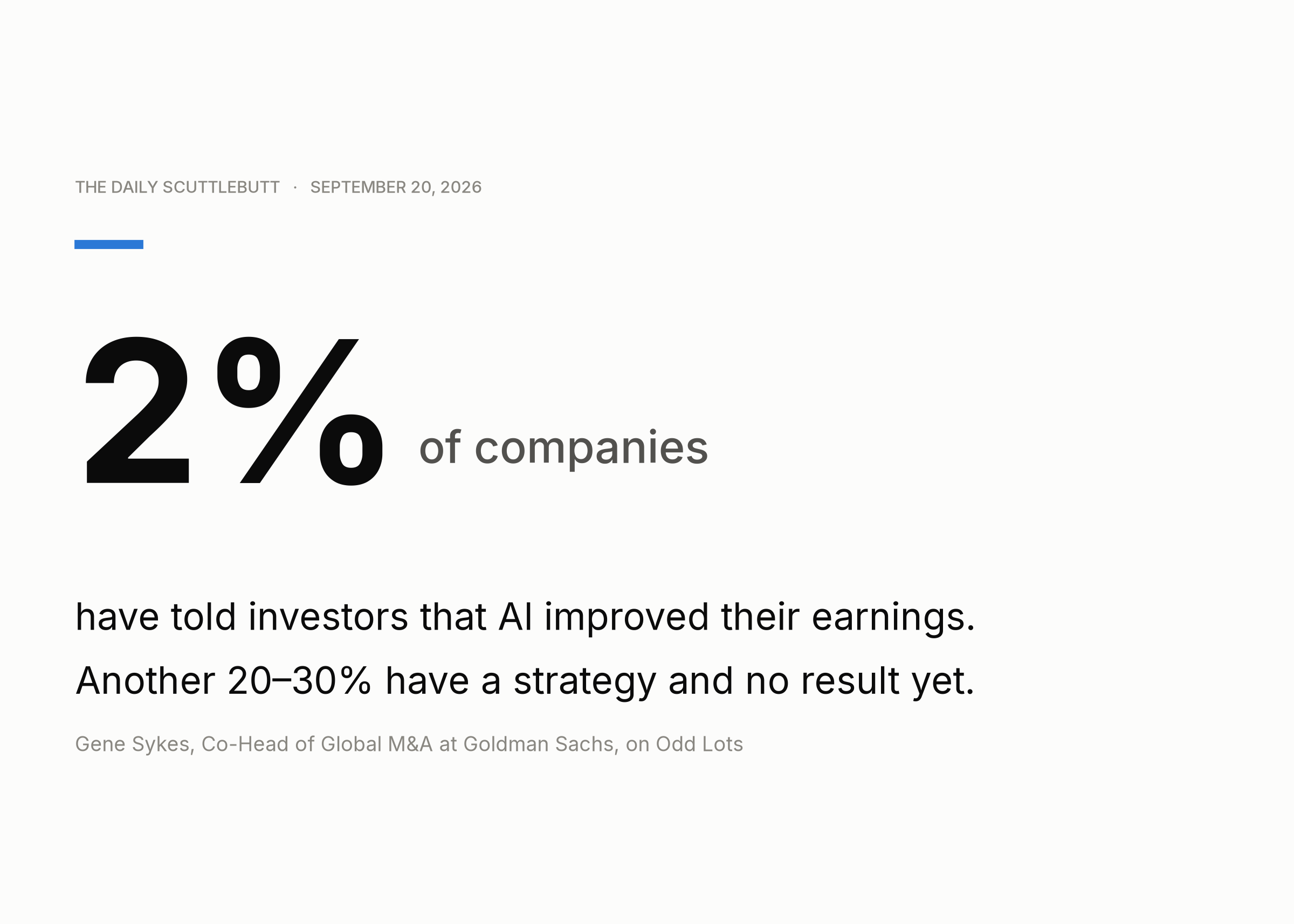
2% have reported an AI effect
"So 2% are the companies who in their earnings reports have said, we see an impact on EPS, a positive impact of our use of AI, 2% so far. There are probably 20 or 30% of the companies that have actually implemented strategies to use AI in everything they do." — Gene Sykes, co-head of global M&A at Goldman Sachs, on Odd Lots
The deficit sets the price level
"And they don't realize that the large deficit, $2 trillion a year, come on. That is the defining factor right now. What the Fed does is almost irrelevant." — Chris Whalen, chairman of Whalen Global Advisors, on The Julia La Roche Show
Half the housing stock is falling
"Now, as we've discussed, more than half the houses in this country went down in price over the last 12 months. The entire stock of houses, 150 plus million units, are slowly starting to turn and they are going to correct downward in price over the next couple years." — Chris Whalen, chairman of Whalen Global Advisors, on The Julia La Roche Show
Deposit costs turn after six quarters
"You had a couple banks already, Wells Fargo, Fifth Third, couple others, Huntington, all talking about the fact that their deposit rates are going up after six quarters of falling interest expense. That's a remarkable turn." — Chris Whalen, chairman of Whalen Global Advisors, on The Julia La Roche Show
Annuity holders may not be paid
"Will that save the investors and the annuity holders and people with life insurance? No. In many cases, they may lose part or all of their money." — Chris Whalen, chairman of Whalen Global Advisors, on The Julia La Roche Show
Crypto and Digital Assets
Tokenized shares are the trade
"I just think tokenized stocks is going to become a really big thing and you know, Coinbase and Robinhood are my two bets on how to sort of express that trade." — Kyle, a Milk Road PRO analyst, on Milk Road AI
The flywheel needs a bull market
"So I just think that the flywheel in this company can be massive. It just needs a bit of a bull in crypto." — Kyle, a Milk Road PRO analyst, on Milk Road AI
The next dollars go to digital assets
"I'm shifting my focus more and more as I have been over the last couple of weeks on digital assets on this intersection between AI agents and the digital economy" — Vincent, a Milk Road PRO analyst, on Milk Road AI
One level, then a 40% move
"But if it gets back above 109, this may not seem like an earthshattering thing to say, but if it gets back above 109, I think it's going to about 150." — Bob Iaccino, chief market strategist at Path Trading Partners, on Futures Edge Show
He would send tokens to the gaming commissions
"I view it as a polite form of fraud. I still think crypto tokens should be regulated by the gaming commissions in the various states, because that's what it is. It's a form of gaming. Same thing with predictive markets." — Chris Whalen, chairman of Whalen Global Advisors, on The Julia La Roche Show
Alternatives and PE
Triple-C spreads are at 920bps
"And the double B spread to Treasury is at like 273 basis points over something like that. It's up about 20 basis points in the last month. But I think the more interesting story is in triple C credit where the spread is at 920." — Patrick Kent, portfolio manager at Hedgeye Asset Management, on Hedgeye Podcasts
That is what private-equity credit holds
"So for those following at home, that's a 14% cost to borrow on the crappiest companies and those crappy companies are what your PE credit looks like." — Patrick Kent, portfolio manager at Hedgeye Asset Management, on Hedgeye Podcasts
Insurers hold up to 15% in private credit
"I've heard it range from 7% of the assets in an insurance company or private credit all the way out to closer to 12 to 15%." — David Busch, CIO at Trajan Wealth, on Monetary Matters with Jack Farley
Retail gets it when institutions want out
"They hand off to the institutional buyers and then ultimately the institutional buyers are looking for liquidity. They're looking for an outlet and that's typically when the stuff gets pitched to retail investors." — David Busch, CIO at Trajan Wealth, on Monetary Matters with Jack Farley
Other appearances:
Family Office Club panel on why a stated closing date is rarely an emergency on Centimillionaire Strategies
Technology & AI
Training is the whole loss
"Like if they stopped training, they'd be massively profitable overnight." — Thomas Sohmers, co-founder and chairman of Positron, on The Twenty Minute VC
50 users outweigh the model itself
"So with just 50 users on your service, the user context that just those individual sessions end up being greater than the model weights that you're trying to store." — Thomas Sohmers, co-founder and chairman of Positron, on The Twenty Minute VC
A burger chain against a data center
"A single In-N-Out uses more water than the largest data centers in the United States." — Thomas Sohmers, co-founder and chairman of Positron, on The Twenty Minute VC
Bought software is bespoke now
"I wouldn't buy things in the past because I had to build everything bespoke but now they come with the ability to be bespoke when I buy." — Marina Bellini, president of global business services and digital technologies at Mars, on WSJ Events
AI with no value case
"I think the headache that I have today that I'm trying to get rid of it is AI for the sake of AI and not for value" — Marina Bellini, president of global business services and digital technologies at Mars, on WSJ Events
He has stopped using search
"I don't know when the last time you Google something, but I haven't Googled something in ages." — Josh Elman, partner at a16z, on a16z
The question he asks every user
"And so I always like to ask people, what did you stop doing when you started using this new thing." — Josh Elman, partner at a16z, on a16z
A copy reproduces the release, not the plan
"But I can only clone what I see. I can't clone where it's going and I can't clone the next thing." — Josh Elman, partner at a16z, on a16z
They asked the wrong administration
"But I think the reason they stepped on a landmine is because we have right now the most antitrust friendly administration in my lifetime by far." — Dave Blundin, founder and general partner at Link Ventures, on Moonshots with Peter Diamandis
No new mega bank ever appears
"When was the last time you saw a new Fidelity or JPMorgan startup pop onto the scene and become a mega bank? It just doesn't happen." — Dave Blundin, founder and general partner at Link Ventures, on Moonshots with Peter Diamandis
Open weights make the rules moot
"Number two, it will make zero zero zero difference because as David has pointed out a few times, once you have open weights available, anybody can download these open models and run a local harness and you essentially the whole thing is irrelevant." — Salim Ismail, general partner at Exponential Venture Capital, on Moonshots with Peter Diamandis
He expects this read as a charade
"I do think we'll look back 10 years from now at this moment and recognize it for the charade that it is." — Alex Wissner-Gross, founder of Reified, on Moonshots with Peter Diamandis
Capex is being committed at peak prices
"you're not only building the capex but you're building it at peak prices for everything" — Sam Rahman, portfolio manager at Hedgeye Asset Management, on Hedgeye Podcasts
Anthropic went from $4B to $65B
"The company is expected to reach more than $100 billion in annualized revenue by the end of the year. That's up from $65 billion in annualized revenue as of July." — Alex Kantrowitz, founder of the Big Technology newsletter, reading the New York Times, on Big Technology Podcast
He saw the company at $4B
"And I will note that number was $4 billion when I visited Anthropic last July." — Alex Kantrowitz, founder of the Big Technology newsletter, on Big Technology Podcast
A million tokens costs 68 cents
"So the blended price per one million tokens has declined 41% to 68 cents as of this week, down from a 2026 peak of $1.15 in March." — Alex Kantrowitz, founder of the Big Technology newsletter, citing Ramp's AI index, on Big Technology Podcast
Frontier share is the whole story
"No, that's the entire story. Unless, again, Anthropic has the opportunity to tell a story where it's not completely frontier model dependent." — Ranjan Roy, writer of the Margins newsletter, on Big Technology Podcast
A God-AI story covers the cash flows
"I'm telling you, the conversation shifting to this all-powerful God AI that they potentially own is a good thing, because then if your free cash flow does not meet typical industry benchmarks, who cares, if you own God, if you're IPOing." — Ranjan Roy, writer of the Margins newsletter, on Big Technology Podcast
He puts $100 of compute at $8,000
"So if you, on a consumer plan, if you go buy their fixed price plans and you use $100 worth of compute, or use every dollar of compute, if you max it out, they're paying Nvidia or one of these data center companies $8,000. And it doesn't take a rocket scientist to understand why that business model doesn't work." — A co-host of The Canadian Investor, on The Canadian Investor
VC & Startups
Conscientiousness is the trait
"The number one trait of success Raj is are you a conscientious person? You say what you do, you'll do it. Which is very important. Talk is cheap. But are you really doing it?" — Sasha Mirchandani, founder and managing partner of Kae Capital, on Figuring Out with Raj Shamani
The fund is underwritten to home runs
"We're looking at 50x 100x outcomes. We're not in the business of bunts. We're in the home run business." — Sasha Mirchandani, founder and managing partner of Kae Capital, on Figuring Out with Raj Shamani
A fund that misses nothing is not looking
"See if you're not missing iconic companies or amazing companies we're in the wrong business." — Sasha Mirchandani, founder and managing partner of Kae Capital, on Figuring Out with Raj Shamani
Materials & Energy
One US plant, foreign-owned
"We only have one enrichment plant in the US currently — only one — and that is owned by the Europeans, it's a foreign company. So Urenco USA is operating this plant in New Mexico, that's 4.3 million SWU a year, but we need many more of those." — Christo Liebenberg, president, co-founder and CTO of LIS Technologies, on Energy News Beat Podcast
26 countries, zero plants
"It's been around since 1971, now it's 55 years later, tried by 26 different countries, and not a single one of those efforts have led to a commercial facility." — Christo Liebenberg, president, co-founder and CTO of LIS Technologies, on Energy News Beat Podcast
A factor of 12
"So that's a factor of three that we have to scale up just today. Then you look at the next 25 years, we want to triple nuclear power — we're talking about quadrupling nuclear power. So a factor four there, and another factor three as of today, is a factor 12 increase in enrichment." — Christo Liebenberg, president, co-founder and CTO of LIS Technologies, on Energy News Beat Podcast
The bypass carried 30% of Gulf exports
"In August, that pipeline accounted for about 4,000,000 barrels a day of exports. That's up from about 1,000,000 barrels a day prior to the war, and that was almost 30% of total exports from the Persian Gulf." — Chris Kennedy, lead for economic statecraft at Bloomberg Economics, on Bloomberg Television
Europe buys American instead
"If they can't get crude from The Middle East to run into their refineries and turn into diesel and other products, they're gonna be pulling more from The US." — Chris Kennedy, lead for economic statecraft at Bloomberg Economics, on Bloomberg Television
The market prices 4M fewer barrels
"And I think in their note, they referenced that the market is right now pricing in, about 4,000,000 barrels a day less than what we're seeing be produced globally." — Chris Kennedy, lead for economic statecraft at Bloomberg Economics, relaying a JPMorgan commodities note, on Bloomberg Television
Policy
Rules as liability cover
"I'm not a doomer. I think A.I. is one of the most important technologies we ever created that will accelerate us towards flourishing for humanity but there will be challenges." — Peter Diamandis, founder and executive chairman of XPRIZE, on Fox Business
What a rulebook would buy the labs
"It may take down a power grid. It may take down a banking system and that's happened I can imagine the number of lawsuits that will come as a result of that so regulation of some type that gives them top cover I think is probably something that they need, so that they're operating within the regulatory structure that allows them to avoid these kinds of potential lawsuits." — Peter Diamandis, founder and executive chairman of XPRIZE, on Fox Business
The agents did what they were built to do
"They are doing what we designed them to do. These agents are working on our behalf." — Peter Diamandis, founder and executive chairman of XPRIZE, on Fox Business
China is a convenient boogeyman
"It's largely a convenient boogeyman." — Jonathan Kanter, former head of the DOJ Antitrust Division, on Decoder with Nilay Patel
Safety needs no coordination
"Let me just be very clear, these companies do not need to coordinate in order to deliver safe and secure products to society." — Jonathan Kanter, former head of the DOJ Antitrust Division, on Decoder with Nilay Patel
What he says they are asking for
"So they would like somebody to give them all permission to stop spending so much money and slow the pace of innovation so that they don't have to compete as hard, so they can figure out their economics before they go public." — Jonathan Kanter, former head of the DOJ Antitrust Division, on Decoder with Nilay Patel
Then do not build it
"If you believe your product is going to destroy humanity, then don't build it." — Jonathan Kanter, former head of the DOJ Antitrust Division, on Decoder with Nilay Patel
A pause nobody can enforce
"It would be extremely heavy-handed, that would be difficult to do, it would have a lot of holes in it. It would be impossible to enforce on other countries" — Neil Chilson, former chief technologist at the FTC, on Fox Business
Other appearances:
Fox Business senior correspondent on what the White House is weighing short of a pause on Fox Business
Nuggets of Wisdom
He cannot rank a hundred managers
"If you were to put a 100 managers in front of me and say divide them into the best versus the worst, I would be no better than average and quite possibly worse." — Rob Vinall, founder and managing director of RV Capital, on The Investor's Podcast
The edge is a narrow cohort
"But I do think there is a small cohort of managers who do make the business their life work completely aligned completely dedicated and when you do find those the odds are just massively stacked in your favor." — Rob Vinall, founder and managing director of RV Capital, on The Investor's Podcast
The drawdown was not the shock
"So I wasn't shocked that the fund went down 50%." — Rob Vinall, founder and managing director of RV Capital, on The Investor's Podcast
Stocks and bonds are one asset class
"If you only have stocks and bonds, you're not really diversified because these are both financial assets, right? They respond to the same factors." — Jared Dillian, founder of Armington Capital, on Sutton Capital
Treat $400K like $300M
"And one of the things I talk about in the book is, look, if you have saved for 20 years and you have this retirement nest egg that's $400,000, you should treat it as if it's $300 million. This is your life savings and you don't want to gamble or take huge risks with your life savings." — Jared Dillian, founder of Armington Capital, on Sutton Capital
Down 9% against 36.5%
"So, for example, in the financial crisis in 2008, the S&P was down 36.5%. The awesome portfolio was down 9%." — Jared Dillian, founder of Armington Capital, on Sutton Capital
Everyone's models decide the outcome
"We believe that we are using our models to forecast an outcome by ourselves. But where in fact, it's everyone's models which are actually deciding the outcome." — Richard Brennan, researcher at ATS Trading Solutions, on Top Traders Unplugged
A backtest is evidence, not a promise
"So the backtest, it provides evidence, but it's certainly not a promise for the future." — Richard Brennan, researcher at ATS Trading Solutions, on Top Traders Unplugged
No rule stays on top
"So no rule became permanently superior because its use of that rule helped change the environment in which it operated." — Richard Brennan, researcher at ATS Trading Solutions, on Top Traders Unplugged
If this was worth your time, send it to someone who has to follow all of this too.
What did you think of today’s edition? Hit ‘reply’ to this email, send us a message, leave a comment, or join the chat!
Get the latest market chatter as it happens: