

The Daily Scuttlebutt · Monday, August 31, 2026
Quotes are condensed and lightly edited for clarity. Numbers, names and speakers' own qualifications are preserved.
Summary: Aahan Menon of Prometheus Research said about 70 to 80% of PCE components are now running above the Fed's 2% target, and that broad inflation of that kind is the kind that persists. His rule is mechanical: above 2% on his nowcast, his firm does not own bonds. Jonathan Liang said the futures market moved from around 30% to about 60% on a September hike after Kevin Warsh spoke at Jackson Hole, and that Standard Chartered's investment office is not making that call yet. Stephen Moore said this is no time to cut and the real question is whether rates go up. Against that, Brent Kochuba said the implied move on the day of the speech was about 38 handles, the term structure is at 90-day lows, and this is a market that has zero concerns. Kevin Muir is buying volatility around the midterms on the argument that you buy insurance when you can rather than when you have to. Ben Hunt said the credibility story went supernova after July's press conference and that gold is one divided by trust. Elsewhere, Dan Rasmussen said private equity's inventory is marked around 17 times EBITDA against a small-cap market near 10, which is why it cannot sell; Lisa Du said Shein is listing at $26 billion in Hong Kong because Beijing would not sign off anywhere else; and Ed Ballard said the Colorado is close to the level at which its dams cannot release water on demand.
Macro
Seventy to eighty percent of PCE components are running above the Fed's target
When we look at that number today, what we basically see is that if we average out the last few months, basically you have about 70 to 80% of PCE components now above that 2% target. And usually when you have those types of dynamics where you have a persistently high level of inflation on a broad basis, you usually tend to have much more consistent inflation when you're looking forward.
Aahan Menon, founder of Prometheus Research, which builds a daily inflation nowcast, on Last Call
One number decides whether his firm owns Treasuries at all
Inflation tends to be a pressure on bonds because it's a pressure on policy makers to hike policy rates. And so all we do is we basically say if our inflation nowcast we have a daily inflation nowcast. If our inflation nowcast is above 2% we avoid owning bonds. If it is below 2% we own bonds.
Aahan Menon, founder of Prometheus Research, which builds a daily inflation nowcast, on Last Call
A career volatility seller is buying insurance around the midterms
I think it is in essence buying forward volatility on the S&P 500 or the stock market around the midterms. ... One of my sayings that I used to love from the trading desk, Matt, was, you buy your straw hats in the winter and you shouldn't buy insurance when you have to. You should buy it when you can. ... I'm buying my insurance today.
The July press conference, not the July decision, is what broke the Fed's credibility
we get to the press conference at the end of July and man, this is what I mean by like the supernova explosion. It's like an own goal. This is self-inflicted. ... it wasn't just that they didn't raise interest rates. It's what he said about it. It was meet the new boss same as the old boss. And that was how the narrative shifted after this press conference at the very end of July and going into August. And it's not a coincidence that's when you see gold just taking off here in August. This big move we've seen in gold because that's how really you think about gold. It's one divided by trust, right?
The options market priced the Jackson Hole speech as something to get out of the way
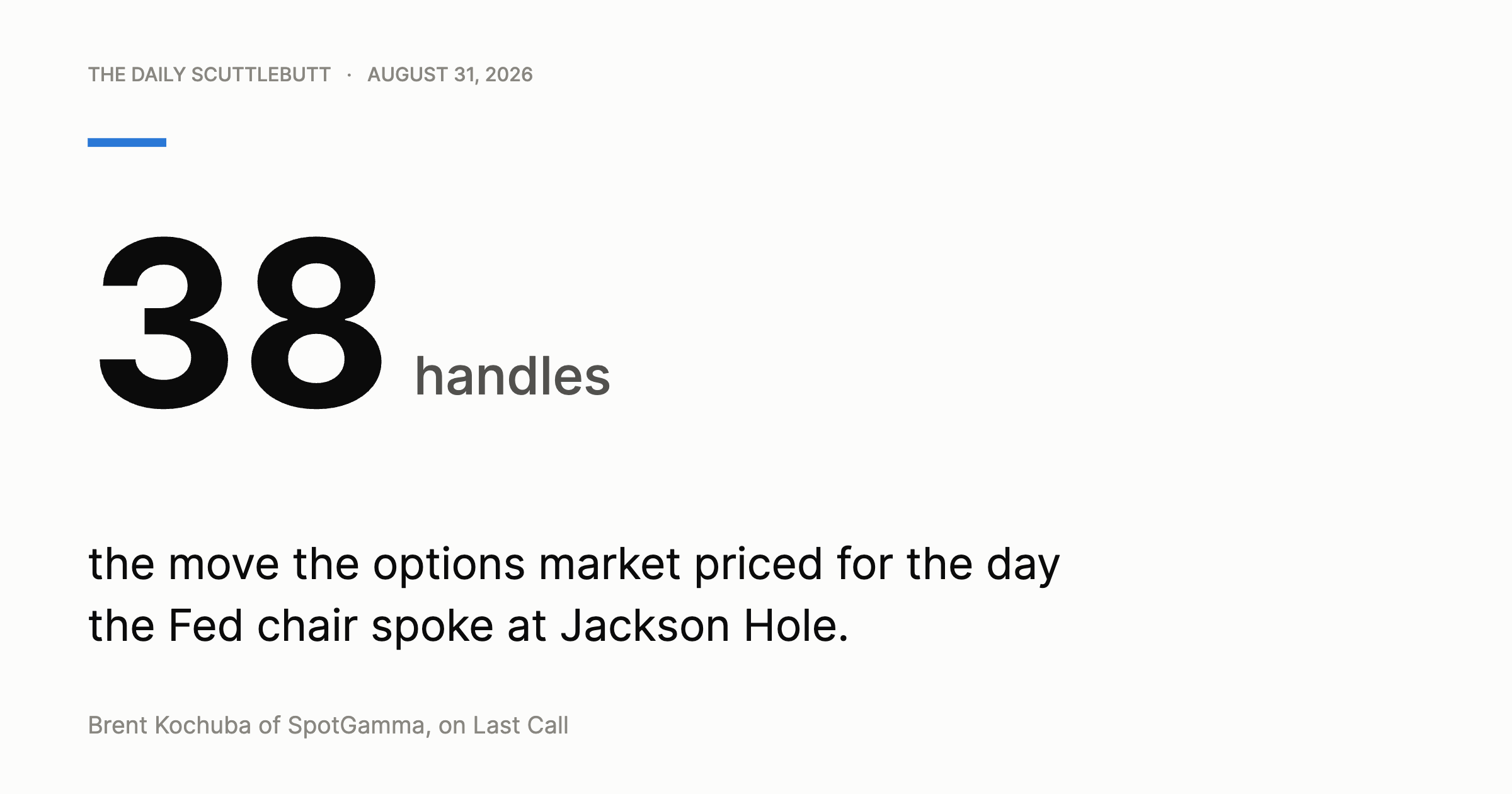
people were worried about Jackson Hole, but it seems like it's not going to be maybe as big a deal for the market as people thought. ... The initial reaction here is up 30 bips. That's pretty pretty nice. The implied move for today was only about 38 handles, Jack, which is the zero DTE straddle. That's not a lot of market movement on Warsh day, right?
Brent Kochuba of SpotGamma, who brings the show its options-positioning data, on Last Call
Nobody owns downside protection, and the term structure is at ninety-day lows
You may occasionally see a six. On Christmas Eve, you'll see a four. But this is very very low. And the fact that this term structure, I'm looking at the darker green or teal line here. It's at 90-day lows, which is that range. This is a market that has zero concerns, right now. And so Warsh is just sort of like this speed bump. It's like, hey, just get out of the way. Don't spoil the party.
Brent Kochuba of SpotGamma, who brings the show its options-positioning data, on Last Call
A diversifier that never disappoints a client is not diversifying
The other thing that I would say and we hear this all the time, investors often evaluate individual positions rather than the full portfolio. ... Why do we own this certain asset that hasn't performed well recently? ... And sometimes the answer is that's precisely why we own it. ... So really as long as all the assets are behaving as they're expected, it's perfectly fine for some portfolio assets to be falling in value at any given point in time. So maybe said another way, a good diversifier should actually occasionally disappoint clients. And if it never does, it's probably not diversifying enough.
Standard Chartered's investment office is not calling a September hike yet
To cut to the chase, we think Warsh's comment has risen the probability of a rate hike in September, but we at the CIO office is not quite yet ready to make that call for a couple of reasons. ... The Fed funds futures market interpreted Warsh's speech as marginally hawkish with Fed fund futures moving from around 30% chance of a September hike to about 60%.
With inflation near 3.5%, the live question is a hike, not a cut
So we've gotten inflation news in the last few weeks that are showing inflation's running at about 3.5%. That's too high, right? ... So the answer to your question is now is not the right time to be cutting rates at all. The real issue is whether rates should be increased. I don't think that the Fed will raise rates at their next meeting. But as you probably know, there's been some disagreement among Fed members about whether a rate increase is necessary right now.
The oil price is the indicator he checks first every morning
The thing that's really hurt the economy for the last three or four months, as everyone knows, has been the high oil price. I mean, when I get up in the morning, the first thing I look at is what's happening with the oil price. If the oil price stays at $80 a barrel, I think it's about that right now, then we have problems. If they can get it down to $70 to $65 a barrel, that makes all the difference in the world. So that is the key indicator everybody should be looking at right now. Is the oil price rising or falling? If it starts to fall, I think we'll see a booming economy. The question for Republicans is, will it fall before Election Day?
International
Shein is listing where Beijing let it, not where it wanted to
Shein in its heyday in 2022 was valued at $100 billion and now going public at $26 billion. Why is it happening now? Well, a lot of it is timing and also regulation. So Shein is a Chinese company, and even though it does no business in China, it required the sign-off from Chinese regulators to go public. That never came, but it was trying to go public in New York. It didn't happen while trying to go public in London. When they switched to Hong Kong, suddenly this summer, the OK came from Beijing that they could go public and they just took the chance and ran with it. A lot of the early investors were getting very impatient for their exit.
Lisa Du, consumer finance reporter at Bloomberg News, on Bloomberg This Weekend
The question the buy side cannot answer is how to price the geopolitics
Investors look at Shein, which is pitching themselves along peer companies like Zara and H&M, and they're like, well, Zara. And H&M are companies that have years of track record that I can depend on, so why would I buy into a company like Shein? And the other thing that investors have really questioned is, how do I price geopolitical risk for Shein? ... I think a majority of the cornerstone investors are actually existing backers of Shein, which is somewhat unusual, which suggests that I think some of the regular IPO investors that would be in on such a deal have actually hesitated and maybe not participated.
Lisa Du, consumer finance reporter at Bloomberg News, on Bloomberg This Weekend
Financials
Nothing on 2026-08-30
Crypto and Digital Assets
Nothing on 2026-08-30
Alternative Investments & Private Equity
Private equity cannot sell because it paid seventeen times for a market trading at ten
So the explanation that you can't sell because the IPO market has closed has just got to be wrong. And I think that the explanation is a little bit different, which is that according to my calculations, the Russell 3000 today trades at about 12 times EBITDA and the small cap index probably trades at around 10 times EBITDA. And I think that private equity, the inventory of private equity that's today on the books of the private equity firms probably trades at around 17 times EBITDA. So the problem is that private equity firms paid way too much money for the companies they own, and now they can't sell them because no one wants to pay those types of prices.
Dan Rasmussen, founder and portfolio manager at Verdad Advisers, on WSJ's Take On the Week
High-yield spreads near all-time lows are the wrong setup for small caps
high yield credit spreads are an economic barometer. In my view, they're the best macroeconomic barometer. They measure the cost of borrowing for small risky borrowers relative to treasuries. And when small risky borrowers have to pay a lot to borrow and spreads therefore are very wide, what you see is that the forward returns to small caps are very high. ... so small caps do extraordinarily well coming out of crises because both the financing environment is improving and credit spreads are tightening, money's flowing back in, and the economic cycle is rebounding.
Dan Rasmussen, founder and portfolio manager at Verdad Advisers, on WSJ's Take On the Week
The problem with private equity is that you never know how you are doing
you have to give them the money for it could be 10 to 12 years that they actually get the money invested in. And you don't really know how good this fund's doing for years and years and years into the future, because it's illiquid and because they're kind of climbing up the marks themselves. So it's an operationally challenging investment. ... But I think private equity is a really challenging space to be as an investor, because you don't really ever know how you're doing.
Ben Carlson, CFA, author of Risk & Reward, on Bogleheads
Consumer
The consumer is resilient in aggregate and promiscuous underneath
I would say, yes, using the word resilient, that's fair, but extremely finicky. The word promiscuous consumer certainly comes to mind. We're becoming more and more choosy in terms of what we want to buy. And holding off purchases more than I would say historically. We cover a lot of athletic companies, and the sneaker space certainly has been pretty toxic. ... just not a ton of innovation in the category. And promotional pressure is starting to pick up. So, that's something we're watching across this industry, and just the consumer delaying some of these purchases unless he or she sees something amazing.
Nobody's category is growing, so the winners are taking share from the losers
I don't see necessarily the whole pie growing. I think it's more about knife fights, if you will, within respective spaces. Because again, I think we're all strapped, relatively speaking, right? In terms of all of the inflationary pressures with the consumer right now. So, yeah, I think it's more about the market share play, if you will.
Women have never had an approved pill for hair loss, and analysts think that is the opening
you have three different areas that these companies are kind of looking to treat. Cosmo is looking at like a lotion that you would add to your hair. Veradermics is creating a pill. And more specifically, at least for the women's side, there hasn't actually been an FDA-approved treatment for hair loss that is a pill. Most of these women have had to take it off-label, so that's definitely something that at least analysts that we've spoken to have said could be a really big deal as well. And Absci actually potentially has the biggest differentiated product. They're looking at a shot that you would take maybe every six months or so, and then that would just keep your hair on your head.
Avalon Pernell, equities reporter at Bloomberg News, on Bloomberg This Weekend
Vanity spending does not get cut in a downturn
talking to one person who owns a clinic and is actually already giving treatments, not necessarily these because they're not approved just yet, is he mentioned how despite the fact that you would expect like maybe if the economy goes up or down, people would be more interested that for a lot of people, this is a vanity issue that they really care about. You don't want your hair to fall out. So they tend to be fairly sticky and they're going to stick with that. Even if the economy has a downturn, they're still willing to pay.
Avalon Pernell, equities reporter at Bloomberg News, on Bloomberg This Weekend
Sports
Nothing on 2026-08-30
Technology & AI
Building for today's models and building for next year's are equally wrong
in building products, another just constant refrain I have to keep in the back of my mind is are we building for where the models are going to be in two to three months? You fail if you build for where the models are now. You fail if you build for where you think the models will be in a year. Like both outcomes are equally wrong. ... If you're too early, you're wrong. If you build something that was overly focused on a past model's capabilities, you're entirely wrong. The only way to build is two to three months and having this beam of like models are going to get way better.
Tara Seshan, product lead for Codex and ChatGPT Work at OpenAI, on Lenny's Podcast
Writing as reporting gets automated; writing as thinking does not
Writing is reporting I happily automate or I use I use the models all the time to make that as simple as it can be. But writing is thinking is something I never will automate. I really strongly believe that the at least for me the act of going through and outlining something, turning it into some level of prose, cutting it and editing it, continuing to iterate on it is one of the most important steps for me to get my ideas in line.
Tara Seshan, product lead for Codex and ChatGPT Work at OpenAI, on Lenny's Podcast
Palantir scores 155 on a test a healthy software company passes at 40
let's say you have a company that has 20% topline growth and a 20% margin that gives you 40 in total. So this would be a company that's hitting the rule of 40 and that's considered a pretty healthy company and growth at a good margin. Now for Palantir that number is not 40%, it's 155% — 65% in profit margins and 90% topline growth. And if you believe Karp and the guidance, this will get even better in the next quarters. And I cannot say it enough, this is an insane number if you look at it the first time.
Daniel Mahncke, analyst at The Investor's Podcast Network, on The Intrinsic Value Podcast
Seventy percent growth is only a disappointment against five years of a hundred
the results were much stronger, like billions of dollars stronger and this is after years of triple-digit growth. So, there's just like demand is there, but then also within that, the demand is being sustained. It's not just a one-time thing. ... So 70% growth is a down tick from 100% growth, but this is 70% after it's grown 100% for 5 years in a row. That's insane. It's just too much. And then also within the guidance in the commentary, there were some hints that maybe they could do even better because there were some capacity constraints mentioned.
Thomas Hughes, analyst at MarketBeat, on MarketBeat
Every bot is an identity, and Okta gets paid to manage it
It just so happens that AI is creating agentic traffic. There are bots. They're moving through the system. They're trying to access files and do things for businesses. Some are known, some are unknown. And these bots equate to IDs and to employees. ... Their business is to help companies identify and track and enable access to applications and software and data within their systems. And so for Okta, the rise of agentic traffic is just driving an exponential increase in need for their product and that's being reflected in their results.
Thomas Hughes, analyst at MarketBeat, on MarketBeat
The cybersecurity names sold as AI casualties in January now trade above ninety times earnings
I was looking at analysts' expectations for Palo Alto, that's ticker P-A-N-W, and they're looking for about 30% year-over-year revenue growth. This comes as all of these cyber names are now considered AI beneficiaries. ... The first couple months of this year, these were considered AI disruption candidates. They were SaaSpocalypse names, and they all traded down as a result. Now they have rallied. And so my question would be, what is the buy side looking for here? The valuation has spiked above 90 times forward earnings. Those are levels not seen in more than a decade.
Matthew Griffin, equities reporter at Bloomberg, on Stock Movers
What Broadcom says about next year matters more than the quarter it is reporting
the real question here is what is Broadcom going to say about whether they see blowout revenue in the future? So the bar for this company, that's ticker AVGO, for their key revenue stream, the AI chip revenue, is not necessarily that high in terms of analyst expectations for this quarter. It's about in line with their $16 billion outlook for the quarter. But for next year, analysts are expecting revenue from AI chips of about $120 billion.
Matthew Griffin, equities reporter at Bloomberg, on Stock Movers
VC & Startups
AI solved software, and the constraint moved into the physical world
we went from, Marc had famously said software's eating the world. Turns out AI has solved software, right? Any software need you have today, AI can actually do it. But we have to solve for all the physical constraints in order for AI to actually solve for software.
Jen Kha, managing partner and head of global partnerships at a16z, on the a16z podcast
The next data-center bottleneck is electricians who can work on DC power
the next set of chips are going to be DC powered versus AC powered. And most data centers aren't actually built for that infrastructure. And by the way, there's less than 2% of electricians in the U.S. that are actually trained on DC power because it's very dangerous and, like, you could potentially kill yourself and it's very volatile to work with. And so you're just seeing all these bottlenecks in the infrastructure that need to get fixed in order for AI to collaborate.
Jen Kha, managing partner and head of global partnerships at a16z, on the a16z podcast
Revenue growth bought with sales and marketing is the growth that does not last
What I would say is that not all revenue growth is created equal. And revenue growth that is funded by aggressive sales and marketing, where it is a lot of push, is very hard to sustain over the long term. And you can tell if they are just spending a ton of money on sales and marketing. And that is just going up and up and up. ... But I'd say like that sales and marketing spend is dedicated to converting people who already have demand rather than trying to convince people they should have demand.
Satisfaction scores are stated preferences; retention is the revealed one
specifically net revenue retention is one of the big things that we look at. That's a signal of kind of product-market fit that we're not just convincing people to buy who will churn, that we are actually converting people who because they have so much demand, they use more and more, they pay more and more and they get increasing value out of it. ... And the things that I focus less on necessarily are like NPS customer satisfaction type things. Those are fine, but those are stated preferences. Revealed preferences are in the post-sale usage.
Industrials and Transport
Europe has made a two-company product compulsory on every new car
Seeing Machines is the leader of a two-player duopoly in what's called DMS technology. Basically, DMS technology is a software that checks your face while you are driving or while you are doing all the type of activity to ensure that you are looking at the road in order to avoid any type of accidents. Why is so interesting? Because, despite this seeming easy to replicate technology, it's very hard to do. There's only two.
A fixed cost base and a mandate put it at eleven times free cash flow
what happens now in Europe, it's mandatory to have this technology, this product, on every car. This means that this companies, and especially Seeing Machines, we'll start to produce free cash flow. ... I think they will make around 20 to 40 million in free cash flow. ... Market cap is 330, so on mid-range it trades at around 11 times free cash flow.
Materials & Energy
The Colorado is close to the level where the dams cannot release water on demand
now we're seeing all of these long-term structural challenges are reaching an acute point where it's quite possible that we'll get to a point where those dams won't be able to discharge water on demand. And this whole intricate system that's been run for decades for apportioning this priceless reserve of water from the Colorado Rockies just won't exist anymore. You won't be able to have water on demand. And then the scary prospect is there'll be some sort of chaotic process for deciding who gets water.
Ed Ballard, climate and energy editor at The Wall Street Journal, on WSJ What's News
The most useful water projects are the ones nobody can earn a return on
There are reasons why this has been a historically underfunded sector, just because it's quite difficult to generate a return from even some of the water projects that'd be most useful. One of the useful interventions you can do to boost water security is something called sponge cities you might have heard of, which basically means having more vegetation in a town or on a street to soak up more water. And this can be a really effective way of preventing floods, but it's hard to see how spending money on that actually generates a return for the private sector. ... Only 2% of funding for water-related projects in the developing world comes from the private sector.
Ed Ballard, climate and energy editor at The Wall Street Journal, on WSJ What's News
Policy
A congressman from an exporting state calls the Canada tariffs a tax on Americans
I don't think it's ever a great time to pick a fight with Canada, one of our closest allies. These tariffs end up just being taxes on Americans at a time when we're already facing $4 gas and inflation that's percolating throughout the economy. And Illinois happens to be a huge exporting state to Canada. So 20% of our exports go to Canada. So if we face counter tariffs or retaliatory tariffs, that would be a double whammy for Illinoisans. I think that in Congress, there's going to be a push to kind of reassert authority with regard to trade with Canada.
Geopolitics
Beijing is counting American munitions, and 2027 is the year Xi asked for
I think that my biggest concern is essentially now that we're moving the George Washington to the Middle East, now that we have seen a depletion of Patriot missiles, THAAD missiles, SM-3s and various other munitions that are necessary for combat, our deterrence, not only with regard to Russia and Europe, but also China in the Indo-Pacific theater, we're going to invite aggression by the Chinese. And I think they are counting our magazine depth every day, the number of munitions we have, where our troops stationed, and they notice, and that only causes them to consider more seriously potentially moving on Taiwan. By 2027, Xi Jinping has asked the People's Liberation Army to be ready to successfully invade Taiwan. Of course, that year is coming up very quickly. And we're kind of in a dangerous window.
Other
Nothing on 2026-08-30
Nuggets of Wisdom
Investing is not a game of analysis, it is a game of meta analysis
I say that investing is not a game of analysis. It's a game of meta analysis. What matters isn't your analysis of the situation, it's what your analysis of the situation is relative to what everyone else is thinking. ... And so for me as sort of an active manager taking active risk, I'm betting against sort of consensus pessimism. Everyone else is terrified of this stuff and I'm willing to step in and buy it. I should in theory earn a premium.
Dan Rasmussen, founder and portfolio manager at Verdad Advisers, on WSJ's Take On the Week
The best inflation hedges are household decisions, not portfolio ones
I look at it more from a personal finance household perspective, where I say the best inflation hedges are a good job where you can hopefully increase your salary at or above the rate of inflation and that you're just desirable to an employer. 30-year rate mortgage, fixed rate mortgage. I think if you looked at that in investment terms, it's funny because a lot of other countries don't have that 30-year fixed rate mortgage. If inflation rises and rates rise in places like Europe and Canada, they actually have more adjustable rate mortgages that will be cranked up and see their monthly payment increase. So if you want to look at it from an investment perspective, I do think a 30-year fixed rate mortgage is kind of like you're shorting the US dollar, right?
Ben Carlson, CFA, author of Risk & Reward, on Bogleheads
What did you think of today’s edition? Hit ‘reply’ to this email, send us a message, leave a comment, or join the chat!
Get the latest market chatter as it happens: