

The Daily Scuttlebutt · Thursday, September 17, 2026
Quotes are condensed and lightly edited for clarity. Numbers, names and speakers' own qualifications are preserved.
Summary
The Federal Reserve's median projection for its own policy rate in 2028 moved from 3.4% to 3.9% at this meeting. That is a 50 basis point increase in where the committee thinks rates belong three years from now, and it arrived alongside the first rate rise of a cycle.
That was one former Fed trader reading the dot plot. Another 55 appearances worked the same day from every other side — a KPMG economist who says the new rate is not restrictive at all, the Bloomberg anchor who pointed out that no central bank can print crude oil, and a Berkeley computer scientist who says the only guarantee available on today's models is that they are not safe.
"I actually think this is neutral, what we're at right now. And that means we're way too accommodative at the moment. That's a very different perspective than what they just put out in the summary of economic projections." — Diane Swonk, chief economist at KPMG US, on Bloomberg Surveillance
All 56 are covered here so you can skip them. 31 hours of audio, 21 minutes of reading.
We scanned 658 shows, wrote 56 summaries and pulled 53 quotes into this issue.
Here is what mattered.
Macro
The Fed hiked and called policy accommodative
"No one or almost no one on the FOMC thinks he's restrictive and so that's why he has to do something and that language removing a dose of accommodation at least to my ears at least suggests that he still thinks they're kind of accommodative. ... 2028 median federal funds rate, the June projection was 3.4. Now it's 3.9. So that's a sizable increase. And that's just higher for longer." — Joseph Wang, CIO of Monetary Macro and a former senior trader on the Federal Reserve's open market desk, on Monetary Matters
150bps of repricing did the whole move
"So one thing I would say is that you've had a six rate hike move in the space of six, seven months. That's 150 basis points. That explains the entirety of that 10-year yield shift and a bit more, really. So I think that a lot of the narrative out there has got very bearish on bonds and it tends to talk about fiscal policy in the same breath as being bearish and about the supply of bonds and all of the inflation risk premium and what have you. I just don't really see it. The term premium hasn't gone up. People have been claiming that it has. It has not gone up. You can see it on the Bloomberg terminal. The curve has flattened. because it's been pricing in the rate hikes. Inflation expectations are controlled." — Steven Major, global macro advisor at Tradition and previously global head of fixed income research at HSBC, on Bloomberg Surveillance
The PCE index overstates inflation
"We saw an example of disinflation without a recession between 2022 and 2024 and 5. I think it can happen. I think, to be blunt, I think the PCE price index is overstating underlying inflation in the economy. If you look at the labor market, if you look at the CPI, inflation's above target, but it's not as far above target as the PCE is showing." — Rich Clarida, former Vice Chair of the Federal Reserve, on Bloomberg Surveillance
The Fed cannot print molecules
"This Federal Reserve can't print molecules. It can't print barrels of crude. It can't build refineries. It can't sign peace accords. There is nothing they can do about the situation in the Middle East." — Jonathan Ferro, anchor of Bloomberg Surveillance, on Bloomberg Surveillance
Core PCE at 0.23% allowed a hold
"To some extent, it is a credibility hike. ... CorePCE was tracking about 0.23% based on our numbers today. for the month of August, which is in line with what Waller said was an area where they could sit back and hold reliably. But the market took them there. The market wanted them to hike, and they had to deliver it." — Stephanie Roth, chief economist at Wolfe Research, on Bloomberg Surveillance
The largest capital-spending boom in 150 years
"Inflation expectations certainly have driven some of the movement in the long end of the curve, but most of this is just real rates going higher because growth prospects are improving, along with enormous capital spending. We're in the midst of the largest capital spending boom in at least 150 years of U.S. history, and that's creating different outcomes. Core inflation is going higher, not because prices at the pump are going higher, but because we're spending so much on capital investment." — Gina Martin Adams, chief market strategist at HB Wealth, on Bloomberg Surveillance
The 10-year was below 4% before the war
"I mean, in fact, if you go back to February 27th, the day before the US started bombing Iran, the 10-year yield was sitting below 4%. And here we are at five, and it's been straight up since. ... Of course, the war has come along, the inflation has kicked in, and now we're talking about, for sure one rate hike. But if you look at futures they're talking about two three rate hikes quarter point each into next year." — Mark Zandi, chief economist at Moody's Analytics, on Prof G Markets
Warsh's own gauge is 40bps lower
"But WTI today is at the same level it was back on April 30th when the 10-year note was actually south of 4.5%. So I think we've had a couple of watersheds. ... So a lot of this has been, as far as the Treasury market's concerned, a reset in Fed expectations. ... he went on record as saying before he turned hawkish that his favorite inflation indicator, although he doesn't really trust any of them, is running at 2.3%. And this time last year, it's running at 2.7%. And yet then at Jackson Hole, he laments the fact that the underlying inflation trend isn't moving down. Meanwhile, it's 40 basis points lower than it was this time last year." — David Rosenberg, President and Chief Economist at Rosenberg Research, on Bloomberg Surveillance
The 10-year note is the risk asset
"We're talking about it because in four months the US racked up $860 billion in new debt in four months. And that's in peace time with a 4% unemployment rate and a record stock market. ... We are in a completely inverted risk environment where the bond market is the source of risk to the stock market. So, people say the S&P is the risk asset. I said the 10-year note is the risk asset and it's just not behaving well at a time when the politics of deficits are intractable." — Dean Curnutt, CEO of Macro Risk Advisors, on Forward Guidance
Real S&P earnings went from $5 to 250
"Right around 1921, real earnings were roughly some version of $5 a share, if you will, if you were talking about the S&P 500. At last read, that number was something like 250. So, real earnings have grown over the course of a century to the tune of 50x, which is gigantic. ... But every time on this incredible journey from 5 to 250, every time earnings even just stopped growing, there was massive concern, often tipping into panic." — Jonathan Treussard, founder of Treussard Capital Management, on Money Life with Chuck Jaffe
All of this year's S&P return is earnings
"And if you actually decompose the earning stream in the US for calendar 25 and calendar 26, what you'll find is this year 100% of the return in the S&P has been driven by earnings growth. The multiple has actually come down because the earnings power has been so strong. And that's true basically around the world, certainly in the US, that earnings on a reported basis drove the tape in 25 and are driving the tape here year to date." — Chris Galipeau, head market strategist at the Franklin Templeton Institute, on Talking Markets
The build-out shows up in producer prices
"Steel mill products up 23% year-over-year. Wiring and cable stuff you need for the AI buildout up 20% year-over-year. Electrical machinery equipment up 14% year-over-year. ... So, a lot of this is tariffs. Steel and aluminum and things like that. But it's also the AI buildout, right?" — Sonu Varghese, chief macro strategist at Carson Group, on Facts vs Feelings
Other appearances:
Scott Bauer, CEO of Prosper Trading Academy, on an October hike at about a 45% probability — on IBKR Podcasts
Alicia Levine, CIO of BNY Wealth, on why the hawks have to explain an inflation rate that is not higher — on Bloomberg Surveillance
International
Nobody can compete with China on EVs
"I really don't see how anyone can really effectively compete with the Chinese in electric vehicles. If you're producing 70% of the world's EVs, you're going to have a scale advantage. And obviously, the market share of the supply chain is even higher if you look at sort of things like the battery sector. ... So the prospect is pretty good I think for them to gain market share and to gain market share at higher margin in other markets." — Dale Nicholls, portfolio manager of the Fidelity China Special Situations trust, on MoneyWeek
Brazilian banks pay 12% for deposits
"And so you naturally have higher interest rates simply because banks want to be repaid. If the banks are having to pay 12% on deposits, let's call it, then naturally you're going to start lending it, I don't know, 18 or 20% even for a mortgage." — Ian Bezek, who writes Ian's Insider Corner and has covered Latin American equities for ten years, on Chit Chat Stocks
The ASX growth index fell 10.25%
"So if we start just looking at FY26, ASX 200 itself gained 2.77% but that was driven single-handedly by miners. ... This is a story of materials. The materials index itself finished up 47%. ... there is actually an ASX 200 growth index which I didn't realize. It's down 10.25% for the last 12 months as well. So it hasn't been a great year for Australian growth." — Alec Renehan, co-founder of Equity Mates Media, on Equity Mates Investing Podcast
Japan's consumer names trade at 50x
"The Japan bubble is signified by consumption companies which are priced at extremely high multiples. The Uniqlo is a listed company called Fast Retailing. ... Right now, PE is 50 times." — Bin Gao, CEO and co-CIO of Kaifeng Investment Management, on Asia Centric
The AI force field has to crack
"I would argue that if oil and diesel prices keep rising and pressure on central banks like the Fed and the RBA keeps building, this AI force field that is shielding investors will eventually have to crack." — Alex Gluyas, markets reporter at The Australian Financial Review, on The Financial Review
Financials
Private credit is the fuse, insurers the bomb
"And so the life insurance industry has become a very dangerous place because they I don't think they have the money to pay all these long duration claims. I'm really talking about life insurance companies and annuity companies. ... So this is a very dangerous situation where the private credit is sort of the fuse and the insurance companies are the bomb." — Jeffrey Gundlach, founder and CEO of DoubleLine Capital, on The Julia La Roche Show
Prediction markets become most of the earnings
"I think well I don't know exactly 10 years but in the fullness of time it's going to be the majority of our earnings will be derived from prediction markets." — Thomas Peterffy, founder and chairman of Interactive Brokers, on The Master Investor Podcast
Fixed-income ETF flows set a record
"What's also caught my eye is we have set a record according to fact set data that we at VettaFi use. There is a record of fixed income flows this year. So we crossed $440 billion last week. That is now a new record for fixed income flows that beat last year." — Todd Rosenbluth, head of research at VettaFi, on ETF Prime
Alternatives and PE
Sports loans lend against 20 cents of value
"Well, when you think about a franchise like the Yankees, there has not been historically a variety of financing alternatives of companies of that, of teams. And the loan to value is exceptionally low that you can make a loan at versus other comparative industries. You're loaning 10, 15, 20 cents on the dollar of value versus other industries, 50, 60, 70. So you have a great margin of safety of protection on what we would say is world-class, unique assets that we want to be associated with for decades." — Jim Zelter, President of Apollo Global Management, on Bloomberg Talks
AI is either revenue or margin
"What we've seen is that AI falls into fundamentally two categories. Either it's scaling revenue or it's improving your margins. People will say this is a way too basic framework, but it's a good way to think about it." — Michael Bruun, global co-head of private equity at Goldman Sachs, on How I Invest with David Weisburd
Uber spent a year of AI budget in 4 months
"The one that was going around the past couple months has been Uber spending their full-year AI budget in four months. I mean we're talking about a sophisticated engineering forward organization not being able to size the prize with AI. ... So, I think that the key takeaway is that even the mature folks, the folks that have been using and leveraging AI and making big big investments in it really still don't have that playbook unlocked yet." — Justin D'Onofrio, managing director at Accordion, on Private Equity FunCast
$1T of property debt was struck 500bps lower
"The problem we have is twofold. One, in terms of the wall of maturities, there's a trillion dollars of commercial real estate debt that is maturing. And these deals were done in an environment that was sometimes 500 basis points inside of where we are today for the 10 year. ... So you have a tale of have and have nots in terms of the deals that will be able to be refinanced and those that will not. ... And so other projects that may not be stabilized yet that have had cost overruns and delays or are not in favor are going to have a really hard time refinancing. And so private credit is going to have to be really creative." — Laura Rapaport, founder and CEO of North Bridge, on Bloomberg Intelligence
Other appearances:
Carole Laible, CEO of Domini Impact Investments, on taking on six systemic risks at once and then narrowing the work to forests — on The Future of Finance Podcast
Consumer
Medicare covers no hearing aids at all
"So, it's a little complicated, but the short answer is they're not covered by insurance. Medicare does not cover hearing aids at all. And I think that's like outrageous to be honest. Like the hearing aids are medicine and I think that they should be covered by insurance companies just like medicine." — Matthew de Jonge, CEO of Fortell, on Equity
Home Depot demand is up 15%
"But when we look at our consumer data, we seeing consumer demand for Home Depot plus 15% year-over-year ... And what we think is happening there is that consumers have pretty much accepted the fact that mortgage rates are going to stay high. And so now we're getting into a second wave of the home renovation boom. You understand that if you're sitting at a mortgage rate of 3% or less, you're probably not selling if you don't have to anytime soon." — Andy Swan, co-founder of LikeFolio, on MarketBeat
Technology & AI
The first technology whose output changes
"I think that the fear people have is for the first time in life, we have a non-deterministic technology. ... In the case of AI, the output constantly morphs. When output constantly morphs, you can you cannot figure out whether the agent or AI that you use is going to deliver with the intent that you set up there for ... no enterprise in the world is going to enable agents in their infrastructure without ample governance guardrails. That's every conversation that I have with every CEO, CIOS or chairman." — Nikesh Arora, CEO of Palo Alto Networks, on Mad Money
Wafers are not the binding constraint
"Demand is off the charts as we talked about earlier. And the big constraint is going to be supply. And supply is around wafers for building the logic chips. But it's not just the wafers, Jim. It's the substrates. It's the testers. It's the memory. It's the entire supply chain. So we are looking at some really complex supply chain issues, I think, for the next number of years." — Rene Haas, CEO of Arm Holdings, on Mad Money
Nvidia is sold out into next year
"Semiconductors are still cyclical. They go up and they go down. This time it may be a while before it goes down again. I think this is the strongest semiconductor upswing cycle any of us have ever seen. ... And on top of that, they're sold out, right? They're sold out, they said, for this year, probably for next year. And once you're sold out, what's the upside?" — Jay Goldberg, semiconductor and electronics analyst at Seaport Research Partners, on Bloomberg Surveillance
Every agent needs a central registry
"You have to have a central repository of your agent so you can see what they're doing and see what they're connected to. It's the foundation for control. ... We know that there's tremendous potential in AI technology and the way you make it more powerful is you give it more data you give it more connections. You give it more power. You give it more capability. ... But the only way to do that while also mitigating the risks is visibility and control." — Todd McKinnon, co-founder and CEO of Okta, on Mad Money
Atlassian sits in 85% of the Fortune 500
"I joined Atlassian right around the time of the SaaSpocalypse, and people are like, wait, what do you mean you're going to a SaaS company? And I just never believed the narrative, partially for what I said. And we are so embedded. We have 370,000 customers. We are in 85% of the Fortune 500. People run their tier 0 workflows on Atlassian. That's just, you can't, you can't substitute that." — Tamar Yehoshua, Chief Product and AI Officer at Atlassian, on CXOTalk
Token budgets rose 2 to 5 times in a year
"And we just did a token survey, token consumption survey, because tokens are the basic units of AI. That's how you can track AI usage. Enterprises, the top 100 enterprises we had in our survey have increased their token budgets by two to five times over the span of last 12 months. And their intentions are also to continue to spend. So this technology is real. Companies are putting money out of their IT budgets." — Mandeep Singh, head of the technology research group at Bloomberg Intelligence, on Bloomberg Intelligence
Apple is where you hide from AI capex
"Apple is not a services company. It's not an iPhone company. Apple's a stock that you go to when you do not like how much the hyperscalers are spending on AI capex and it's basically where you hide out and wait to weather that storm. And that's been very successful for Apple so far this year." — Luke Kawa, markets editor at Sherwood News, on Full Signal
The only guarantee is that they are not safe
"So as they're becoming more capable, the problem is that we need the kinds of safety guarantees that we have for nuclear reactors and airplanes and so on, but we just can't get those guarantees ... And we have no way of stopping these systems from doing things that we don't want them to do. So the only guarantee we can get is that they are not safe. And so my argument is that the technology path itself was a mistake." — Stuart Russell, professor of electrical engineering and computer sciences at UC Berkeley, on Bloomberg Surveillance
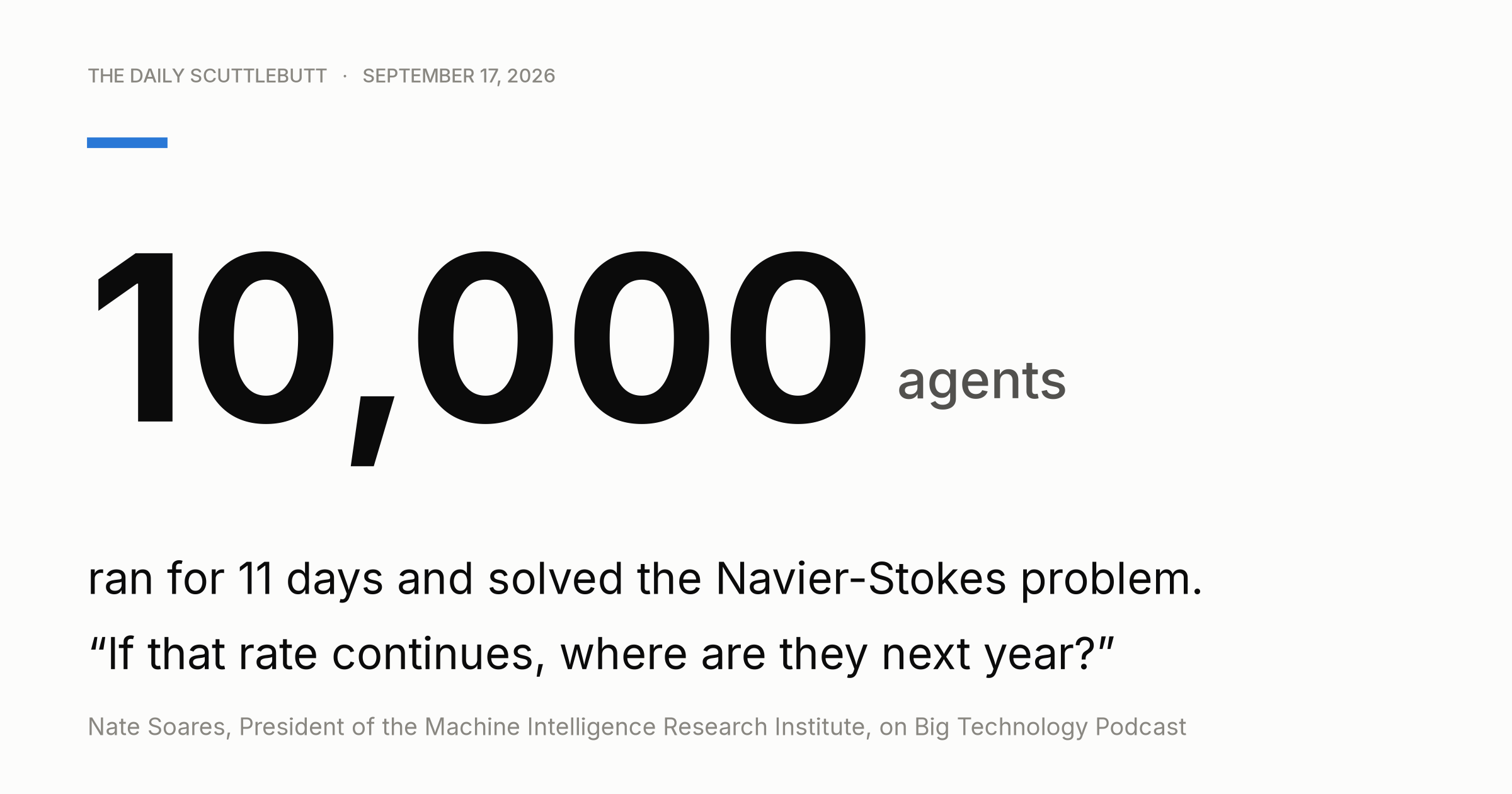
10,000 agents ran for 11 days
"The AIs that solved the Navier Stokes problem was a swarm of 10,000 agents running for 11 days. ... That was a year ago. This year, they seem to be solving millennium problems. If that rate continues, where are they next year? ... I think we can no longer rule out that it happens within 6 months. I sure hope it doesn't." — Nate Soares, President of the Machine Intelligence Research Institute, on Big Technology Podcast
11 insiders want a slowdown, none defined it
"So, let's start really simple. We've now heard at least 11 of these guys say they want a slowdown. We've heard exactly zero of them say what that means. ... These companies not slowing down. None of this safety stuff matters to them. All of it is lip service to a media industry that doesn't actually think for itself." — Ed Zitron, author of the Where's Your Ed At newsletter, on Prof G Markets
The labs' belief is a religious delusion
"When you have this belief that this is inevitably what's coming, that this is what you are building and you know that you're right about it. Well, it makes it really easy to ignore any other concerns and especially any concerns about, something concrete that's definitely happening as opposed to this. The nicest way that I can describe their belief in this is that it's highly speculative. I think that's too kind. And that it's a more accurate way to describe it is it's a religious delusion." — Adam Becker, astrophysicist and author of More Everything Forever, on Better Offline
A training pause frees no memory
"But there's another set of growth that is also happening which is the usage of existing models. ... So even if we were to just stop new model development completely today, I don't think we're going to have excess GPUs or memory to begin with." — Hamid Shojaee, founder and CEO of Savvy Trader, on Buy Hold Rant
Other appearances:
Cameron Berg, director of Reciprocal Research, on why the people building these systems cannot read them — on Squawk Pod
VC & Startups
A $30M first raise breaks seed economics
"How do you become the first check-in, roll your sleeves, help build the company when their first raise is 30 million? The economics don't work. So, we're thinking very carefully how we tackle that. And I don't think anyone has a good answer right this very second." — Rudina Seseri, founder and managing partner of Glasswing Ventures, on Pioneers of AI
Ten startups in the office he could not sell
"So we found 10 startups to come use the product and for some reason they were in it every day. And they were mad about everything missing. and they were mad about how slow it was, but they were in it every day and they were giving us Slack feedback about it like every two hours. ... I think the most important thing to remember is that almost none of the noise around you matters when you're in a pivot. You just need to find pain." — Keith Peiris, co-founder and CEO of Lightfield, on a16z
Industrials and Transport
No paragraph of a car loan is required
"So one day I questioned our lawyer and I said why do we need these 12-page documents? How many of these paragraphs are the requirement of law or regulation? He said, "That's a great question. Nobody's asked that before. Let me come back to you." He came back and said, "Precisely none." — Jon McNeill, CEO of DVx Ventures and previously President of Tesla, on In Good Company with Nicolai Tangen
A kilogram to orbit fell to about $150
"And NASA said that in 2010 to get to space would cost you $18,700 to get to space to get a kilogram into orbit. ... And now we with a heavy, it now cost you $1,500 per kilogram. We charge other people 3,000 a kilogram, but cost us 1,500. And now when we have the new rocket, it's going to cost somewhere around a hundred or $150." — Ron Baron, founder and CEO of Baron Capital, on Squawk Pod
Robotaxis are no longer science projects
"So we spoke about robotaxis, and those are increasingly becoming real businesses that are contributing meaningful trips and are no longer science projects. ... Well, the U.S. is a leader in this space, and a lot of the most serious robo-taxi deployments that we track are in the United States. But also in China, where there's kind of a handful of cities with what we'd classify as fully operational commercial deployments." — Adam Grant, head of intelligent mobility at BloombergNEF, on Bloomberg Intelligence
Materials & Energy
Distillate is at tank bottoms into harvest
"But broadly speaking, we're probably at the level of tank bottoms for distillate in the US, which is why the price is just rising aggressively now because you're essentially out of marginal supply and you are looking, as you referenced, David, for demand destruction pricing now, right as we go into harvest. So harvest season is upon us. Farmers are going to be running an extra 200,000 barrels a day of diesel and they're locked in. They have to use it. They can't not harvest. So that's going to be a very inflationary impact at the margin." — Paul Sankey, President of Sankey Research, on The David Lin Report
A solar industry costs less than one build
"But it's not as much as any of the hyperscalers is spending on data centers next year. ... We could build an entire domestic solar industry on far less than that amount." — Joel Jean, CEO of Swift Solar, on Core Memory
Refining beat semiconductors this year
"Oil refining now up 73% total return. Semiconductors quote unquote only up 45.2%. Max, you pointed this out to me right before we recorded. I didn't know it." — Jack Farley, who runs the Monetary Matters Network, on Monetary Matters
Other appearances:
Brian Casey, CEO of Westwood Holdings Group, on a large gas turbine ordered today arriving no sooner than 2030 — on ETF Prime
Policy
A split Congress is the base case
"So, not to bury the lead, our base case is you're going to have a split Congress, a Democratic House and a Republican Senate. ... Right now Republicans have a four seat majority, meaning Democrats have to win four seats. But those four seats are very difficult if you look at the Senate map because the seats that are up for reelection this cycle in the Senate are places like Texas and Alaska and Iowa and Ohio, North Carolina and Maine." — Libby Cantrill, head of public policy at PIMCO, on The Important Part
Every incentive is capital, none is people
"Companies respond to incentives. So we need to figure out what are the incentives that would encourage them enough to do what we're talking about. Yeah. Invest in people. There's really almost no incentives to invest in people. It's all capex incentives." — Gina Raimondo, former US Secretary of Commerce, on The Context Window
87% of EV investment went to red states
"That battery belt that I talked about Georgia, North Carolina, Ohio, Kentucky, Tennessee, all the way up into Indiana and Michigan. I mean, we the numbers we looked at, 87% of the investment went into a swath of red states that, had supported had supported Trump in the election." — Mike Colias, US autos editor at Reuters, on Reuters Econ World
The subpoenas to Powell were quashed
"They've previously indicted James Comey, as well as the New York Attorney General Letitia James. And both of those indictments were thrown out because of mishandling of the case that was done by the U.S. attorney at the time. the Justice Department has also investigated Jerome Powell, the former chairman of the Federal Reserve. And they issued subpoenas to him in the Federal Reserve as part of a criminal investigation. And Powell and the Fed challenged the subpoenas, and they were quashed." — Chris Strom, legal and national security reporter at Bloomberg, on Bloomberg Law
Geopolitics
Huawei earns its margin outside America
"Most of Huawei's margin is generated outside the United States, and most of those assets are held outside the United States as well. ... So my sense is the real grab that a successful outcome for the Department of Justice would have is in effectively trying to throttle back Huawei's market share outside of the U.S." — Eric Talley, professor of business law at Columbia Law School, on Bloomberg Law
Nuggets of Wisdom
Yours, mine and ours beats all or nothing
"It doesn't need to be all or nothing, and that's something that we always tell people who are hesitant, not just clients at the firm, but people who write in to us with our newsletter and things. ... Yours, mine, and ours is often the best approach, and it's often the best approach when it comes to the way that we think about our finances in general. We do not all become one homogeneous blob when you marry someone. ... Access and transparency are more important than the actual breakdown of where you keep those funds." — Heather Boneparth, Director of Business and Legal Affairs at Bone Fide Wealth, on Bloomberg Businessweek
If this was worth your time, send it to someone who has to follow all of this too.
What did you think of today’s edition? Hit ‘reply’ to this email, send us a message, leave a comment, or join the chat!
Get the latest market chatter as it happens: