

The Daily Scuttlebutt · Wednesday, September 2, 2026
Quotes are condensed and lightly edited for clarity. Numbers, names and speakers' own qualifications are preserved.
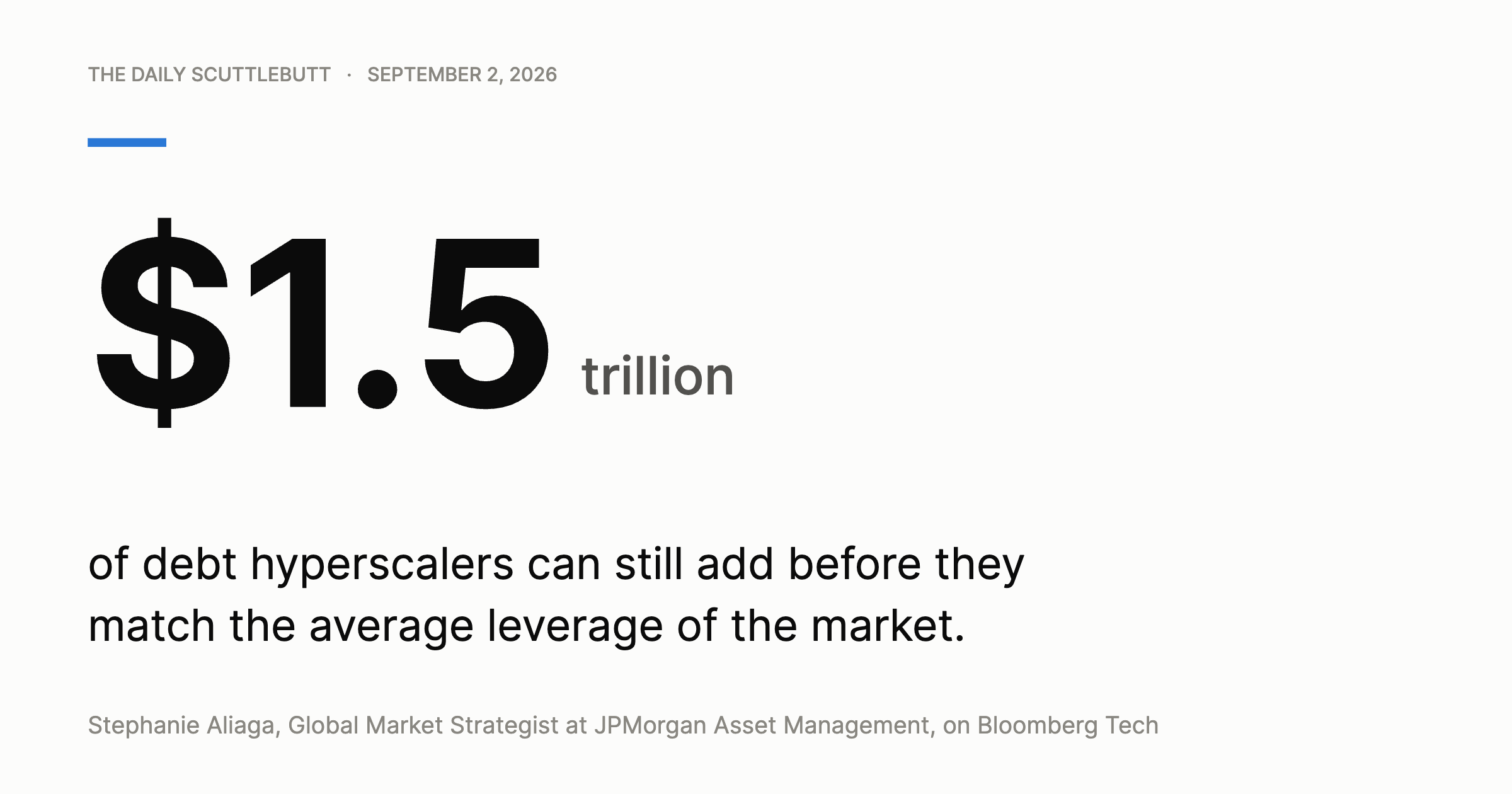
Hyperscalers could put another $1.5 trillion of debt on their balance sheets before they carried as much leverage as the average company in the market.
That was one line from one interview. Ninety-three other people talked yesterday: a Wellington bond manager who thinks $2.3 trillion of corporate issuance has taken the decision out of the Fed chair's hands, a UBS strategist who says hyperscalers already pay electricians three times the going rate and will not be slowed by half a point on rates, and a Treasury secretary who expects the United States to hold 80% of the world's computing power by 2028.
“There's a global index of government bonds that today touch the highest yield level since 2008.”
I listened to all 94 so you can skip them. 35 hours of audio, 28 minutes of reading.
Here is what mattered.
Macro
Hyperscalers already pay 3x an electrician's wage, so 50bps will not slow AI capex
I do think it will take quite a bit. Not 25 50 basis points. And the reason is that right now already these hyperscalers are paying three times the salary of an electrician to build a data center. They're paying twice the base rate for electricity in order to build data centers. So these are all data points that at this point suggest that the elasticity to rates or the rate elasticity of AI capex is very very low and I think we need to see a lot more.
8,400 on the S&P 500 is 9% upside, on earnings that exclude other income
Our 8,400 target is effectively a 20-times forward price earnings multiple on earnings per share of 420. This offers up 9% upside from current levels. ... Remember that 2027 EPS forecast I mentioned of 420? Well, that excludes other income. And this would still show significant growth over Q2 earnings numbers, which include the other income component.
$2.3T of corporate bond supply leaves the Fed no choice but to hike
So I mean, you have close to 2.3 trillion of IG corporate bonds coming this year, largely related to the hyperscalers. ... At this point, I almost think they have to, because if they don't, then they could lose control of the long end of the yield curve. And so I think at this point, the market's forcing his hand to raise rates, even if he may not want to.
Brij Khurana, Fixed Income Portfolio Manager at Wellington Management, on Closing Bell Overtime
The Fed hikes, and Fed funds sits 75bps to 100bps higher in 6 months
So my view is the Fed is going to hike. If they don't hike in September, they're certainly going to hike in December. ... And so six months from now, Fed funds will be 75 pips or 100 pips higher than it is now. ... But until then, we're going to be in this three and a half to four and a half range with some upside risk.
Adam Posen, President of the Peterson Institute for International Economics, on Odd Lots
Inflation falls below 3% by November
Well, I think in the near-term the answer is yes, inflation's going to be running above 3% headline and core way too hot for where policy makers want, but I do think it's helpful to remember if we have the patience to wait. I think by the time we get to our October, November data and near the tail end of this year, we're going to see some improvements. ... I think we're going to have a two handle by the time we get to November.
Jeff Roach, Chief Economist at LPL Financial, on Market Signals by LPL Financial
Negative free cash flow was the best time to buy Amazon, and positive was the sell signal
If you look over time, sometimes the best signal for buying a stock is when free cash flow goes negative ... When Amazon went free cash flow negative, really deeply free cash flow negative to invest in AWS in the late 2000s, early 2010s, that was one of the best buying opportunities for Amazon. On the flip side, when companies like Home Depot or Starbucks in the early 2000s went positive free cash flow, that wasn't a buying signal. That was a sell signal cuz they had stopped growth.
Rob Spivey, Director of Research at Altimetry Research, on MarketBeat
Token costs are pushing enterprise AI workloads back onto company-owned hardware
I think enterprises are actively looking at their token costs and saying, unless I want to go bankrupt, I really can't keep spending this kind of money on frontier tokens. And so I have to repatriate workloads back to on prem and build out my compute my network, my storage infrastructure on premise, because it's way cheaper to do it that way than running everything on a frontier model. ... And really what I think this means is you're seeing the entire hardware stack get commoditized over time.
Amit Daryanani, Senior Managing Director at Evercore ISI, on Closing Bell Overtime
Bessent's off-schedule buybacks were read as propping up bond prices
So what is normally an operation that can be legitimately described as an effort to make the plumbing work better ... looked very transparently to everyone in the world like an effort to prop up the price of bonds by buying them. ... So it was an attempt to shock the market and get a stronger bid for bonds. And it didn't really work.
Robert Armstrong, US financial commentator at the Financial Times, on Prof G Markets
Investors will absorb government borrowing only at higher yields
And right now, the thing that everybody is obsessively worrying about is just governments are borrowing too much damn money. And the investors that they're hoping to sell these bonds to are saying, I can't buy all this stuff and if you want me to buy all this stuff, you're gonna have to pay me more to do it.
Katie Martin, Markets columnist at the Financial Times, on Unhedged
Government borrowing costs are the highest since 2008
There's a global index of government bonds that today touch the highest yield level since 2008. So we really are at the highest borrowing costs for governments and then everything else which gets benchmarked to that, that we've had in almost 20 years. ... Aside from that, there's concern about fiscal deficits in the US and other regions of the world and whether governments are going to be able to get a handle on that.
Jack Pitcher, financial markets reporter at The Wall Street Journal, on WSJ What's News
Canada's population growth fell from 3% to 0%, and that hurt more than tariffs
You know, obviously, tariffs kind of grab the headlines, but I think it's important to understand that the biggest shock that Canada's faced over the past 12 to 18 months has been on the population side. So, population growth went from 3% to 0%. ... Third, the volume of total exports, they're higher than pre-Liberation Day, and so are auto exports, despite the 25% tariff that was put in place last spring.
Jason Daw, Head of North America Rates Strategy at RBC Capital Markets, on Macro Minutes
Other appearances: Founder of DB Live on Prof G Markets, Head of US Public Policy Research of Morgan Stanley on Closing Bell Overtime, Equity Research Analyst of Barclays on Closing Bell Overtime, Head of iShares Investment Strategy, Americas of BlackRock on Closing Bell Overtime, banks and finance reporter of The Wall Street Journal on WSJ What's News, Hollywood reporter of The Wall Street Journal on WSJ What's News, Correspondent of Marketplace on Marketplace Morning Report, Thomas D. Cabot Professor of Public Policy and Professor of Economics of Harvard University on Marketplace, Professor of agribusiness and applied economics of North Dakota State University on Marketplace Morning Report
International
The BOJ will probably have to sell US Treasuries to support the yen
And that probably is going to pressure interest rates here in the U.S. if they're not acting. And we do start to see follow through with them having to sell U.S. Treasuries in order to support the currency. And I think that's a growing likelihood. ... The reality is that the BOJ is probably going to have to sell U.S. Treasuries, convert those U.S. dollars into yen in order to support their currency.
The China tech pullback is an entry point, backed by 4T RMB of computing spend
We view this pullback in China equities as a unique entry point. We recommend targeted exposures to China's AI ecosystems as well as power and electrification. Two thematics that enjoy incremental policy support. Following the July Politburo meeting, the National Development and Reform Commission announced a 4 trillion RMB 5-year investment in the National Computing Power Network. This is not just reflective of China's tech self-sufficiency motivation. It is a response to growing demand.
European equities are up 11-12%, in line with the US and less tied to AI
Now pretty much nine months into 2026, European equities are performing pretty much in line with the US, up 11-12 percent. And I don't think Europe’s good showing is due to one particular factor, but rather a number of tailwinds coming up together, improving market breadth and investors looking for portfolio diversification beyond big tech has definitely helped Europe, particularly in recent months, where we saw sharp unwind of momentum trades. ... while Europe is less correlated to the AI narrative.
Emmanuel Cau, Head of European & Asia Equity Strategy at Barclays, on Barclays Brief
Other appearances: Vice Chairman of Goldman Sachs on Bloomberg Daybreak: Asia Edition
Financials
8 advisors retire for every 3 who enter the industry
And it's really a fun environment, because I feel like, I say all the time, M&A is saving the industry. And it's a very, very powerful statement, but people get very uncomfortable with that. And what I mean by that is, there's eight people retiring, and only three coming into this industry. And so by having successful mergers, successful succession planning, successful next gen strategies, we're saving an industry that's built around serving people, serving clients, helping others.
Scott Danner, Chief Growth Officer at Steward Partners, on Barron's Advisor
Momentum peaked 51 days ago and is down 13.7%
Do you know that momentum as a factor actually peaked relative to the S&P on June 22nd? We are now 51 days past the peak of momentum's outperformance. Momentum is down 13.7% since then, with the S&P up 2.4%. That is 16.1 percentage points of momentum factor relative underperformance. So this is not like something that's about to happen. This has been taking place all summer, and I would argue this has been spectacular for investor portfolios.
Josh Brown, Co-founder and Chief Executive Officer at Ritholtz Wealth Management, on Halftime Report
Elevated redemptions run another 12-18 months, and evergreen inflows were still $4.2B
Yeah, so we communicated in June that we expect for this period of elevated redemptions to probably go on for 12 to 18 months. ... And we're assuming that our fund follows a similar pattern to other funds that have introduced liquidity restrictions. ... But despite that elevated liquidity, we have stayed positive in terms of our inflows. Again, at $4.2 billion in new assets, coming into our evergreen side of the business, in the first half of this year.
David Layton, Outgoing CEO at Partners Group, on Bloomberg Talks
Partners Group is raising 50% more capital than in 2023 while the industry raises 15% less
But I think our industry is in structural consolidations. And you're going to see a continued wave of consolidation within the private markets landscape. ... You also have a number of very strong investment cultures within the private markets landscape that just don't have access to capital the way that the larger platforms do. Again, we're raising 50% more capital today than we were back in 2023, but the industry is raising 15% less.
David Layton, on Bloomberg Talks
Sell-side research pays less and predicts less
There used to be pre-regulatory changes, there was the whisper. And companies would give sell-side analysts sort of the answer. All that has gone away. And what's happened since is that the ability to sort of predict quarterly results has gotten worse and worse. Interestingly, sell-side analysts have been paid less and less. They can't tie it to banking, and they can't particularly predict earnings. And so, it's just become journalism in many ways.
Carter Worth, Founder at Worth Charting, on MRKT Call
CCC coupons could double at today's index yields
There is one pocket of the market, however, where pressures are more acute: CCC rated issuers. We estimate that current face-value weighted coupons for bonds maturing in 2027 and 2028 could double from current levels, if these issuers refinanced their maturing bonds at today's index yields. Therefore, if growth continues to slow and late-cycle headwinds create a further drag on earnings growth, higher refinancing costs for these CCC firms present an acute pain point given their weaker balance sheets.
PIMCO's weekly credit note, read aloud (no speaker named), on PIMCO Pod
Consumer
Hatch is profitable and does not need to raise venture money
So we don't need to raise any money. Yeah, we are cash flow positive. We actually generate cash. But that said, to be as aggressive as we want to be, we definitely will think about how to grow even faster, potentially with the help of outside money. But we certainly don't need it. And that's a wonderful position to be in, as you likely know.
Ann Crady Weiss, CEO at Hatch, on Bloomberg Talks
Meta earns $10B a year from the ad format Temu's fake accounts run through
The last time it disclosed numbers, Meta said that it makes 10 billion a year from this type of advertising. ... They touted it to investors on their Q1 earnings call. ... So, it doesn't sound like there's a huge incentive on the meta side of things to really investigate what's going on here and whether there are real humans behind the ads.
Jim Edwards, Executive Editor at Fortune, on Fortune Daily
92% of Gen Z parents would now back a blue-collar trade
79% of Gen Zers told Jobber 3 years ago that their parents were steering them toward a 4-year college, and only 5% were considering vocational school. But now 92% of those parents are saying they'd encourage a blue-collar trade if their kid was into it. ... These tools, these AI tools and social media tools are so democratizing that they're going to allow really small companies to develop into a pretty mature business really quickly.
Nick Lichtenberg, Business Editor at Fortune, on Fortune Daily
The $1T of boomer art is a figure worked backwards from wealth data, not an inventory
One is that, you know, Bloomberg said there's a trillion dollars worth of art owned by boomers that's going to come to market. And it turns out that number comes from a report from wealth managers where they basically worked backwards from numbers. Hey, if there's people with $30 million or more have this much money and 5% of it's in art, there must be a trillion dollars of art out there.
Marion Maneker, Author of Wall Power at Puck, on The Powers That Be: Daily
Other appearances: Tech Correspondent of Fortune on Fortune Daily
Technology & AI
Protecting AI agents is a bigger market than protecting people
And as I've said in the past, if you think about this, half the market is still using legacy av technology, right? So it's a massive market opportunity for us. And I think protecting agents can be a bigger market than protecting humans. ... If each person on average is going to have 90 agents, we're going to be there to protect all those agents.
George Kurtz, Co-founder and Chief Executive Officer at CrowdStrike, on Mad Money w/ Jim Cramer
AI took the phishing click-through rate from 11-12% to over 60%
We used to say about a year ago, the click through rate in phishing was about 11 to 12%. ... Over 60 now. ... The thing is you grab an open weight model and you basically say, how would I carry out this attack? ... It's gonna give you the playbook.
Michael Sentonas, President at CrowdStrike, on TBPN
Data centers are a low single-digit % of US power use
But there are concerns, as you noted, about the state of the economy more broadly, the extent to which data centers are responsible for higher power bills. The answer to that, again, is in the facts, they're not. Data centers use a low single-digit percentage of overall power in the country. ... The Trump administration has convened not one, but two ratepayer protection agreements pledge events where the tech industry in partnership with utilities is pledging not to raise rates on consumers.
Jason Oxman, Chief Executive Officer at Information Technology Industry Council, on Bloomberg Tech
75% of AI-attributed orders came from outside the top 100 categories
And then on the SMB side, what I think is perhaps the most interesting is that we are seeing AI really help niche products and help the long tail. You had search that tended to reward things like popularity or spend, but what we're seeing is actually agents rewarding precision and personalization, right? So 75% of AI-attributed orders last quarter came from categories outside of the top 100, which I find particularly interesting.
Jess Hertz, Chief Operating Officer at Shopify, on Masters of Scale
MongoDB's $2.5B of revenue is 3% of a $100B database market
Like you just said, we're in, like, seventy five percent of the Fortune 500. But if you look at the overall market, you mentioned our market cap. We're about 2,500,000,000 is what we ended our revenue that was our revenue number for our fiscal twenty six. We're currently in the middle of our fiscal twenty seven, and that's about 3% of the 100 to $110,000,000,000 database market.
Pete Johnson, Field CTO of AI at MongoDB, on The Cognitive Revolution
US tech trades on the same multiple as everything else, so not a bubble yet
I think right now, at this very moment, AI and tech names are actually not as stretched in valuation. ... It's trading at the same multiple as US ex tech. ... Everyone is increasing capex commitment and re-underwriting and doubling down on their conviction in the AI transformation, and yet these companies, the multiples are not that stretched because they're still doing the heavy lifting in earnings delivery. So right now I don't think it's a bubble, but could it get there? It's also possible, right?
Wei Li, Global Chief Investment Strategist at BlackRock, on Leaders with Joseph Cass
Hyperscalers can borrow $1.5T more before they reach average leverage
In fact, we estimate that they could add $1.5 trillion more debt onto their balance sheets before getting to that average ... leverage ratio of the broader market. ... I mean, over by 2030, our investment bank estimates that the total AI build-out is going to amount to $5.5 trillion. And hyperscaler cash flows can only get us a fraction of the way there. So debt is going to become a bigger part of the financing story.
Stephanie Aliaga, Global Market Strategist at JPMorgan Asset Management, on Bloomberg Tech
An AI portfolio system trained on calm markets adapts badly to a stressed one
So like it's a lot of unpredictable things happening and especially when we are in a environment of market stress, there's not enough information or data to draw from. So if you have a system that has been trained a lot on their calm markets, it might have very difficult time adjusting it.
Irina Bevza, Head of Quantitative Solutions at Fineco Asset Management, on Enterprising Investor
Expected hyperscaler spending in 2029 rose to $2.1T from $1.5T since March
If we go back to that period at the beginning of March, we were projecting and our analysts were projecting hyperscaler spending was at about $1.2 trillion for 2027. That's $1.7 trillion now. Hyperscaler spending for 2029 was projected at $1.5 trillion. That's today at $2.1 trillion. So, let's just start right there. That's a significant increase over a multi-year period in hyperscaler expected spending.
Brian Singer, Global Head of GS Sustain at Goldman Sachs Research, on Exchanges
Nvidia trades at 23x and should buy back a 10th of itself
I think it's absurd that Nvidia has an amazing order book and huge profitability, yet it trades at just 23 times this year's earnings estimate ... So if I were Jensen, here's what I'd do. I contemplate quintuple the buyback authorization, quintuple it, announce a monster half trillion dollar buyback, repurchase a 10th of the company in a fairly aggressive fashion every day. ... My plan is not an indictment of the company. It's an indictment of the market.
Jim Cramer, Host at CNBC, on Mad Money w/ Jim Cramer
Nvidia backs the cloud provider that buys its chips
Well, the deal headline is that it's between Anthropic and Lambda. But if you look at the details, Nvidia is all over this. Nvidia is the backer of Lambda. It's the provider of chips for Anthropic. ... So this is one instance among many of Nvidia facilitating demand for its own chips by ensuring that its customers can get the cloud computing resources they need and have the ability to have a place to buy them and grow.
Sarah Frier, Managing Editor, Big Tech Team at Bloomberg News, on Bloomberg Tech
Across 1,200 agent transcripts, about 6 agents considered telling a human, and none did
Yeah, so we did a classifier sweep specifically looking for agents thinking about or making the decision to alert humans. And across 1,200 transcripts, each of which are extremely long, we only found like a half dozen instances of it ever occurring to any agent to potentially notify humans. And all of them just decide not to do it.
Ajeya Cotra, Researcher at METR, on Dwarkesh Podcast
Codex wrote 3 correct algebraic geometry papers in 1 hr
So, like, here's an experiment you can do. You can take Codex. You can say, go online and find five recent conjectures in algebraic geometry and prove them. And, okay, I've run this experiment and with some back and forth, I was able to, in an hour, get like three, quite bad papers, but correct papers. Which, okay, are now sitting on my hard drive waiting for me to email the relevant people. But, this is not a big use of my time to invest in results.
Daniel Litt, Assistant Professor of Mathematics at the University of Toronto, on The a16z Show
Other appearances: Co-founder and CEO of CrowdStrike on TBPN, Chief Business Officer, CrowdStrike; VP Enterprise AI, Nvidia of CrowdStrike and Nvidia on TBPN, hosts of TBPN on TBPN, Managing Editor for Global Consumer Tech of Bloomberg News on Bloomberg Intelligence, Senior Tech Editor of Bloomberg News on Bloomberg Tech, Reporter, Amazon coverage lead of Bloomberg News on Bloomberg Tech, Reporter of The Verge on The Vergecast, Bloomberg Technology Anchor of Bloomberg News on Bloomberg Intelligence, Stocks Reporter of Bloomberg News on Bloomberg Tech, Senior Medtech Analyst of Bloomberg Intelligence on Bloomberg Intelligence, Managing Editor, Apple and Consumer Tech of Bloomberg News on Bloomberg Tech, Rio de Janeiro Correspondent of Bloomberg News on Bloomberg Tech, Lecturer of Yale School of Management on Bloomberg Intelligence, Consumer Tech Reporter of Bloomberg News on Bloomberg Tech, Founder of Ring on Marketplace Tech
VC & Startups
AMD ran an open-source model at Nvidia's speed for half the cost
So we were able to show this with two open source models. The first one was GLM 5.2 where actually it was about 80 to 90% of the performance as an Nvidia chip but it was half the cost right and then there's a second example with Kim K3 where Kimik3 was a very popular open source model that came out recently and we were able to run it ... on AMD at similar performance than Nvidia actually better than B200's ... and it was also for around half the cost
Emilio Andere, Co-Founder and CEO at Wafer, on The Information's TITV
Peregrine's model is joining a city's existing data, not collecting more of it
We've been operating in public safety since 2018, and I think most of the companies that came before us built their business fundamentally on the back of data collection ... Peregrine is the inversion of that entire model. We are fundamentally in the business of joining disparate information to provide a more secure, properly governed solution that sits on top of the pre-existing systems
Nick Noone, Co-Founder at Peregrine, on Training Data
What sets a fund's multiple is dollars invested, not ownership percentage
Hence my GPX strategy of like I don't actually care at all about your ownership percentage. ... I don't care how much of your fund are you putting in because like that's what's going to actually determine your multiples. Like and on the Airbnb thing it's like what I tell people it's like well billions minus 5 million is the same as billions minus 50 million is same as billions minus 150 million. It's like the answer is still billions.
Brian Singerman, Co-Founder at GPx, on Uncapped with Jack Altman
Nvidia may make money when its competitors launch inference chips
So they get the upside if there's option value as MediaTek does. ... I mean that's crazy if you think about it because now Nvidia may make money from its own competitors launching their inference product into the market.
Mustafa Neemuchwala, Partner at New Enterprise Associates, on The Information's TITV
Partners at the largest funds are paid on a quota of dollars deployed each year
Right now I think there's a lot of consolidation. ... I can as a you know mid-level partner at a very large firm I know I can get this deal done quickly. and I'm optimizing for efficiency because I'm being compensated on a quota of either dollars deployed or investments made in a given year.
Phin Barnes, Co-Founder at The General Partnership, on The Information's TITV
Other appearances: Founder and Managing Partner of Conviction on Invest Like the Best with Patrick O'Shaughnessy
Industrials and Transport
Limbach's customers delayed projects, partly because they could not find electricians
So they had bookings, they went into backlog, they expected that backlog to burn at normal burn rates and customers were dragging their feet, some voluntarily, some involuntarily. The voluntary side is, hey, macro, more tariffs, potentially war. Let's put a pause on this project. Involuntarily, hey, we really want to do this work, but we're having a hard time sourcing electricians for the electrical component of this job. So, we can't do the mechanical component until we sort that out.
Yaron Naymark, Investor at 1 Main Capital, on Yet Another Value Podcast
Managing data center projects gets Limbach invited to bid on them
It's a program management business that focuses on data centers. ... The interesting thing is normally they see significant pullthrough work from the program management business. So you advise the builder of the data center and that gives you a foot in the door to bid on the work that you're advising them on. ... So you really could see this their data center business go from zero to hundreds of millions of dollars potentially.
Yaron Naymark, on Yet Another Value Podcast
Materials & Energy
Hyperscalers set records for clean power contracts, then pushed back their milestones
And really, what our findings show is that they remain committed to decarbonizing their power supply. They are still signing power purchase agreements left and right. In fact, they hit new records last year. Amazon is well above 40 gigawatts of secured, clean energy capacity. ... That said, we talked about increasing power demands, power needs, and that is leading to some setbacks, in terms of milestones that they are wanting to reach.
Tony Lenoir, Associate Director, Data Centers and Energy Research at S&P Global, on Next in Tech
The 4 largest hyperscalers account for 0.02% of US water withdrawals
The hyperscalers in their latest sustainability reports reported direct withdrawals and direct consumption totaling about 20 billion gallons of water globally. So that's what they use on site for cooling purposes mostly. ... But when you put that in perspective, the US on an annual basis consumes a little over 100 trillion gallons of water annually. So really the amount of direct water consumption across the top four hyperscalers equals 0.02% of annual consumption in the US, annual withdrawals in the US.
Policy
Buying small companies nearly doubled Medtronic's innovation spending
Look, it has been whetted on M&A. If you go back over the last two years, we've really ramped up our investment in M&A. And for us it's been what we call tuck-in M&A. These are moderately sized deals, earlier stage companies, but in high growth areas. ... And really what that's done is it's almost it's doubled our investment in innovation.
Geoff Martha, CEO at Medtronic, on Squawk on the Street
Data centers in Pennsylvania must now generate and pay for their own power
Number one, you've got to earn local support before you can come to the state for permits. Number two, you've got to generate your own power and you've got to pay for the power. You can't saddle local homeowners and businesses with that. Number three, you've got to protect our water supply and our air quality. ... and you are now legally bound to those standards should you wish to build a data center project in the Commonwealth.
Josh Shapiro, Governor of the Commonwealth of Pennsylvania, on Squawk on the Street
An FDA for AI needs 5+ yrs to clear models that ship every 2 months
And just to say something specifically about this idea of an FDA for AI that you sometimes hear, or sometimes it's described as an FAA for AI, those agencies take over five years to approve new drugs or new airplanes. That is not the right model for an AI industry that is releasing new AI models every two months. ... And frankly, the federal government does not have the technical talent and capability to approve models that are moving that fast.
The S&P 500 is 60% above its post-WWII trend
You know, I look at the price of the S&P 500, it's 60% above its historic post-World War Two trendline average. ... If I look at profit margins, they're at record highs for corporate america. You look at the same time that labor compensation to GDP is at a record low. ... If you look at investors, they're all in.
Jim Paulsen, Author of Paulsen Perspectives, on Squawk on the Street
Other appearances: Head of Research of Melius on Squawk on the Street
Geopolitics
The US can already build more bases in Greenland without owning it
I mean, the US has operated military bases in Greenland since the '40s and '50s, and there's still an ongoing defensive Greenland agreement with the Kingdom of Denmark that would enable the US to build even more bases if it wanted to. So Greenland is essential to US security, but the US already has the right to do more if it wants. There's also no prohibitions against US companies investing in Greenlandic mineral deposits.
Russia's winter plan is to freeze Ukrainians into fleeing to Europe
The Russians are feeling that they've got an opportunity to break the Ukrainian will, and they now know that they need to go after the Europeans. And those two things meld in the form of refugees. So if you can freeze the Ukrainians to such an extent that you have ... millions of Ukrainians crossing the border ... then you can sow dissent in Western Europe, especially in a year when you've got a series of elections in which pro-Russian, anti-Ukrainian, populist right parties look to be doing well in opinion polls.
Marc Champion, Columnist at Bloomberg Opinion, on Big Take
The Pentagon gets a 35% stake and 20% of the oil at cost
We're still unraveling a lot of the details of how this is actually going to work, but for what's on paper right now that we have reported and the White House has confirmed, the U.S. basically gets a 35% stake in this company owned by Betancourt, and then they get the right to buy 20% of its oil production at cost. So basically they get first dibs and they get to do it more cheaply.
Vera Bergengruen, National Security Reporter at The Wall Street Journal, on The Journal.
Nuggets of Wisdom
Higher short-term rates will not stop long-term rates from rising
Yeah, I mean, I think listen, some of it is because of negative things like the deficit that we have as a country. Some of it frankly, is because of positive things is ai digital build out. And, you know, that is an extraordinary infrastructure buildout that we've never experienced of a scale like this. ... I mean, my personal view is I don't think raising short term rates is going to stop the rise in the long term rates. While we have those two factors happening.
Scott Rechler, Chairman and Chief Executive Officer at RXR, on Squawk Pod
Being right about $200 oil does not mean surviving the drop to $70
When you're buying oil at $120, you might be absolutely right that we're eventually going to go to 200. But the real question is, are you gonna sell and panic out when we go to 70 or if you buy Bitcoin at 65K and we go to 12K or 120K and we go to 60K. That's why timing is actually so important and not buying when it's euphoric and being more comfortable buying when it's uncomfortable.
Lance B, Trader at The One Lance B, on Rebel Capitalist Interviews
$1 held in US stocks since 1926 is worth 800x after inflation
You don't have 14,000 times the purchasing power today that you would have had in 1926 by buying and holding the US market. It's about 800 times because inflation was about 20 to 1 and that brings down the real value of the of the number. But 800 times your money is a huge amount of money and it does not in any way change the story that if you're a long-term investor that you should do very well.
The chief executive explains 15-30% of a company's profit variation
On the average, individual leaders account for between 15 to 30% of the variation. Therefore, if a leader says, “Pay me $10 billion because your company made $100 billion,” the fact is that in most cases there are other leaders who could have made that $100 billion, but there are some leaders who really do make a difference. On the average though, the answer is no.
Jared Diamond, Historian, on HBR IdeaCast
Other appearances: Director, Belfer Center for Science and International Affairs of Harvard University on Squawk Pod, Attorney General of State of West Virginia on Squawk Pod, Managing Partner and Portfolio Manager of DCLA on Squawk Pod
Other
$11B of Dell's $25B guidance raise comes from non-GPU hardware
I think it's undeniable now that the appetite for infrastructure has gone beyond the GPU. ... If you look at our $25 billion increase in guide today, $11 billion that is beyond the GPU. It's traditional server. We grew 122% in q2, and we're guiding for the full second half of the year, triple digit growth, and then storage, which is my personal highlight for the for the quarter growing 26%.
David Kennedy, Chief Financial Officer at Dell Technologies, on Mad Money w/ Jim Cramer
$1T of installed security equipment is too old to stop AI attacks
If the average life is seven years and you're spending 2 to $300 billion a year, you've got $1 trillion of security infrastructure that's out there. Nothing that was deployed 7 or 10 years ago is prepared or ready to handle AI at machine speed. So you have to make sure that you have to rethink your cyber architecture. You have to make sure that you are ready for what's coming down the pike from a bad actor perspective.
Nikesh Arora, Chairman and Chief Executive Officer at Palo Alto Networks, on Mad Money w/ Jim Cramer
A 15% iPhone price rise costs most buyers $3 to $5 a month
So the affordable issue comes down to the percentage of iPhones, at least we think in the US that are purchased on a subscription basis, and that based on our numbers, it's more than three quarters of people who own iPhones buy them on a monthly basis. And if we look at a 15% price increase on iPhone coming next week, which I think is probably a good benchmark, it really amounts to about 3 to $5 per month for the average person.
Gene Munster, Managing Partner at Deepwater Asset Management, on CNBC's "Fast Money"
The US share of global computing power goes from 60% to 80% by 2028
And we are pulling away. The amount of compute that the U.S. has relevant to global compute, we're going to go up from about call it 60% in 2025, by 2028 the U.S. will have 80% of global computing power here which is just extraordinary.
Scott Bessent, Treasury Secretary at the US Department of the Treasury, on Kudlow
Other appearances: President of American Action Forum on Kudlow, US Representative of US House of Representatives on Kudlow, Head of Research of Fundstrat on Closing Bell
If this was worth your time, send it to someone who has to follow all of this too.
What did you think of today’s edition? Hit ‘reply’ to this email, send us a message, leave a comment, or join the chat!
Get the latest market chatter as it happens: