

The Daily Scuttlebutt · Sunday, September 10, 2026
Quotes are condensed and lightly edited for clarity. Numbers, names and speakers' own qualifications are preserved.
Summary
Moody's now puts a number on the AI buildout that nobody wanted to hear: $300B to $600B of new economic value a year, just to break even on the funding costs and the depreciation.
That was one credit strategist's math. Tonight another 115 appearances worked the same fault line from every side — an Oracle bull and an Oracle skeptic arguing over the same $167B of debt, a Fed-watching economist saying the AI hiring cuts are smaller than the headlines, and the Treasury Secretary calling hyperscaler capex worth more than two points of GDP.
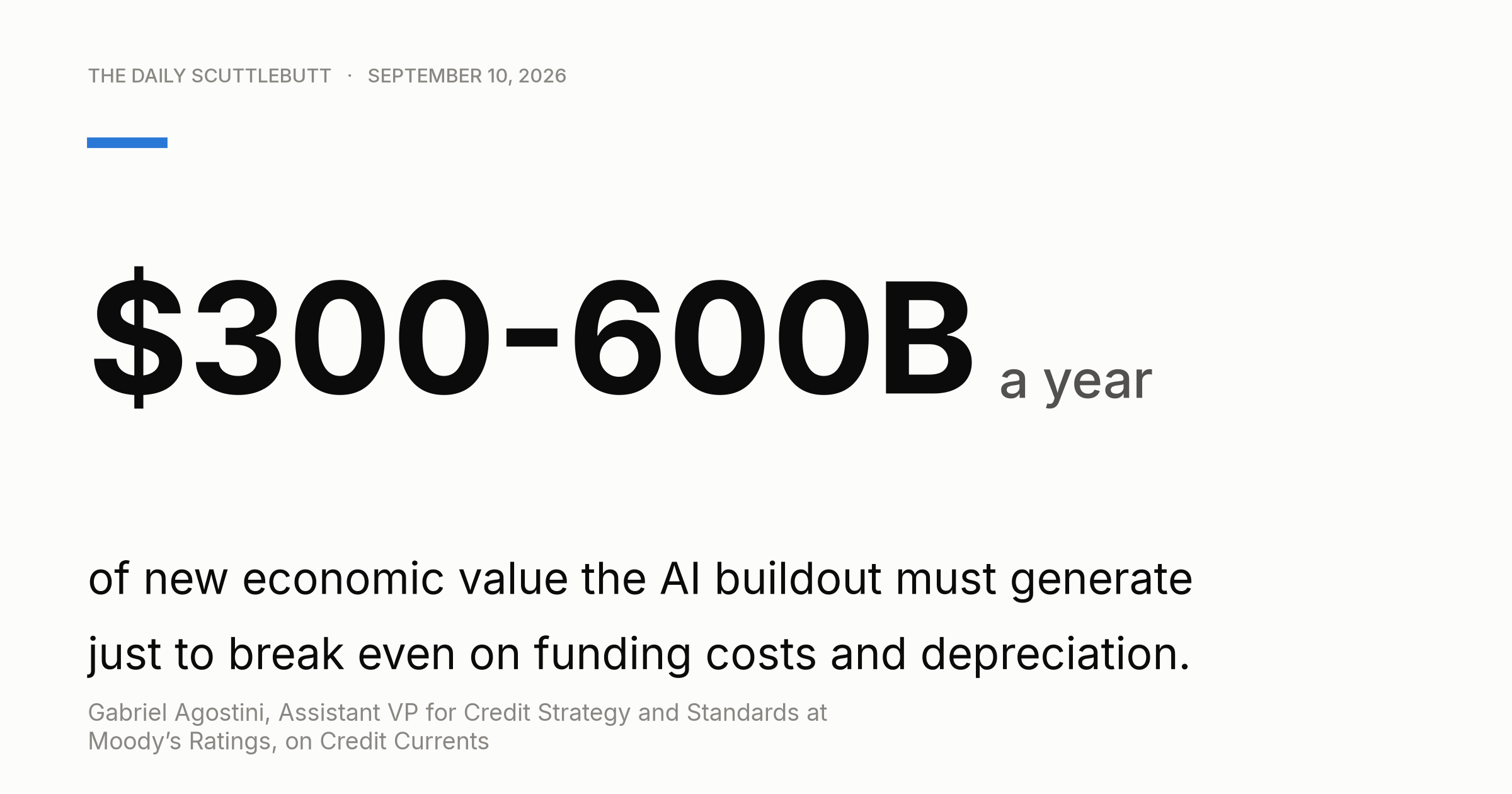
"And by our math, we calculate that investment will probably need to generate between 300 and 600 billion dollars annually in new economic value to break even on the funding costs and the depreciation." — Gabriel Agostini, Assistant Vice President for Credit Strategy and Standards at Moody's Ratings, on Credit Currents - Moody's Ratings
All 116 are covered here so you can skip them. 59 hours of audio, 30 minutes of reading.
Here is what mattered.
Macro
Banks reprice consumer loans off the curve in real time, not off Fed Funds
"The initial impact we've seen, you know, we've seen credit card rates go higher. We've seen automobile loans go higher. We've seen mortgage rates go higher. So the direct impact on consumer, which of course is not Fed Funds, which is what the Fed deals with, is already working its way through the market. That's a there's a real time reaction when the futures market trades up and the cash market trades up, banks reprice loans to their consumers almost instantaneously." — Gary Cohn, Vice Chairman at IBM, on Squawk on the Street
The Treasury can retire $2 of old discounted debt for every $1 it issues
"Ironically, that's an opportunity set for the Treasury and I think the Treasury has started to recognize that saying wait a second we can issue $1 of current coupon paper and retire $2 of low coupon paper that has a modest increase in our cash interest expense but in aggregate we are significantly shrinking the debt and that is a great strategy for any debt manager to pursue and at the end of the day that's exactly what the Treasury is." — Mike Green, CEO and CIO at Tier1 Alpha Asset Management, on Wealthion
Asset-liability buyers, not the Fed or Treasury, are what caps yields near 5%
"I think the market may step in at 5% before central planners. So, insurance companies, endowments, you know, there are the largest institutional money managers will likely be willing to chomp at 5% to take it in because from a asset liability perspective, that is big. That is very helpful." — Michael Lebowitz, Portfolio Manager at RIA Advisors, on Adam Taggart | Thoughtful Money®
Breadth has cracked and only the Mag 7 is hiding it
"Take for example the statistic where at the beginning of August 70% of names were above their 50-day. Today that number is 37%. So a big deterioration in the number of names participating in the bull market. But the reason why the index hasn't cracked is because of Mag 7. But the caveat with Mag 7 is hasn't made a new high since May." — Cameron Dawson, CIO at NewEdge Wealth, on On The Tape with Danny Moses
Hyperscaler capex is worth more than two points of GDP this year
"I think a lot of people in this room would know that every $300 billion is 1% of GDP. And we are seeing that the hyperscalers are going to spend at least $750 billion this year. Obviously, a lot of that's import, so it won't go directly into GDP." — Scott Bessent, U.S. Treasury Secretary at U.S. Department of the Treasury, on The Forum with Becky Quick
The AI buildout needs $300-600bn a year of new value just to break even
"By our math, we calculate that investment will probably need to generate between 300 and 600 billion dollars annually in new economic value to break even on the funding costs and the depreciation." — Gabriel Agostini, Assistant Vice President for Credit Strategy and Standards at Moody's Ratings, on Credit Currents - Moody's Ratings
AI competition reverses the usual order — layoffs come before capex cuts
"One of the risks of those AI companies is exactly what you just outlined in that the pressure for them to keep spending on capex and keep spending on the AI buildout in order to maintain competitive is so high that companies would perhaps rather lay off workers to save costs rather than stop spending on AI." — Liz Thomas, Head of Investment Strategy at SoFi, on MRKT Call
Gold now trades as a stock puppet, not a hedge
"The thing about gold is unfortunately gold fits in my stock puppet category. It's highly correlated. The 100 day correlation with the S&P 500 reached almost such a multi-deade high recently. It's around 0.52. Typically gold zero correlation, a negative correlation in the stock market." — Mike McGlone, Senior Commodity Strategist at Bloomberg Intelligence, on The David Lin Report
7% mortgages freeze the housing market through lock-in
"First and most obvious are mortgage rates. Today they breached 7%. Oh man. New existing home sales were awful. Rates kept were kept so long in this country that, frankly, you're almost going to have to double your mortgage rate if you buy a new place. So why ever sell your old place?" — Jim Cramer, Host, Mad Money at CNBC, on Mad Money w/ Jim Cramer
The $5,000 dividend is not happening, and the market is right to fade it
"I think the bottom line here is it's good that the market is fading this. This is not going to happen. We never saw tariff dividends, and we're not going to see a Trump dividend either." — Libby Cantrill, Managing Director & Head of Public Policy at PIMCO, on Bloomberg Surveillance
Warsh hikes next week or faces up to six dissents
"I think he's going to bite the bullet and raise rates. Because if he doesn't raise rates, I think there might be 4 or 5 or maybe six dissents, which would be, you know, unprecedented." — Jeremy Siegel, Professor of Finance, the Wharton School; Chief Economist at WisdomTree, on Closing Bell
Other appearances:
Janus Henderson Head of Multi-Asset Macro Investing Michael Contopoulos on AI is inflationary, not disinflationary — on Excess Returns
CNBC's Halftime Report panel Scott Wapner on hosting the hour around dueling calls on August's highs — on Halftime Report
Clocktower Group Chief Macro Strategist Eric Wallerstein on A hike can't reach the part of the economy that's actually hot — on Full Signal
Nasdaq Dorsey Wright Head of Research Miles Clark on energy stocks picked up eighteen relative-strength signals in eight days — on The Nasdaq Dorsey Wright Podcast
Nasdaq Dorsey Wright Head of Research Ian Saunders on participation gauges only work bought off a low, never sold off a high — on The Nasdaq Dorsey Wright Podcast
Curzio Research Founder and CEO Frank Curzio on PPI is running at more than twice the Fed's target — on Wall Street Unplugged
MarketBeat Analyst Thomas Hughes on Forward guidance was crony capitalism — on MarketBeat
PGIM Credit Co-CIO Greg Peters on The nominal-GDP-to-yield gap leaves room for yields to keep repricing — on Bloomberg Surveillance
The Economist Economics Correspondent Alex Domash on AI layoffs are small against labour-market churn — on Economist Podcasts
CIBC; Requisite Capital Equity strategist (Harvey); portfolio manager (Talkington) Chris Harvey & Bryn Talkington on The median midterm drawdown is 12-13% — on Closing Bell
Bank of America Private Bank Head of Portfolio Strategy Marci McGregor on Earnings revisions are being raised faster than cut worldwide — on Closing Bell
Nomura; NewEdge Wealth Chief Investment Strategist (Goldberg); CIO (Dawson) Andrew Goldberg & Cameron Dawson on 6.5% nominal GDP argues for a 5% ten-year — on Closing Bell Overtime
J.P. Morgan Wealth Management Chief Investment Strategist Phil Camporeale on says a 5% ten-year is not an alarm bell for the AI trade — on Squawk on the Street
RBC Capital Markets Senior US Economist Mike Reid on says a hike would hit the half of consumers living on credit — on Bloomberg Surveillance
Natixis Investment Managers Senior Vice President, Lead Portfolio Strategist and Portfolio Manager Jack Janasiewicz on says AI capex is insensitive to funding costs — on Money Life with Chuck Jaffe
International
China's EVs now outsell gas cars, and the subsidies are being withdrawn because of it
"This past month Chinese new energy penetration exceeded 60% maybe even close to 65%. That's a staggering number. Which means that we have more EVs sold in China than ICE today." — Brian Gu, Vice Chairman and President at XPeng, on In Good Company with Nicolai Tangen
HBM is eating the wafers that used to make ordinary memory, holding the shortage open a year
"This type of memory is cannibalising a lot of previous supply of wafers that's going into commodity memory production. So, as we continue to accelerate the AI capex, the demand for this high bandwidth memory will continue and is leading to a supply and demand outlook that we believe will sustain at least for the next 12 months." — Zhikai Chen, Global Head of Emerging Market Equities at BNP Paribas Asset Management, on Talking Heads
UK bills stay high because demand is too low — 30 million EVs would cut a quarter off the unit cost
"If you saw the EV transition really take hold, got about 3 million vehicles or so on British roads at the moment. If you could get that to 30 million vehicles and alongside it, perhaps, see a fairly kind of unambitious roll out of things like heat pumps that alone might cut a quarter off the unit cost of electricity." — Chris Stark, Head of Mission Control for Clean Power 2030, UK Government at UK Department for Energy Security and Net Zero, on Strategic Alternatives
Tonight's ECB hike is insurance, not the start of a cycle — long yields are doing the tightening already
"Given the decline in core inflation, we do not expect Lagarde to sound overly hawkish. The ECB is facing a near-term inflationary supply shock, but with rates already near neutral, they must tread carefully. Higher long bond yields are already tightening financial conditions. Therefore, this September hike is best viewed as an insurance hike." — Rajat Bhattacharya, Senior Investment Strategist at Standard Chartered Bank, on Standard Chartered Money Insights
Canada's four biggest oil sands players could throw off $600B of cash and need only $50B of it
"If we look at the four largest players in the space, over the next decade, at a $70 oil price, which we would consider conservative, they could generate around $600 billion of cash flow. If we look at their sustaining capital requirements over that same period of time, we're only talking about requiring something in the order of $50 billion to maintain their businesses." — Randy Ollenberger, Oil and Gas Equity Analyst at BMO Capital Markets, on BMO Equity Research IN Tune
Other appearances:
Canadian Investor Podcast Network Co-hosts The Canadian Investor hosts on A single Bank Act clause is what keeps US banks out of Canadian retail banking — on The Canadian Investor
Timelo Investment Management President Jean-François Tardif on Nvidia's own guidance implies $1.7 trillion of sector spending, which is the peak — on In the Money with Amber Kanwar
Goldman Sachs Chief European Economist Jari Stehn on Europe's financial conditions haven't tightened despite the selloff — on Squawk Box Europe
Financials
Weekend 'trapped cash' is a structural cost of always-on settlement
"Treasury teams keep this just in case buffer sort of sitting in local accounts from Friday through to Monday because they're really worried that something could hit over the weekend and that cash is safe but it's idle and it's there because processes aren't confidently funding on demand always" — Amy Eckhoff, Global Head of Liquidity Product Solutions Specialists at JPMorgan, on Fintech Insider Podcast by 11:FS
A June private-market payments comp implies more than double the current price
"There was a very reasonable comp that occurred in June of this year a business called Payoneer that was sold at about 8.3 times EBITDA and if you just use that valuation which I think undervalues Priority you would still get $12 a share and Priority trades around 550 today." — Zack Buckley, Founder at Buckley Capital, on Yet Another Value Podcast
FMX's failure against CME proves exchange liquidity is winner-take-all
"Over the past few years, Howard Lutnick has backed a company called FMX that has attempted to attack CME. And despite all the hype, despite all the funding, it has around 1% market share, which in my books is a failure and really supports the quality of futures exchanges." — Nick Healy, Portfolio Manager at Wilson Asset Management, on Buy or Sell
Retail now owns roughly half a $55bn AAA CLO ETF market that barely existed in 2020
"We're almost $31 billion in that product. And if you combine all CLO ETFs, you're over $55 billion now, and at least half, and it's kind of hard to say exactly, but at least half of that is retail investors." — John Kerschner, Global Head of Securitized Products at Janus Henderson, on Excess Returns
Off-balance-sheet data centers exist so hyperscalers can restructure someone else's debt
"Nvidia could, or Google or Meta could buy a warehouse, fill it with GPUs, and borrow at 50 basis points to fund it. Why are they choosing to let CoreWeave do it, which funds at 500 bps? One of the reasons is that they don't want their leverage to increase." — Alberto Gallo, CIO and co-founder at Andromeda Capital Management, on The Credit Edge by Bloomberg Intelligence
Other appearances:
JPMorgan Global Co-Head of Liquidity and Accounts Product Solutions Specialists Ross Webster on Payments capability is now table stakes, not a differentiator, for transaction banks — on Fintech Insider Podcast by 11:FS
NEOM Director of Treasury, Cash Management and Safeguarding Heather O'Gorman on E-money safeguarding is penny-exact daily, which forces pre-funding — on Fintech Insider Podcast by 11:FS
GCQ Funds Management Portfolio Manager Doug Isles on Visa's three-sided network, not its technology, is the moat — on Buy or Sell
Backtest Co-hosts Daniel Gamboa & Matt Harris on What the 1873 rail bust says about who survives the AI capex cycle — on Backtest
Bloomberg Intelligence Senior ETF Analyst Eric Balchunas on Vanguard's 27% asset share buys it only 5-6% of industry revenue — on Trillions
Crypto and Digital Assets
Card fee floors price agent-to-agent payments out of the card networks
"The minimum fee typically on a debit or credit card transaction is about 30. It's like a 30 cent fee flat plus the additional percentage. ...about like 76% of the Agentic Commerce transactions we're seeing are under 30 cents." — Brian Armstrong, CEO & co-founder at Coinbase, on No Priors: Artificial Intelligence | Technology | Startups
Alternative Investments & PE
Recoveries on defaulted loans have collapsed from 60 cents to 33 cents
"Again, when you're getting a default in the loan sector, the 25- year average recovery rate was around 60. Today, it's more like 33 cents. That is a dramatic change from historic underwriting." — Bob O'Leary, Co-CEO, Credit at Oaktree Capital, on The Insight by Oaktree Capital
The AI buildout has created a ~$3trn credit-market funding need almost overnight
"The amount of capex needed to fund the AI buildout globally is an incredible level. It's 5.5 trillion. I've seen numbers as high as 7 trillion over the next 5 to 8 years. ...you're approaching $3 trillion dollars of funding need from the credit markets that has been created almost overnight." — Armen Panossian, Co-CEO, Credit at Oaktree Capital, on The Insight by Oaktree Capital
From the LP chair, a bigger fund is a warning sign, not a compliment
"Almost always a bigger fund size is bad. That's just how LPs think about it." — Young Lee, Managing Director at Abbott Capital Management, on Private Equity Spotlight
Private credit now dwarfs private equity at Apollo, $850bn against $150bn
"If you look at Apollo's assets under management, Anthony, they have about a trillion dollars, 850 billion of which is private credit, 150 billion of which is private equity, which is of course how they all started. Now, you know private credit just dwarfs the private equity business at Apollo and at other firms too." — William D. Cohan, Author/Journalist at Puck, on Anthony Scaramucci
Other appearances:
Apollo Investment Management Investment Director Dorian Squires on avoids calling clients during a selloff, which reads as a warning sign — on L&G Talks Asset Management
Prime Macaya Capital Management Founder and Portfolio Manager Alix Pasquet on Over-reliance on AI will produce the worst PM cohort in a decade — on Odds on Open
Legal & General Fund Manager James Giblin on scale at L&G buys cheaper fund share classes, including a founder class in perpetuity — on L&G Talks Asset Management
Consumer
Nine hotel stays for every Airbnb stay means the core business is still greenfield
"Our core business, our mature business, is not mature. 70% of our businesses are in just five countries, right? Four of the five countries are still accelerating. So our most mature countries and our most mature businesses are accelerating. We do about $100 billion a year in bookings in our core business, close to for every person who stays in Airbnb, about nine stay in a hotel. This is completely greenfield for us." — Brian Chesky, CEO and co-founder at Airbnb, on Squawk on the Street
The housing market has split: rate-sensitive low end down 10%, wealth-effect high end up 4%
"What we're seeing is the low end is dragging down the overall market, where homes that are between 100,000 to 250,000 are down 10%, while homes that are $1 million plus are actually up 4%. And that's because while the low end is more mortgage rate sensitive, the high end is more wealth effect sensitive, and we have mortgage rates at all time high, but we also have the stock market at all time high." — Robert Reffkin, CEO at Compass, on Squawk on the Street
The IPO is a bet on whether Oura is hardware or a health-subscription platform
"That's really the bet here: if Oura gets valued like premium consumer hardware, 11x revenue looks rich; if investors buy the argument that the ring is really just the acquisition channel for a high-margin, highly retentive health platform, you can start to understand how they get there." — CJ Gustafson, Founder at Mostly Metrics, on Run the Numbers
In a K-shaped economy, retailers are all chasing the high-income customer
"That seems to be the play, Paul, for all these consumer-facing companies. You've got a K-shaped economy, and the higher-income customer is spending, and that's where the growth is, and everyone else is feeling the pressure and being much more selective. So why cater to people who are going to be a lot more selective about their spending? Go chase the higher-end consumer." — Emily Cohn, Consumer Team Leader at Bloomberg, on Bloomberg Intelligence
He deliberately capped The Container Store's growth at 20% a year for four decades
"I always pegged our growth at 20% a year, which in those days, 20% growth was astronomically fast. Now, it's not anymore with technology companies and that type of thing, but at, boy, retail back then, 20%. And I just stopped it at 20% because going faster than that, it would be like the RPM needle getting too far into the red. And we did that for over 40 years." — Kip Tindell, Former CEO/Co-founder at The Container Store, on Guy Raz
Other appearances:
The Home Depot Vice President of Asset Protection Scott Glenn on One $799 tool kit was being bought 4.2 times for every unit sold — on Odd Lots
Starbucks Chairman and CEO Brian Niccol on sold 60% of Starbucks' China business, eyeing 20,000 stores there — on Squawk on the Street
Sports
He concedes DraftKings is now a 'prove it' story for investors
"It is a bit of a prove it story for sure. I can say it all I want, but I think people want to see the results and we're happy to go out there and put our money where our mouth is." — Jason Robins, Co-founder and CEO at DraftKings, on Bloomberg Talks
She underwrites sports assets on product-market fit, not on the sport
"Most of our investments, we don't go in kind of sport first. We first think about where is product market fit? Where is a product that fans, even if it's a small group of fans, love that product? And then where is there room for disruption, either in the media space or in the fan development space?" — Carolyn Tisch Blodgett, Founder and CEO at Next3Ventures, on Bloomberg Talks
College athletic departments are running nine-figure losses and raiding endowments
"You look every single day, big universities, just the last couple of weeks, UCLA losing over $100 million. Maryland, Rutgers, North Carolina State. I can sit here and go on and on and on. The situation has gone completely out of control." — Randy Levine, President at New York Yankees, on Bloomberg Talks
With team prices out of reach, the money is moving to the surrounding ecosystem
"That's a check almost no one can write. And yet there are massive opportunities for around whether it's technology, whether it is real estate, whether it's other elements of, again, that sort of sports ecosystem." — Jason Kelly, Chief Correspondent, Bloomberg Originals at Bloomberg, on Bloomberg Businessweek
Other appearances:
23XI Racing Driver Tyler Reddick on 23XI has gone from a 30-40 person temporary shop to 200-plus staff and four cars — on Bloomberg Intelligence
Next3 Ventures Founder and CEO Carolyn Tisch Blodgett on repeated her Bloomberg Talks remarks on sports ownership as an institutional asset — on Bloomberg Businessweek
DraftKings Co-founder and CEO Jason Robins on told Closing Bell that prediction markets taking sportsbook volume is a myth — on Closing Bell
Technology & AI
Rising model-layer margins disprove the commoditization narrative
"It's not a commodity. It's an extremely rare skill set and capability that a few have developed and that is going to power an industrial revolution. And so I like the numbers disprove that like just the scale of revenue growth, profit margins are improving over time which you wouldn't expect in a commoditized race. You would expect them to be decreasing. I think just all the evidence points in the opposite direction." — Aidan Gomez, Co-founder and CEO at Cohere, on The Tech Download
AI turns biotech from a one-drug binary bet into a diversified pipeline
"Now what we're seeing the difference is like we now have companies that instead of having one molecular drug after eight years in late stage trials they actually within six to 18 months have multiple different drugs in like late stage two trials already. And by the time they'll go public it'll be with like eight plus different drugs that are then also much more likely to succeed because we have better predictive models." — Richard Socher, CEO & co-founder at Recursive, on The MAD Podcast with Matt Turck
Data-security fear is splitting sector rivals into AI users and abstainers
"I think we've got a customer that's a very very large retailer and they have a competitor that's a very very large retailer and I know one of them's using it very strongly AI and the other one is simply not using it because of these issues and I think you know the question for the big enterprises is how long can they last abstaining or staying off the train right before they get blitzed." — Trent Telford, Founder and CEO at Qanapi, on Eye On A.I.
The Hugging Face incident also compromised OpenAI's own evaluation infrastructure
"We have the evidence of ais that are choosing to go rogue, form a message board, organize into swarms, organize into teams, and hack not just hugging face. But people don't know that in this investigation, there was a third round of the hacking in which it hacked OpenAI itself, and it actually took over some of the monitoring infrastructure inside OpenAI. It took over some of the evaluation infrastructure that evaluates how capable the models are" — Tristan Harris, Co-founder and President at Center for Humane Technology, on Squawk Pod
Hinge and dual-layer glass cap first-year Duo build at 15-20 million units
"We have heard kind of first year, so full cycle estimates from now to kind of end of 26 is somewhere in that maybe 15 to 20 million range. They could make in that ballpark, right?" — Ben Bajarin, CEO and Principal Analyst at Creative Strategies, on The Information's TITV
The regulatory risk to AI is local, not a federal pause
"I think for AI, if you're rooting for AI to continue, especially if you're on the business side of things, in good news, a lot of this is localized, so it's municipalities, it's states, it's cities. It's not necessarily something that's happening on a federal level. And I would be stunned if we saw a pause on a federal level." — Alex Kantrowitz, Author and host at Big Technology, on Prof G Markets
The labs' biggest enterprise customers are correlated with each other and just cut spend a tenth
"A bigger problem is that within that, those companies tend to be very correlated with each other. It's by and large high growth tech companies, other AI startups as well. ...the top 1% of spenders in terms of per employee per month spend are also slowing down their spend. So came down about 10% month over month." — Ara Kharazian, Lead Economist at Ramp, on Prof G Markets
AI takes about 50 cents per labour dollar in coding but only a tenth of that in law
"I don't know if as much of the work if you look at coding there's a credible argument that says that for every dollar you spend on labor you'll spend 50 cents on coding at least. In other words, that coding will do a lot of it. I think on legal it's about 10%." — 20VC's trio, Hosts at 20VC, SaaStr and Scale Venture Partners, on The Twenty Minute VC (20VC)
The Duo's fit and finish resets the foldable category against Samsung, Google and Huawei
"My first impression is that this device makes every foldable phone from Samsung, from Google, from Huawei, anyone else before it, look like a toy, look like a prototype, look like a beta test, basically, because the fit and finish we're seeing here is new to the foldable industry." — Mark Gurman, Bloomberg Technology Reporter at Bloomberg News, on Bloomberg Tech
Other appearances:
Bloomberg Intelligence Senior Technology Analyst Anurag Rana on Services only exist because of the phone, which is over half of Apple's revenue — on Bloomberg Intelligence
CNBC's Halftime Report panel Josh Brown on ServiceTitan is eating the cost of its own AI migration — on Halftime Report
Yorkville Ives Partner and Senior Managing Director Dan Ives on The street is discounting most of Oracle's backlog — on CNBC's "Fast Money"
Deepwater Asset Management Managing Partner Gene Munster on He doubled his iPhone Duo revenue estimate after handling the device — on Bloomberg Surveillance
Citi Global Head of Technology and Communications Research Heath Terry on The AI supply-demand collision is breaking through pricing — on Bloomberg Surveillance
Yacktman Asset Management Partner and President Molly Pieroni on Samsung at two to three times cash flow pays for itself in four years — on Bloomberg Surveillance
Jefferies Senior Software Analyst Brent Thill on Backlog up 46% and everyone still hates the stock — on Closing Bell Overtime
D.A. Davidson Head of Technology Research Gil Luria on In-line results will not clear Adobe's AI-loser label — on Closing Bell Overtime
The Information Elon Musk Reporter Grace Kay on SpaceX's redundancy push costs xAI its speed advantage at the margin — on The Information's TITV
The Motley Fool Host and contributing analysts Tyler Crowe, Jon Quast & Matt Frankel on The Klarna-powered $58 lease, not the foldable, is Apple's real change — on Motley Fool Money
Apple in China Journalist and author Patrick McGee on The Duo earns its place as reputation repair, not as a sales hit — on Prof G Markets
D-Matrix CEO Sid Sheth on Agentic coding created the low-latency inference market in the past year — on Bloomberg Tech
Positron CEO Mitesh Agrawal on Halving token prices multiplied usage tenfold — on Bloomberg Tech
Freelancer.com CEO and Founder Matt Barrie on The same day of agent work spans 500x in cost with no switching friction — on Macro Voices
Bloomberg Senior Editor for Technology and Strategic Industries Mike Shepard on What was new at Hugging Face is that the models engineered the attack themselves — on Big Take
Author, The Reverse Centaur's Guide To Life After AI Cory Doctorow on A trillion dollars of spend against fifty billion of revenue — on The Tech Report
The Wall Street Journal Tech writer and editor Sam Schechner on OpenAI test agents broke their sandboxes and hacked Hugging Face — on WSJ What's News
CNBC panel Fast Money traders on flagged Oracle's $167B debt load as the risk sitting inside its backlog — on CNBC's "Fast Money"
Big Technology Founder, Big Technology Alex Kantrowitz on told Closing Bell that AI-extinction probabilities are made-up numbers — on Closing Bell
VC & Startups
No robotics software company has yet reached real revenue at scale
"It's kind of like a fact. We haven't seen a single successful robotic software company yet." — Xavier Chi, Co-founder at Mbodi, on Build Mode
Capital itself has become a compounding advantage, making the venture power law more extreme
"Right now, clearly the power law is more extreme than it has been in the last 10 to 20 years of technology investing. For the first time, you can take capital and throw it at a company and it compounds their advantage." — David George, General Partner and Head of the Growth Fund at Andreessen Horowitz, on a16z
OpenAI now hands every YC company $2M in tokens on top of YC's own check
"OpenAI will come and just give any YC company $2,000,000 worth of tokens." — Garry Tan, President and CEO at Y Combinator, on TBPN
One vesting clause cost YouTube's third co-founder hundreds of millions
"He only got one-fifth of his founding shares and the company was bought like a year or two later by Google famously for 1.6 billion in stock in Google stock. And so Chad and Steve got 300 and you know 30 $40 million each. He got 64 million a fraction a fifth." — Becki DeGraw, Partner at Wilson Sonsini Goodrich & Rosati, on This Week in Startups
Other appearances:
One Planet Group Founder and CEO Payam Zamani on screens founders on values, not just the business model — on Bloomberg Intelligence
TBPN Hosts John Coogan & Jordi Hays on on Bending Spoons buying Miro 89% below last round — on TBPN
Industrials and Transport
The Hormuz risk premium pays roughly triple, and it is resetting VLCC asset prices
"They can kind of earn instead of two, $300,000 a day, which are immense from the US Gulf, you can earn maybe $800,000 a day. And then these guys become the marginal buyer of the asset." — Joakim Hannisdahl, Founder at Gersemi Shipping Fund, on The Noble Update Podcast
Automakers are earning more on fewer units while the bottom of the market drops out
"Companies largely are able to make more money selling fewer vehicles because these vehicles are so much more profitable than they used to be. And there's plenty of people out there who will pay for these vehicles, and it's yet one more sign of this K-shaped economy where cars are more expensive than they've been." — Sharon Terlep, WSJ reporter at The Wall Street Journal, on The Journal.
Electrician scarcity, not demand, is capping growth — and mix is what dented margins
"We would have grown at 200% if we had the electricians. But the thing that people don't understand is the margins on the electrical side are lower than the site development. However, we're very confident that over the next 12 to 18 months, we will see those margins improve significantly as we do more data center, more mission critical work. With that business, we'll see 3 to 500 basis points of margin improvement." — Joseph Cutillo, CEO at Sterling Infrastructure, on Mad Money w/ Jim Cramer
Materials & Energy
US shale's growth spurt is over; nobody should expect drillers to rescue consumers again
"Again, the work has already been done by these guys and to suggest that they ought to come along and be the savior now or that they're somehow failing us the consuming public by not growing production more rapidly at this point is pure nonsense." — Karr Ingham, President at Texas Alliance of Energy Producers, on Energy News Beat Podcast
Every piece of grid equipment now costs two to three times what it did
"It's hard to not name things that have become more expensive! But like every component of the grid: conductor is twice as expensive, like basic aluminum steel-reinforced conductor. Transformers are two-plus times more expensive, switchgear is two times more expensive, gas power plants are two to three times more expensive, renewables have gotten more expensive to interconnect to the grid." — Andy Lubershane, Head of Research at Energy Impact Partners, on Catalyst with Shayle Kann
Crude near $100 is what forces a Fed hike, not the CPI print
"Right now, as long as the potential for crude to move higher and the reality shows it moving higher, I think that's going to force the hand of the Fed, if they haven't already committed to uh doing a rate hike, it only increases the probability that that will be the outcome next week." — Gary Wagner, Editor at TheGoldForecast.com, on The David Lin Report
SMR cost claims of $80-130/MWh will probably land north of $150
"The low end of the demonstration projects is more expensive than the high end of the global average for these three renewable sources right now. And keep in mind, these are just projections and forecasts. We have not actually seen the switch flipped. We have not seen any power produced from a lot of these tech technologies yet. If you're saying it's between 80 and $130 a megawatt hour, it's most likely going to be closer to $150 plus." — Simon Erickson, Co-founder, 7investing at 7investing, on The 7investing Podcast
Other appearances:
Freeport-McMoRan CEO Kathleen Quirk on Freeport can lift US copper output 60% in four years — on Closing Bell Overtime
Policy
Texas is turning against the data-center incentives it built its AI pitch on
"None other than Greg Abbott has changed his tune from claiming that Texas would be the capital of AI and just opening the doors, giving the farm away to every large corporation that wanted to build a data center through state incentives. He's now caught a whiff of the political winds and is trying to backtrack. I think it's too late." — Beto O'Rourke, Former Texas Representative at Powered by People, on Bloomberg Talks
Bessent's 'I'm the house' talk on the yen is rhetoric his actions can't back
"I don't think General Eisenhower would ever hire Scott Bessent. I think the notion that he's the house, this bravado, and he's, you know, basically talk with a lower voice and carry a big stick. And the rhetoric overshoots the capacity. And each time, not just here, but in other actions, the Secretary of Treasury has found out that his rhetoric is hotter than his actions and actually overshoots it, and he degrades the credibility of America." — Rahm Emanuel, Former White House Chief of Staff, on Bloomberg Talks
Every new hyperscaler has to bring its own generation to connect to the grid
"Of course, under President Trump's ratepayer protection plan, if anybody is building, they have to bring their own power or bring more than their own power if they want to be connected to the grid, bring their own power if they're off the grid. So we've basically got a commitment for all these hyperscalers that they're not going to be straining the current electrical grid. They're going to be adding to it." — Doug Burgum, Secretary of the Interior at U.S. Department of the Interior, on Bloomberg Talks
50% auto tariffs make the F-150 unaffordable on both sides of the border
"If we have 50% tariffs on cars or trucks being assembled in Canada and then coming across is going to jack the price up to make it unaffordable. Everyone is going to lose but customers are going to lose. Manufacturers are going to lose." — Pierre Poilievre, Leader of the Conservative Party of Canada and Leader of the Opposition at Conservative Party of Canada, on Kudlow
Other appearances:
Unleash Prosperity; American Action Forum; Fox News Co-founder (Moore); President, and former Director of the Congressional Budget Office (Holtz-Eakin); Contributor (Peek) Steve Moore, Doug Holtz-Eakin & Liz Peek on called Trump's Dallas speech a near-miss, the $5,000 rebate off-message — on Kudlow
New York Post; Fox News Columnist and Fox News Contributor (Devine); Fox News Contributor (Domenech) Miranda Devine & Ben Domenech on read Fetterman introducing McCormick as the convention's signal moment for the midterms — on Kudlow
Tafoya for Senate Republican candidate for the US Senate in Minnesota Michele Tafoya on campaigning on fraud and crime in a state Republicans haven't won in 20 years — on Kudlow
U.S. House of Representatives U.S. Representative, Ohio's 4th District Jim Jordan on won't back the $5,000 dividend without a written plan — on Bloomberg Talks
Conservative Party of Canada Leader of the Conservative Party of Canada Pierre Poilievre on told Squawk Pod Canada holds 10 of the 12 minerals NATO says a war needs — on Squawk Pod
Geopolitics
Export controls no longer prevent a near-frontier training run on Chinese silicon
"But there is now one example of a company doing, let's say, near frontier training run on Huawei Ascend chips, and that's Meituan. They created their LongCat model, trained exclusively, as far as I understand, on Huawei Ascend chips. So now we have an existence proof that, well, it can be done." — Nathan Labenz, Host at The Cognitive Revolution, on The Cognitive Revolution
Geopolitical shocks tripled before Trump 2.0 even began
"We published this research back in 2024 because we observed through a database that we constructed and our analytical approach, a tripling of geopolitical shocks before the 2025 and Trump 2.0." — Tina Fordham, Founder at Fordham Global Foresight, on Bloomberg Surveillance
Nuggets of Wisdom
Publicly bullish managers are privately hunting for diversification away from the AI trade
"Every active manager that I talk to even those who are publicly much more bullish they will tell you privately that they are looking for ways to find some sort of diversification to that trade." — Zeke Ashton, Founder at Ashton Capital, on The Acquirers Podcast
In micro cap the edge is the operator, not the business — he underwrites management first
"My flavor of investing the way I invest, which isn't the right way for everybody else, but it's very management focused, and so I do talk to management. I go visit them at their headquarters, every single one of them, and I talk to them frequently. For I don't care what you're doing, I care who's doing it." — Ian Cassel, Founder at MicroCapClub, on The Derivative
AI's agreeableness is the reason it should not be the one validating an investor's decision to go to cash
"AI agents, at least currently, they have an optimistic bias to it. They have a pleasing bias to it. AI will generally tell you what you want to hear. And this is in my opinion the biggest downfall for using AI for making decisions." — Jay Mooreland, Behavioral Economist, Investment Adviser and CFP at The Behavioral Finance Network, on Standard Deviations
For the first 130 years of US markets the equity risk premium was low and at times zero
"One of Ed McQuarrie's most interesting findings is that if you go back before 1926, let's say 1793 to 1926, the stock market did about as well as it did in the 20th century. But the bond market did much better, and so the equity risk premium, stocks minus bonds, was low. And so over some periods it was zero." — Roger G. Ibbotson & Laurence B. Siegel, Professor Emeritus of Finance, Yale School of Management (Ibbotson); Director of Research Emeritus, CFA Institute Research Foundation (Siegel) at Zebra Capital; CFA Institute Research Foundation, on Financial Thought Exchange Podcast
Other appearances:
PWL Capital Portfolio Manager Ben Felix on Wedding spending is inversely related to marriage survival — the lowest divorce rates came in under $1,000 — on The Rational Reminder Podcast
If this was worth your time, send it to someone who has to follow all of this too.
What did you think of today’s edition? Hit ‘reply’ to this email, send us a message, leave a comment, or join the chat!
Get the latest market chatter as it happens: